Donald Trump launched a war with Iran without congressional authorization, without a strategy, and without comprehension of the consequences. The global energy crisis now unfolding — the worst in recorded history — is the direct result of his leadership failure. And a growing chorus of lawmakers from both parties is asking whether the man who started it is fit to finish it.
When Fatih Birol, executive director of the International Energy Agency, stepped before the National Press Club of Australia in late March and declared that the world was facing “the biggest energy security threat in history,” he was not engaging in diplomatic hyperbole. He was stating a fact — a fact with a name, a date, and an address: Donald J. Trump, February 28, 2026, 1600 Pennsylvania Avenue. That is when American forces, acting on the president’s orders and without a formal declaration of war from Congress, joined Israel in striking Iran and set off a chain of events that has now severed the world’s most critical energy corridor, shattered global markets, and killed more than 3,000 people across the Middle East.
The numbers alone are staggering. The global economy was losing roughly 13 million barrels of oil per day as of this week, according to the IEA — more than double the combined shortfall of the twin oil shocks of 1973 and 1979, each of which triggered global recessions. Natural gas losses from the blockade of the Strait of Hormuz and the attendant destruction of regional energy infrastructure have reached 140 billion cubic meters per day, nearly double the gas Europe lost when Russia invaded Ukraine in 2022. “This crisis, as things stand,” Birol told the National Press Club, “is now two oil crises and one gas crisis put all together.” At least 40 energy facilities across nine countries have been severely damaged. Airlines are slashing routes. Gasoline prices have surged past $4 a gallon. Goldman Sachs has raised its inflation forecast by a full percentage point and cut its GDP growth estimate to 2%. The IMF now lists the Iran conflict as the primary driver of its revised, weaker 2026 global growth projection of 3.1%.
Donald Trump’s response to being confronted with this catastrophe, in a Tuesday morning appearance on CNBC’s Squawk Box, was to tell America he was pleasantly surprised. “I thought the oil would be much higher,” the president said — and expressed what can only be described as satisfaction that oil was trading “at 90 as opposed to 200.” This from a man who once campaigned on the promise that under his leadership, Americans would pay less at the pump. We are watching, in real time, a president who confused the absence of his worst-case scenario with success.
1. The War Nobody Authorized
The constitutional framework for this conflict has been entirely bypassed. Trump ordered the joint U.S.-Israeli bombing campaign against Iran on February 28, 2026, without seeking a declaration of war or authorization for the use of military force from Congress. Rep. John Larson of Connecticut subsequently introduced articles of impeachment, citing Trump’s “serial usurpation of the congressional war power and commission of murder, war crimes and piracy.” The administration has offered no coherent legal justification for bypassing the War Powers Resolution. When Trump was asked about his objectives, he told Americans the conflict “may take weeks” to resolve — and could not define what victory would look like.
The intelligence community’s own assessments undercut any weapons-of-mass-destruction pretext for the war. In March 2025 — nearly a full year before the bombing began — Tulsi Gabbard, Trump’s own Director of National Intelligence, testified before Congress that the U.S. “continues to assess that Iran is not building a nuclear weapon.” The president launched a war whose strategic rationale his own intelligence apparatus explicitly rejected. This is not leadership. It is improvisation with cruise missiles.
“The speech was a disaster. The market is rapidly pricing in the impact of a prolonged war and closure of the Strait of Hormuz. Trump did not present a U.S. plan to open the strait.”
— John Kilduff, founding partner, Again Capital — speaking to CNBC after Trump’s national address on the war
2. The Strait That Stopped the World
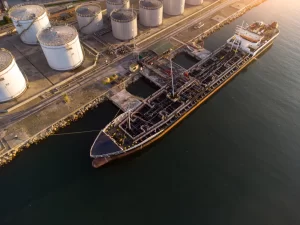
The Strait of Hormuz — the narrow passage connecting the Persian Gulf to global markets — carries approximately 20 percent of the world’s oil and petroleum products under normal conditions. Iran effectively shut it down in the opening days of the conflict, and it has remained functionally closed since, under what energy analysts are now calling a “double blockade.” Qatar’s LNG complex — the world’s largest single liquefied natural gas production facility — was hit by a drone strike and shut down. The United Arab Emirates, Iraq, and Kuwait have all cut output, having run out of storage capacity. Shell CEO Wael Sawan warned at the CERAWeek energy conference in Houston that fuel shortages would ripple around the world beginning with jet fuel, then diesel, then gasoline — a ripple effect now materializing in real time. Lufthansa has slashed 20,000 flights. United Airlines has raised ticket prices by up to 20 percent.
The administration’s attempt to ease sanctions on Iranian oil to cool prices was a stunning admission: having gone to war with Iran, the White House then moved to benefit Tehran financially in order to undo the damage its own war was causing. The policy logic is circular to the point of self-parody. Meanwhile, Trump told the American people that the United States “imports almost no oil through the Hormuz Strait and won’t be taking any in the future,” as if the global economy were not thoroughly interconnected — as if the rest of the planet could simply suffer alone while American consumers felt no pain. JPMorgan’s head of global commodities research, Natasha Kaneva, punctured that illusion immediately, noting that California’s West Coast could face supply disruptions by May due to its reliance on imports.
The energy disruption alone will cost billions of ordinary people dearly — families who pay for heating oil, farmers who rely on diesel, airlines that employ hundreds of thousands. Fossil fuel companies, meanwhile, stand to reap windfall profits in a year that had previously looked lean for the industry, with Brent crude having surged from $58 per barrel in early January to above $103 today. Oil Change International noted the bitter irony succinctly: the people who will profit most from the devastation are the same fossil fuel interests whose influence permeates the Trump administration’s energy policy.
The IEA estimates 13 million barrels of oil per day have been lost to the crisis — more than double the combined shortfall of both 1970s oil shocks. Fortune, April 23, 2026
Goldman Sachs raised its December 2026 PCE inflation forecast by a full percentage point to 3.1% and trimmed 2026 GDP growth to 2% as a direct consequence of Trump’s war. Fortune, April 21, 2026
U.S. retail gasoline prices have surged, with GasBuddy projecting a potential high of $4.45 per gallon — approaching the all-time record of $5.02 set after Russia invaded Ukraine. CNBC, April 2, 2026
More than 3,000 people have been killed across the Middle East since hostilities began. In Iran, U.S. and Israeli strikes have killed more than 1,200 people per the Iranian Red Crescent Society. Al Jazeera, April 27, 2026
The IEA coordinated the release of a record 400 million barrels of oil from emergency stockpiles — a historically unprecedented intervention that Birol himself described as helping to reduce the pain without being a cure. Al Jazeera, March 23, 2026
The International Monetary Fund revised its 2026 global growth forecast down to 3.1%, explicitly naming the Iran conflict as the primary driver of the downgrade. Fortune / Goldman Sachs analysis, April 2026
3. The Rhetoric of a Man Unmoored
It is worth pausing to examine not merely the policy failures of this presidency, but the language from the Oval Office that has accompanied them — because rhetoric at the level of the American commander-in-chief is itself a form of policy. On Easter Sunday, Trump posted on Truth Social: “Tuesday will be Power Plant Day, and Bridge Day, all wrapped up in one, in Iran. There will be nothing like it!!! Open the F–kin’ Strait, you crazy b-stards, or you’ll be living in Hell — JUST WATCH!” He signed off: “Praise be to Allah.” The following Tuesday morning, as his deadline approached, the president escalated further: “A whole civilization will die tonight, never to be brought back again. I don’t want that to happen, but it probably will.”
These are not the utterances of a statesman navigating a crisis. They are the dispatches of a man who has confused belligerence with strength, who conflates shock with strategy, and who appears to reach for his social media account when the weight of the moment demands cabinet-level deliberation. Agnes Callamard, Secretary-General of Amnesty International, responded to the power-plant threat by writing that she was “running out of language to denounce and condemn.” The United Nations’ official account posted a reminder of the Geneva Conventions. The international legal community was unified: targeting civilian power infrastructure would constitute a war crime. Trump, when asked about this, said he wasn’t worried — and that the real war crime was “allowing Iran to have a nuclear weapon,” a weapon his own intelligence community assessed Iran was not, in fact, building.
“The 25th Amendment exists for a reason. The President of the United States is a deranged lunatic, and a national security threat to our country and the rest of the world.”
— Rep. Yassamin Ansari (D-Ariz.) — statement posted April 7, 2026
4. A Timeline of Escalation Without Coherence
Get Involved Today
Contribute to our mission and turn your concerns into action.
5. What Leadership Actually Looks Like — And What This Is Not
To govern is to foresee. Any serious engagement with the strategic landscape of the Persian Gulf prior to military action would have surfaced an obvious and catastrophic risk: that Iran, unable to match American military power, would instead seize the only lever available to it — the Strait of Hormuz — and hold the global economy hostage. This is not a novel scenario. It has been a feature of every serious risk assessment of Gulf instability for decades. Intelligence analysts, energy economists, and military planners have modeled it extensively. The president acted anyway, without a coherent plan for what would happen when Iran did exactly what Iran would predictably do.
TD Securities’ senior commodity strategist Ryan McKay summarized the situation after Trump’s national address: “With the conflict now expected to last at least into deep April, the barrel math becomes increasingly grim.” Nearly one billion barrels of oil will be lost by the end of April alone — roughly 600 million barrels of crude and 350 million barrels of refined products. Shell’s CEO warned that the shortages would radiate outward in concentric waves: first jet fuel, then diesel, then gasoline. Europe, Birol told CNBC on April 23, gets roughly 75 percent of its jet fuel from Middle Eastern refineries. That supply is now effectively zero. Airlines are rationing. Logistics networks are straining. The global food system, which depends heavily on fertilizer routed through the Gulf, faces compounding disruptions.
A president equipped for this moment would have assembled his national security council, obtained congressional buy-in, built a coalition of allies with genuine equities in Hormuz security, and developed off-ramps before pulling the trigger. Instead, Trump acted unilaterally, governed by impulse, communicated in profanity-laced social media posts, and later told an CNBC anchor that he was surprised oil wasn’t higher — as if the distinction between catastrophic and catastrophic-plus were evidence of prudence. House Democratic leadership issued a joint statement calling the president “completely unhinged” and demanding Republicans reconvene Congress to vote on the war. Those are strong words from legislative leaders. They are also accurate ones.
The 25th Amendment: What It Says, Who Is Calling for It, and Why the Barriers Don’t Settle the Moral Case
The Twenty-Fifth Amendment to the Constitution, ratified in 1967, establishes a formal mechanism for addressing presidential incapacity. Section 4 — the provision now being widely invoked — states that the Vice President and a majority of the principal officers of the executive departments may declare the President “unable to discharge the powers and duties of his office,” at which point the Vice President assumes the role of Acting President. If the President contests the declaration, Congress must convene within 48 hours and, within 21 days, vote on whether to uphold the removal. A two-thirds supermajority in both chambers is required for permanent removal. Section 4 has never been successfully invoked in American history.
The calls for its use have been extraordinary in their breadth and, in some cases, their political source. More than 70 Democratic lawmakers have posted, introduced legislation, or issued formal statements demanding invocation — including Rep. Alexandria Ocasio-Cortez of New York, who called Trump’s behavior evidence that “the President’s mental faculties are collapsing and cannot be trusted”; Rep. Ro Khanna of California, who argued that threatening war crimes was “a blatant violation of our constitution and the Geneva Conventions”; Rep. Mark Pocan of Wisconsin, who declared Trump “too unhinged, dangerous, and deranged to have the nuclear codes”; and Sen. Ed Markey of Massachusetts, who warned that “we cannot leave this man in charge of America’s nuclear weapons as he threatens to end an entire civilization.” Former House Speaker Nancy Pelosi stated plainly that “if the Cabinet is not willing to invoke the 25th Amendment and restore sanity, Republicans must reconvene Congress to end this war.”
Remarkably, the calls have not been exclusively Democratic. Former Congressman Joe Walsh, former Trump allies Anthony Scaramucci and Tucker Carlson, right-wing podcaster Candace Owens, former Rep. Marjorie Taylor Greene, and Sen. Ron Johnson of Wisconsin have all, in varying ways and with varying degrees of commitment, raised the question of whether this president has crossed a line. Even Trump himself, in an unguarded moment in March, acknowledged the dynamic: “I can’t say what we’re going to do because if I did, I wouldn’t be sitting here for long. They’d probably — what is it called? The 25th Amendment?”
The practical barriers are real. Vice President JD Vance would need to initiate the process, and as of this writing he has shown no sign of doing so — he was in Budapest praising the president when the war crimes debate peaked. A majority of the Cabinet would also need to concur. There is no open revolt within the administration. Republicans control both chambers of Congress, making a two-thirds removal vote nearly inconceivable.
But the existence of those barriers does not neutralize the constitutional argument. The framers of Section 4 anticipated precisely this scenario: a president whose decision-making has become so impulsive, so disconnected from strategic reality, and so dangerous to the Republic that those around him bear an affirmative duty to act. A president who launches a war without congressional authorization, whose stated objectives remain undefined, who threatens to commit acts that his own allies describe as war crimes, who privately admits he expected oil to hit $200 a barrel, and who communicates American foreign policy in profane Truth Social posts late on Easter Sunday — this president is not “discharging the powers and duties of his office” in any sense the Constitution’s authors would recognize. The 25th Amendment was written for this moment. The fact that it will not be invoked is a failure not of the amendment, but of the political actors who refuse to use it.
6. The Verdict
There will be those who argue that the Iran war, whatever its failures, represents a legitimate exercise of American power in a dangerous region. There will be those who point to the ceasefire announcement as evidence that Trump’s erratic approach to diplomacy somehow works. There will be those who note that oil, at $90–$103, has not reached the apocalyptic $200-per-barrel level the president himself apparently anticipated. These arguments mistake the floor for the ceiling and confuse the avoidance of total catastrophe with the presence of wisdom.
The International Energy Agency — a nonpartisan, intergovernmental body established after the last great oil shock — has declared this the largest energy crisis in history. The IMF has downgraded global growth. Goldman Sachs has raised its inflation forecast. European airlines are rationing jet fuel. American families are heading into a summer of high gasoline prices. The Strait of Hormuz remains closed. More than 3,000 people are dead. Thirteen American service members have been killed. And the president responded to questions about all of this by expressing pleasant surprise that things weren’t worse.
This is the record. It does not require embellishment. What it requires is accountability — from a Republican caucus that continues to enable and excuse, from a Cabinet that has not had the courage to speak plainly about what it is witnessing, and from the American public, which in November 2026 will have the opportunity to elect a Congress capable of exercising the oversight this moment demands. The 25th Amendment will not be invoked, nor will impeachment succeed, with the current Congress. But history will be written. The energy crisis of 2026 will have an author. His name is on the executive orders, on the Truth Social posts, and on the decision to go to war without a plan.
Editorial Conclusion
Donald Trump launched an unauthorized war, destabilized the world’s most critical energy corridor, triggered the worst energy crisis in recorded history, threatened acts that the international community unanimously classifies as war crimes, and governed the resulting catastrophe by social media post and improvisational deadline. The 25th Amendment was written precisely for this — a presidency that has substituted impulse for strategy, belligerence for leadership, and shock for statecraft. The fact that invocation remains politically impossible does not make the constitutional case wrong. It makes the political failure complete. What this moment demands is not a more favorable framing of the disaster. It demands accountability — in Congress, in the Cabinet, and at the ballot box — before the next deadline, the next civilization Trump threatens, and the next crisis his impulsiveness manufactures.
Sources & References
- Fortune — “We are facing the biggest energy security threat in history,” IEA chief tells CNBC (April 23, 2026)
- CNBC — IEA chief: World facing biggest energy security threat in history (April 23, 2026)
- Fortune — Trump’s Iran war spin risks sending traders the wrong message, Goldman warns (April 21, 2026)
- Fortune — IEA: Iran oil crisis the worst energy shock ever recorded, world leaders not ready (March 23, 2026)
- Al Jazeera — World in energy crisis worse than 1970s oil shocks combined, IEA head says (March 23, 2026)
- CNBC — A timeline of how the Iran war shook oil prices — and what comes next (April 21, 2026)
- CNBC — Trump’s Iran war speech paints a grim picture for oil markets (April 2, 2026)
- CNBC — Oil supply crunch will worsen in April, IEA warns as it weighs releasing more reserves (April 1, 2026)
- Oil Change International — Trump’s War on Iran: Big Oil’s Windfall Will Deepen Our Energy Crisis (March 3, 2026)
- CNN — What to know about Trump’s threat to bomb Iran’s infrastructure — and why it could be a war crime (April 7, 2026)
- TIME — Trump Again Threatens to Bomb Iran’s Power Plants If Strait Not Open by Tuesday (April 5, 2026)
- TIME — What to Know About the 25th Amendment as Lawmakers Call for Trump’s Removal (April 6, 2026)
- CNN Politics — An eclectic, bipartisan group suddenly calls for removing Trump using the 25th Amendment (April 7, 2026)
- CNBC — Trump faces calls for removal over threats to wipe out “whole civilization” in Iran (April 7, 2026)
- NBC News — Dozens of Democrats call for Trump’s removal after his Iran threats (April 7, 2026)
- TIME — Democrats Demand GOP Leaders End Recess to Stop Trump’s Iran War (April 7, 2026)
- The Hill — Democrats say Trump’s Iran threat cause for 25th Amendment removal or impeachment (April 7, 2026)
- Axios — Trump 25th Amendment chatter erupts among Dems over Iran post (April 7, 2026)
- NBC News — Live Blog: Iran War, Trump, Hormuz Deadline, Energy Crisis (March–April 2026)
- Al Jazeera — What was the Iran nuclear deal Trump dumped in search of “better” terms? (April 21, 2026)
Related News