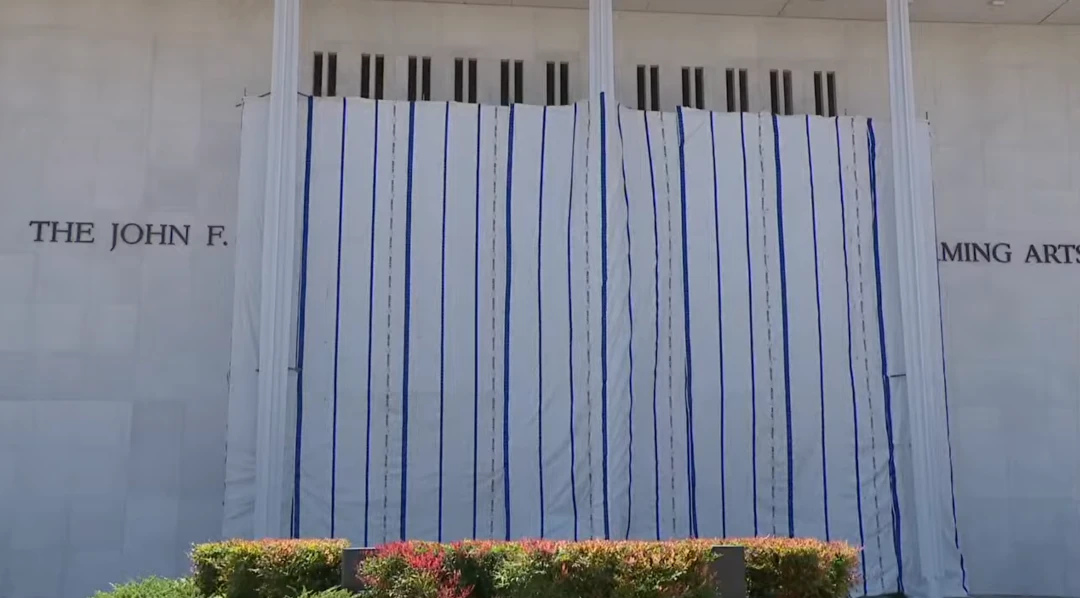
Behind the Tarp, a Portrait of a Presidency in Decline
For more than thirty-nine days (and counting) a length of blue canvas has hung across the front of a national memorial — a monument to a murdered president — because the sitting president cannot stand the sight of his own name being lawfully removed. What began as vanity has curdled into evidence: of impaired judgment, of shoddy construction rushed to feed televised events, and of a Republican Congress that has decided to simply not look.
The John F. Kennedy Center for the Performing Arts, the sole national memorial to a president assassinated in Dallas sixty-three years ago, currently looks like a construction accident. A large tarp and scaffolding have obscured the marble facade since the early hours of June 13, when workers arrived under federal court order to remove the words “Donald J. Trump” from a sign Congress never authorized in the first place. The name is gone. The tarp remains. It has hung there for more than a month — long enough that a federal judge has now demanded, in writing, that the administration explain why.
The Kennedy Center says nothing about when it will come down. The White House says nothing. The Kennedy Center’s board — chaired by the president, staffed entirely with his appointees — says nothing. What we are watching is not a construction project. It is a sulk with a permit, and it says a great deal about the man in the Oval Office, the people who serve him, and the legislators who continue to pretend none of this is happening.
Days the Tarp has remained up:
I. A Coverup in Plain Sight
The basic facts are not in serious dispute. On May 29, U.S. District Judge Christopher R. Cooper — a jurist appointed by President Obama — issued a 94-page opinion finding that the Kennedy Center’s board had “overstepped its statutory bounds” by unilaterally renaming a congressionally-designated national memorial after the sitting president. “Congress gave the Kennedy Center its name,” Cooper wrote, “and only Congress can change it.” He ordered Trump’s name removed from the facade, digital signage, and official materials within fourteen days, and he blocked the board’s plan to shutter the venue for a two-year renovation he described as “ill-informed and seemingly preordained.”
Workers complied on June 12–13. But rather than simply peel the letters off and be done with it, the administration erected scaffolding, hung a broad tarp, and then walked away. Nearly six weeks later, no name is visible. Not Trump’s. Not Kennedy’s. Just canvas. On July 8, the U.S. Court of Appeals for the D.C. Circuit rejected the administration’s request for a stay pending appeal, finding that the Kennedy Center had failed to provide “any specific facts or evidence” that it stood to lose the “hundreds of millions” in donations it claimed would evaporate without Trump’s branding. On June 24, Judge Cooper ordered the administration to file a joint status report by July 31 — or within seven days of the Kennedy Center’s mid-July board meeting, whichever came first — explaining “the purpose for and status of the tarp and scaffolding.” That deadline is now days away.
The court filings from Rep. Joyce Beatty, the Ohio Democrat whose December lawsuit began this litigation, are blunt about what the tarp is. Her lawyers accuse the Kennedy Center of keeping it up in “petulant defiance” of the court’s order and suggest it remains, in their filing’s memorable phrase, to “massage broken egos.”
“A literal coverup, to add to all the others. Nobody’s fooled. Trump and his team got caught vandalizing federal property by posting graffiti with his name on the Kennedy Center and a judge shut them down.”
— Rep. Jamie Raskin (D-Md.), on X, June 17, 2026
II. How a National Memorial Became a Vanity Project
To understand what the tarp is hiding, you need the sequence. This has been, from the beginning, a story of a president treating a shared national institution as personal property, and a board of trustees eager to help him do it.
February–March 2025
Trump takes office, purges the Kennedy Center’s board, installs himself as chairman, and fires its longtime president. His new board is stocked with loyalists and MAGA celebrities.
August 12, 2025
Trump posts on Truth Social: “Great Nominees for the TRUMP/KENNEDY CENTER, whoops, I mean, KENNEDY CENTER, AWARDS…” The “slip” telegraphs what is coming.
December 2025
Trump accepts a newly-created FIFA “Peace Prize” at a televised Kennedy Center ceremony. Whistleblowers will later allege that renovations were rushed specifically to prepare the building for this event.
December 18–19, 2025
Trump’s handpicked board votes to rename the venue “The Donald J. Trump and John F. Kennedy Memorial Center for the Performing Arts.” Workers install his name on the facade the next morning. Rep. Beatty, an ex-officio trustee, says she was muted on Zoom when she tried to object.
December 22, 2025
Beatty sues, arguing the board violated the Kennedy Center’s organic statute. She calls the renaming “scenes more reminiscent of authoritarian regimes than the American republic.”
March 16, 2026
The board — chaired by Trump — votes to close the Kennedy Center for two years for a $257 million renovation. Judge Cooper will later find the vote “ill-informed and seemingly preordained.”
May 29, 2026
Judge Cooper rules the renaming unlawful and blocks the closure. Trump lashes out on Truth Social, calling the judge’s wife an “anti Trump Hater” and demanding Cooper “be brought up on charges.”
June 12–13, 2026
Trump’s name comes down. The tarp goes up.
July 21, 2026 (today)
The tarp is still up. Day 39.
III. Behind the Tarp: The Whistleblower’s Ledger
On July 9, Sen. Sheldon Whitehouse of Rhode Island, ranking Democrat on the Senate Environment and Public Works Committee, released a whistleblower disclosure furnished to Congress by the nonprofit Government Accountability Project. The report, drawn from “firsthand accounts of multiple former Center project managers, supported by contemporaneous documents and photographs,” runs to an 83-page appendix. Its portrait of what has been happening inside the Kennedy Center under Trump’s chairmanship is damning.
A newly installed bathroom floor was ripped out and replaced because the president did not like the color of the tile. Whitehouse’s letter, addressed to Kennedy Center executive director Matt Floca, catalogs this as one of several instances of demolition “driven by the President’s aesthetic whims.”
Exterior steel columns were painted for televised events with rust corroding underneath. Whitehouse writes that the corner-cutting has produced “steel columns that are rusting through fresh paint” and will now have to be redone.
An $8 million no-bid flooring contract was awarded to a company with no concert-hall experience, according to the disclosure. The Kennedy Center disputes this characterization, saying the vendor was the only qualified regional option — but concedes standard federal contracting rules were not applied.
Kennedy Center management, per the whistleblowers, “set aside contracting rules to hit the President’s deadlines, telling staff, ‘We’ll deal with the lawsuits later.’” Renovations reportedly began before Congress even authorized them.
The Kennedy Center’s reflecting pool “is now unevenly painted and rusting” after a hasty cosmetic revamp — mirroring the widely-documented failures at the Lincoln Memorial reflecting pool, where a Trump-approved renovation has produced algae blooms and peeling paint.
Work was rushed, the disclosure alleges, so the facility would be camera-ready for Trump to receive the FIFA Peace Prize in December 2025 — a ceremony that appears to have been the actual construction deadline driving every corner-cutting decision.
Get Involved Today
Contribute to our mission and turn your concerns into action.
Sen. Whitehouse’s assessment in the letter is not that these are unrelated errors. “Taken together,” he writes, “these are not isolated lapses but a single pattern that runs counter to everything the Center has told Congress it would do with the public’s money.” The Kennedy Center has disputed some specifics, but has not denied that renovations began before congressional authorization, and has not denied the substance of the whistleblower report — including the bathroom tile, the rushed timeline for the FIFA event, or the phrase “we’ll deal with the lawsuits later.”
IV. The Ballroom, the Bathroom, and a President’s Priorities
The Kennedy Center is not the only building this president has been redecorating. Since October 2025, construction crews have been demolishing the historic East Wing of the White House — built in 1902, home to the First Lady’s offices and dozens of staff workspaces — to make room for a $300 million ballroom that Trump personally announced would seat one thousand people. Trump had previously promised the ballroom would not touch the East Wing at all. It has now consumed the entire structure. The White House says the project is being funded by private donors “pledging seven or eight figures.” No one has explained why the sitting president considers a private-donor ballroom the most urgent architectural need of the American executive.
Consider the ledger. In a year in which working Americans have faced rising grocery costs, in which a federal judge has been publicly attacked by the sitting president for enforcing a plainly-worded statute, in which whistleblowers describe a national arts center being run “as if it were a private renovation project,” the priorities visible from the president’s own decisions are: a private ballroom on the White House lawn, a vanity nameplate on a memorial to a slain predecessor, a rushed televised prize ceremony, and a tile color in a bathroom. These are not the priorities of a person discharging the duties of the office. These are the priorities of someone confusing an office with a residence, and a residence with a stage set.
“Instead of pursuing renovations tailored to the building’s actual needs, the Center rushed a series of renovations driven by the President’s aesthetic whims and his desire to star in a series of televised events in December.”
— Sen. Sheldon Whitehouse (D-R.I.), letter to Kennedy Center executive director, July 9, 2026
V. A Republican Congress That Won’t Look
The Republican majorities in both chambers of Congress have said virtually nothing about any of this. Not about the illegal renaming a federal court has now struck down. Not about the rusting steel painted over for cameras. Not about the $8 million contract awarded outside federal procurement rules. Not about the fact that Kennedy Center management, per sworn whistleblowers, was told to hit the president’s deadlines and let the lawyers clean up afterward. Speaker Mike Johnson has not called for an investigation. Senate Majority Leader John Thune has not called for a hearing. The Republican members of the Senate Environment and Public Works Committee have not joined Sen. Whitehouse’s inquiry. The Kennedy Center’s own Republican-appointed trustees have not resigned.
This is a bipartisan-created national memorial, funded by taxpayer appropriations, chartered by an act of Congress that Congress has now been told — by a federal court — was flatly violated. The appropriate congressional response is subpoenas. The actual congressional response is silence. Rep. Beatty had to file a lawsuit, in her personal capacity as a trustee, because the institution designed by the Framers to check exactly this kind of conduct has chosen to look away. Every day the tarp stays up is a day a Republican Congress is choosing loyalty over its own Article I authority — because a president they are afraid of would rather sulk than lose. Members who once styled themselves as constitutional conservatives now cannot bring themselves to speak the name of the John F. Kennedy Center for the Performing Arts.
The Twenty-Fifth Amendment and the Word “Unable”
The most common objection to raising the Twenty-Fifth Amendment in a moment like this is that its Section 4 was written for a president in a coma, not a president in a snit. But that objection reads a definition into the text that the drafters — deliberately, and on the record — refused to write.
Section 4 of the Amendment permits the Vice President and a majority of the Cabinet (or of another body Congress may designate) to transmit a written declaration that the President is “unable to discharge the powers and duties of his office.” The Amendment does not define “unable.” It does not define “inability.” According to the Fordham Clinic’s landmark study of the Amendment — conducted with Professor John D. Feerick, its principal drafter — the framers “expressly disclaimed any intent to define ‘inability'” and “purposefully set forth a flexible standard intentionally designed to apply to a wide variety of unforeseen emergencies.” The determination, the study concluded, should focus on “the overall effects of the inability — whether the totality of the circumstances suggests that inability prevents” the president from carrying out his duties.
“The drafters used intentionally vague and open-ended language… because they recognized they couldn’t predict every scenario in which a president could be deemed disabled.” — legal experts consulted by PolitiFact and PBS on Section 4
The Constitutional Argument
A president who orders a $257 million renovation of a national memorial to be rushed for a televised award ceremony; who fixates on the color of bathroom tile while allowing steel columns to be painted over rust; who orders the demolition of the White House East Wing for a $300 million ballroom; who attacks the wife of a federal judge for enforcing a statute; who cannot bring himself to accept the removal of his own graffiti from a building Congress named for a martyred predecessor — is a president whose judgment and priorities have detached from the powers and duties the Constitution assigns him. The Amendment’s text asks whether the totality of circumstances prevents him from discharging those duties. The totality here is not one bad day. It is a documented, months-long pattern.
Legislators Who Have Raised the Question
Sen. Chris Murphy of Connecticut and other Democrats called for invoking Section 4 earlier this year after Trump’s Easter Sunday social-media threats against Iranian civilian infrastructure. Rep. Raskin, who literally co-wrote the leading Democratic legislation on presidential-capacity procedures during the previous Trump administration, has publicly called the Kennedy Center episode “a literal coverup.” Rep. Beatty has called the underlying conduct evocative of “authoritarian regimes.” These are not fringe voices. They are constitutional lawyers holding elected office.
The Barriers — Named Honestly
Section 4 is exceptionally hard to use. It requires the Vice President plus a majority of the Cabinet to act — and this Vice President and this Cabinet were selected precisely for their loyalty. If the President then contests the finding, Congress must sustain it by a two-thirds vote in both chambers. In a Congress whose Republican majority has chosen not to speak the name “Kennedy Center” in public, that vote will not happen. Scholars from Michigan State’s Brian Kalt to the analysts at Just Security have also warned that the Amendment was not designed as a vote of no confidence, and that reading it as one collapses a distinction the drafters cared about.
Why the Barriers Do Not Extinguish the Case
All of that is true, and none of it settles the constitutional question. The framers of the Twenty-Fifth Amendment did not write a mechanism that could only be invoked when it was politically easy. They wrote one that could be invoked when the country needed it, and they left the definition of “unable” open on purpose so that future generations would not be trapped by their imagination. The political difficulty of using the Amendment does not tell us the constitutional case has not been made. It tells us the political system is failing to act on a case that the text of the Constitution plainly permits. That is a different problem, and it belongs at the feet of the officers of state who have chosen silence over their oath.
Editorial Conclusion
A tarp is hanging over a national memorial because a president cannot accept that he does not own it. That is the story, whole and undiminished. Everything else — the rusting steel, the ripped-up bathroom, the no-bid contract, the demolished East Wing, the FIFA prize, the silence of a Republican Congress — is a footnote to that sentence.
The Twenty-Fifth Amendment does not define “unable” because its drafters knew that some day a president would give the country reasons they could not have foreseen. The Kennedy Center tarp is such a reason. Whether the officers of state will act on it is a political question. Whether the constitutional case exists is not.
Take the tarp down. Restore the name of the murdered president Congress chose to honor. And name, out loud, what the last seven months have shown: that this presidency is unfit for the powers it holds, and that a Congress that continues to look away is complicit in every day that it lasts.
Sources & References
- Forbes — “1 Month Later, It’s Unclear When Kennedy Center Tarps Will Come Down” (July 13, 2026)
- Forbes — “Judge Demands Answers About Kennedy Center Tarps” (June 24, 2026)
- NPR — “A judge says the Kennedy Center must update him on its plans — and address that tarp”
- The Hill — “Judge orders Kennedy Center to explain covering over building signage”
- Artforum — “Judge Demands Explanation from Trump Administration for Tarp Obscuring Kennedy Center”
- WUSA9 — “Tarp remains at the Kennedy Center as appeals court rejects latest request”
- Rep. Jamie Raskin on X — “A literal coverup, to add to all the others” (June 17, 2026)
- PBS NewsHour — “Sen. Whitehouse announces whistleblower allegations of construction problems at Kennedy Center”
- Al Jazeera — “Whistleblower claims Kennedy Center ‘rushed’ renovations to please Trump”
- Facilities Dive — “Kennedy Center repairs were rushed, shoddy, whistleblowers allege”
- Fox News — “Kennedy Center disputes Sen Sheldon Whitehouse’s whistleblower renovation claims”
- CBS News — “Judge blocks closure of Kennedy Center and orders removal of Trump’s name”
- PBS NewsHour — “Judge says Kennedy Center board violated law putting Trump’s name on building”
- NPR — “President Trump’s name must come off of the Kennedy Center, judge rules”
- CNBC — “Trump loses latest appeals court bid to restore his name to Kennedy Center”
- Washington Post — “Lawmaker sues to stop Trump from adding name to Kennedy Center”
- Rep. Joyce Beatty (official) — “New Lawsuit Challenges Illegal Renaming of the Kennedy Center”
- CBS News — “Trump administration plans to demolish White House’s entire East Wing as ballroom cost grows to $300 million”
- American Constitution Society — “The Incapacitation of a President and the Twenty-Fifth Amendment: A Reader’s Guide”
- Just Security — “How the Twenty-Fifth Amendment Applies Today”
- National Constitution Center — Text of the 25th Amendment
- PolitiFact — “Following Trump’s Iran social media post, could the 25th Amendment be invoked against him?”
Related News