On Cuban Independence Day, the Justice Department charged a 94-year-old former dictator over a thirty-year-old crime. The timing was not subtle. Neither is what the president is telling the country he intends to do next — to a military already buckling under the weight of his other wars.
There is a kind of political theater that the Trump Justice Department has refined into a signature genre, and on Wednesday morning at the Freedom Tower in downtown Miami, it staged another performance of it. Acting Attorney General Todd Blanche, surrounded by Cuban exile families, announced that a federal grand jury had indicted former Cuban president Raúl Castro — age 94, ailing, and unreachable to American courts — for his alleged role as defense minister in the 1996 downing of two civilian Brothers to the Rescue aircraft in which four people, three of them Americans, were killed. The charges include conspiracy to murder U.S. nationals, destruction of aircraft, and four individual counts of murder. The Washington Post reported plainly what everyone in the room understood: the indictment is “likely to remain symbolic.”
That symbol, however, is doing a great deal of work. The announcement was deliberately staged on May 20 — the day Cuban exiles mark as the end of U.S. occupation of the island in 1902, the day Cuba itself calls Independence Day. Pinned to that calendar, the indictment becomes more than a cold case dusted off after three decades. It is a flag planted. It is a justification being readied for something else.
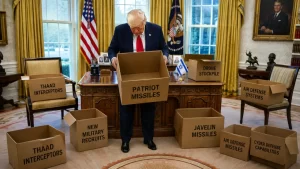
That something else, the president has been describing in plain English for months. At a Forum Club appearance in West Palm Beach on May 1, Donald Trump told the audience the United States would be “taking over” Cuba “almost immediately” once the war with Iran is done. He has said in the same period that he expects the “honor” of “taking Cuba.” He has said: “Whether I free it, take it — I think I can do anything I want with it.” Senior Pentagon officials, according to reporting by Axios and others, have updated contingency plans for some form of military intervention. The carrier USS Gerald R. Ford has only just returned home from a record back-to-back deployment in the Caribbean and the Middle East, and the president has openly mused about stationing the next one a hundred yards off the Cuban coast and waiting for surrender.
An indictment without an arrest. A blockade without an authorization. A war powers resolution voted down on party lines. And a president who keeps telling anyone who will listen that Cuba is next. This is the part where serious people are obligated to ask serious questions: about what this means for ordinary Americans, about whether the country can even sustain another front, about long-term security, and — yes — about whether the constitutional mechanism designed for exactly this kind of moment is being ignored to the country’s peril.
1. Theater at the Freedom Tower
To take the indictment seriously on its merits is to be generous. The Brothers to the Rescue shootdown was, as the International Civil Aviation Organization concluded in 1996, a brutal act — and the planes, ICAO determined, were in international airspace when the Cuban MiG-29s fired. Federal prosecutors in Miami drafted indictments against the Castros in the 1990s and never brought them. As CNN reported on Wednesday, the draft sat untouched through the Clinton, Bush, Obama, and Biden administrations. A 2016 memo by former U.S. Attorney Guy Lewis circulated to then–Attorney General Jeff Sessions and produced nothing. It made its way again in recent months to Secretary of State Marco Rubio, the son of Cuban immigrants and the administration’s most aggressive voice on the island.
What changed is not the evidence. What changed is the use being made of it. Cuban President Miguel Díaz-Canel called the indictment “a political manoeuvre, devoid of any legal basis, aimed solely at padding the dossier” the United States is assembling to justify what it intends to do next. One does not have to be sympathetic to the Cuban regime — and no progressive worth the name should be — to recognize that he is, on this narrow point, describing what is happening in front of us. Federal prosecutors are not staging anniversary events at the Freedom Tower because the evidence newly compels them. They are staging them because the White House wants a moral throughline that connects an old crime to a new operation.
“We may stop by Cuba after we’re finished with this.”
— President Donald Trump, on the Iran war, April 2026
2. “Cuba Is Next” — The Long Telegraph of a War
The president has not been coy. He has not hedged, as presidents preparing for a war of choice often do. He has narrated the operation in advance, repeatedly, in front of cameras, to anyone who will listen — most notably to the assembled press on Air Force One after the capture of Venezuelan president Nicolás Maduro, when he ran down a list of countries in which the United States might next intervene: Cuba, Colombia, Mexico, Iran, Greenland. The supporting infrastructure of a Cuba campaign is already largely in place.
None of this is hidden. None of it requires inference. The administration has executed every step of a public buildup short of an order to move, and it has done so while the Pentagon is still actively engaged on multiple fronts elsewhere.
3. The Wars Already Underway
Here is the part of this story that gets least attention and matters most. The United States military, in May 2026, is not a force at rest waiting to be called. It is a force already at work, in more places, under more strain, than at any point since the early years of the Global War on Terror. Consider the active inventory.
Venezuela — January 3, 2026
Multi-domain operation captured President Nicolás Maduro in Caracas; Delta Force, the 160th SOAR, Cyber Command and Space Command all participated. Operations have cost roughly $31 million per day, per CSIS.
Iran — Active since February 28
Joint U.S.-Israeli campaign now in its fourth month. Pentagon officials told Congress in April the war has cost more than $25 billion and counting; 15 U.S. service members have been killed and 538 wounded.
“Drug Boat” Strikes
More than 50 strikes against vessels since September, with at least 159 people killed. The government has presented no public evidence linking the targets to trafficking, as Small Wars Journal documented.
Somalia — 10 strikes since February
U.S. forces have conducted ten strikes against militant groups in Somalia since the first Iran strike on February 28, alongside an ongoing training mission in Nigeria.
Ecuador — March 3, 2026
Joint counter-narcotics operations launched with Quito, plus a bombing operation in Ecuadorian territory — expanding what was a “war on drugs” into what experts call “an expansion of U.S. counterterror operations.”
Greenland — Two new bases
Planning underway for two additional U.S. bases on the island, part of Trump’s continuing pressure on Denmark over Greenland — the same Greenland gambit that triggered the first 25th Amendment calls in January.
Cuba — Active fuel blockade
Coast Guard and other assets enforcing a near-total fuel quarantine of the island since January 30. Senator Tim Kaine has argued the blockade itself already constitutes hostilities under the War Powers Resolution.
$5.6 billion in 48 hours
Trump’s own administration told Congress in March that the first two days of the Iran war alone consumed $5.6 billion in munitions. The defense industrial base, by the Pentagon’s own admission, cannot keep pace.
The Center for Strategic and International Studies’ Matthew Haelig has described the cumulative effect with a phrase that ought to be carved into every congressional office wall this season: “death by a thousand cuts.” No single commitment, he said, breaks the force. All of them together — plus a major war — start to crack readiness and capability. The USS Gerald R. Ford has just completed a deployment so extended that the Navy was forced to delay the retirement of the USS Nimitz by a year to cover its absence. Conscientious objector hotlines are reporting a surge in calls from active-duty personnel. The Pentagon press secretary insists there are “zero retention concerns.” But as NPR has documented, that data, if it exists, would not be visible for months or years.
And lawmakers — including, notably, Republican senators concerned about reelection — are now warning that the $150 billion the Pentagon was allocated through the so-called “One Big Beautiful Bill” could be fully exhausted by the end of 2026, with an $80 to $100 billion supplemental request circulating informally on the Hill. This is what the country is being asked to put on its tab so that the president can station an aircraft carrier off Havana and wait for capitulation.
Get Involved Today
Contribute to our mission and turn your concerns into action.
4. What This Costs the Average American
The conversation around foreign policy in this country has been trained, over decades, to treat war as an abstraction — something that happens to other people, in other places, paid for from a separate ledger. It has never been true, and it is conspicuously not true now. Every dollar spent maintaining a blockade of an island ninety miles off Florida is a dollar not spent on the things ordinary households are actually contending with in 2026: groceries, rent, premiums, child care, an electrical grid that increasingly cannot handle a hot summer.
The $25 billion already burned through on Iran is not free money. It is, in real terms, larger than the federal Pell Grant program. It is more than the entire annual budget of the Department of Housing and Urban Development. The $31 million per day on Venezuela operations alone is roughly the cost, every twenty-four hours, of funding the federal home heating assistance program for a year in several Northeastern states. None of this is in a budget. It is being added to the deficit, and the deficit is being added to the conditions — inflation, interest rates, mortgage costs — that have already strained working families through this entire administration.
“Such action would be unlawful, deeply destabilizing, and catastrophic for the Cuban population, while further increasing displacement, exacerbating mass suffering, and undermining U.S. interests in the region.”
— More than 30 House Democrats, letter to Trump administration, May 12, 2026
There is also the security ledger, which is the one Trump’s own party used to pretend to care about. A military stretched across eight theaters of operation is a military that cannot meaningfully deter the adversaries the country actually faces. China’s planners are watching the Ford battle group’s rotation schedule. Russia’s defense ministry is watching munition expenditure rates. North Korea is watching the pace at which Patriot interceptors get used up in the Gulf. Every cruise missile fired at a fishing boat in the eastern Pacific is a cruise missile not available for an actual contingency in the Taiwan Strait. This is not a hawkish argument; it is an arithmetic one. Readiness has a denominator, and the president keeps adding to it.
The long-term effect is the one the country will live with longest. The post–Cold War American security architecture rested on the proposition that the United States used its overwhelming power sparingly, predictably, and within a rules-based framework that its allies could trust. That proposition has now been functionally retired. Brazilian President Lula was told privately, at a White House meeting, that Trump had no plans to invade Cuba; a week later Trump was at a rally promising the opposite. Allies cannot plan around a president who narrates contradictory operations between breakfast and dinner. Adversaries can — and they are.
5. Priorities, in the Plainest Possible Light
Look at what the administration has done in the eighteen weeks between Inauguration Day 2025 and this morning’s announcement in Miami. It has launched or sustained military operations in Venezuela, Iran, Somalia, Ecuador, the eastern Pacific, the Caribbean, the Horn of Africa, and now plainly threatens a ninth in Cuba. It has applied 240-plus new sanctions on a single small island nation already starving in the dark. It has dispatched the CIA director on quiet diplomacy at the same moment the Justice Department is staging anniversaries for the cameras. And it has done all of this while the actual conditions of American life — wages, housing, healthcare, the climate emergency the administration refuses to name — have continued to deteriorate.
The president has had time, in this window, to threaten Greenland, threaten Mexico, threaten Colombia, threaten Canada, capture the elected leader of a sovereign nation, prosecute a 94-year-old man on a thirty-year-old case, and tell a Miami rally that he can “do anything I want” with a neighboring country. He has not had time, somehow, to deliver the infrastructure bill, the tax cut for working families, or the lower grocery prices that his campaign promised every American who would listen. These are choices. They reveal a worldview. They are the worldview of a man who confuses the projection of his own grievance with the conduct of a great power.
What the drafters Built for Exactly This Moment
Section 4 of the 25th Amendment, ratified in 1967, provides that when the Vice President and a majority of the Cabinet transmit to Congress a written declaration that the President “is unable to discharge the powers and duties of his office,” the Vice President immediately assumes those powers as Acting President. The mechanism was designed, in the wake of the Kennedy assassination, to ensure the republic was never trapped with a head of state who had become unfit — for any reason — to wield the powers of the office.
The case for invocation has been made publicly, with specificity, by sitting members of Congress. In January, Senator Ed Markey (D-Mass.) called for the amendment to be invoked after Trump’s letter to Norwegian Prime Minister Jonas Gahr Støre linking U.S. designs on Greenland to his failure to win the Nobel Peace Prize. In April, after Trump’s Easter-night threat that “a whole civilization will die” in Iran, more than 70 lawmakers — including Senators Markey and Chris Murphy (D-Conn.), and Representatives Ro Khanna (D-Calif.), Raja Krishnamoorthi (D-Ill.), Eric Swalwell (D-Calif.), Sydney Kamlager-Dove (D-Calif.), and Yassamin Ansari (D-Ariz.) — made the call publicly. Representative Jamie Raskin (D-Md.) introduced legislation to establish a commission empowered to assess presidential fitness. Even some of Trump’s former defenders — Anthony Scaramucci, Marjorie Taylor Greene, columnist David French — joined the call.
The constitutional argument is straightforward. The Twenty-fifth Amendment does not require a single triggering event. It requires a sustained pattern in which the President’s conduct demonstrates an inability to exercise the powers of his office responsibly — judgment, restraint, command of consequence. Public threats to “eradicate civilizations.” Private contradictions to foreign heads of state. Promises to “take” sovereign neighboring countries because “I can do anything I want.” A reported text message linking U.S. foreign policy to a personal grudge over a literary prize. The constitutional question is not whether reasonable observers can disagree about a single decision; it is whether the totality, over time, describes a president in command of his office.
The practical barriers are real and should be named honestly. Section 4 requires action by Vice President JD Vance and a majority of a Cabinet hand-picked for loyalty. None has shown the slightest appetite for invocation. A Republican Congress, even should it be presented the question on a presidential challenge, would almost certainly side with the president. Representative Raskin’s commission bill is, as Axios noted, “long-shot.” No invocation is plausibly imminent.
The barriers do not retire the question; they sharpen it. The Twenty-fifth Amendment exists precisely because the framers and the 1967 Congress understood that political will would not always rise to meet constitutional duty. The mechanism’s unavailability today does not mean the conditions for its use are absent. It means a coordinate branch — and a Cabinet — are failing in their duty. A president who openly threatens unprovoked wars against multiple sovereign neighbors, while the military is already cracking under the wars he started, while he tells the country he can “do anything I want” with another nation’s territory, is the very portrait the amendment’s drafters had in mind. The political path is closed. The constitutional case is not.
6. What the Country Is Really Being Asked
The proper response to a federal indictment of a 94-year-old foreign defendant who will never see the inside of an American courtroom is not, on its own, alarm. The proper response to an oil blockade of a country ninety miles off Florida, layered onto a fourth-month war in Iran, layered onto a January military intervention in Venezuela, layered onto fifty boat strikes in the Caribbean, layered onto open presidential rhetoric promising to “take” Cuba “almost immediately” — is alarm. It is the response that more than thirty House Democrats put in writing to the administration in their May 12 letter, calling any military action against Cuba “unlawful, deeply destabilizing, and catastrophic.” It is the response Senators Kaine, Schiff, and Gallego wrote into the Cuba War Powers Resolution that Republican leadership refused to allow a floor vote on.
The question is no longer whether this administration possesses the judgment, restraint, or constitutional fluency to be entrusted with the war powers of the United States. The question is what the country’s other institutions — Congress, the Cabinet, the courts, the press, the voters — are going to do about a president who has answered that question for everyone in office and out of it.
Editorial Conclusion
An indictment delivered on an exile community’s holiday is not a prosecution; it is a press release for a war the president has been narrating in advance for half a year. Congress has not authorized it. The American people have not been asked to consent to it. The military cannot sustainably absorb it. The Constitution provides a mechanism for the orderly removal of a President whose conduct demonstrates an inability to exercise the powers of his office; that mechanism has been ignored by the men and women constitutionally obliged to consider it.
The stakes are not partisan. They are the things a republic forfeits when it discovers that none of its checks held: a War Powers Clause that does not bind, a Cabinet that will not act, a Cabinet’s vice president who treats the 25th Amendment as a threat rather than a duty, and a Congress that watches the carrier groups deploy and votes the resolutions down.
Cuba is the test. The Constitution is the stake. The country cannot afford either failure.
Sources & References
- Washington Post — “Former Cuban president Raúl Castro indicted in U.S. on murder, conspiracy charges” (May 20, 2026)
- CNN Politics — “Raúl Castro indicted in a prosecution that has been in the works for 3 decades” (May 20, 2026)
- Al Jazeera — “US indicts Cuba’s former leader Raúl Castro: Why it matters” (May 20, 2026)
- NPR — “U.S. grand jury indicts Raúl Castro, ex-Cuban president” (May 20, 2026)
- Newsweek — “Donald Trump says US will take over Cuba ‘almost immediately'” (May 2026)
- Axios — “Why Cuba could be Trump’s next invasion target” (May 11, 2026)
- Common Dreams — “‘Unlawful, Deeply Destabilizing, and Catastrophic’: Dems Warn Trump Against Cuba Attack” (May 2026)
- U.S. News / Reuters — “US Democrats Look to Rein in Trump’s War Powers, This Time on Cuba” (April 24, 2026)
- PBS NewsHour — “Senate Republicans reject attempt to end Trump’s blockade of Cuba” (April 2026)
- CSIS — “Beyond Venezuela and Cuba: The U.S. Military’s Future Operations in the Western Hemisphere”
- Tucson Sentinel — “U.S. military commitments go far beyond Iran: ‘Death by a thousand cuts'” (April 2026)
- Small Wars Journal — “While all eyes are on Iran, what else is the US military doing?” (April 16, 2026)
- Reuters via AOL — “Trump administration says cost of Iran war’s first two days was $5.6 billion” (March 10, 2026)
- NBC News — “Dozens of Democrats call for Trump’s removal after his Iran threats” (April 2026)
- PBS NewsHour — “Could the 25th Amendment be invoked against Trump? Here’s how it works” (April 6, 2026)
- Axios — “House Democrats file long-shot 25th Amendment bill targeting Trump” (April 14, 2026)
- TIME — “Can the 25th Amendment Be Used to Remove Trump From Office?” (January 2026)
- OPB / NPR — “There’s growing disquiet in the military. The Iran war made it worse” (April 10, 2026)
Related News