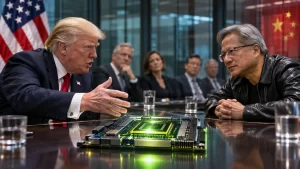
The Wall Street Journal reports that Howard Lutnick was on his way out as Commerce Secretary, until he wrote a $25 million check to Donald Trump’s presidential library. It is not an aberration. It is the operating system of an administration where pardons, chip-export licenses, merger approvals and private dinners have all moved alongside money flowing to the president, his family and his monuments.
Every presidency has its donors. What Americans have never had, until now, is a president who reportedly tells his own aides that the reason he keeps a Cabinet secretary around is that the man paid him. According to reporting by The Wall Street Journal, President Trump had been on the verge of firing Commerce Secretary Howard Lutnick after Lutnick acknowledged in congressional testimony in February that he had visited Jeffrey Epstein’s private island more than a decade earlier. Then Lutnick gave $25 million to Trump’s planned presidential library in Florida, and, in the Journal’s words, “Trump stopped talking about replacing” him.
That sentence should be read twice. It describes not a campaign contribution, not a lobbying expense, not a policy argument — but a payment, from a sitting official whose job was in jeopardy, to an entity that exists to glorify the man who decides whether that official stays employed.
I. The $25 Million Reprieve
The Journal’s account did not stand alone for long. The New York Times’ Maggie Haberman, who first reported the donation in Regime Change, the book she co-wrote with Jonathan Swan, added on X that Trump has raised the gift in several large meetings, at times explaining his tolerance of Lutnick by pointing to the money, and at other times saying simply that he asked and Lutnick paid.
He asked, and Lutnick gave it “in one second.”
— President Trump, as described by Maggie Haberman of The New York Times, via The New Republic
The background makes the transaction uglier. As The New Republic recounts, Lutnick’s admission that he visited Epstein’s island in 2012 contradicted his 2025 claim that he cut off contact after a 2005 visit to Epstein’s townhouse, and emails released in the Epstein files showed continued contact after Epstein’s conviction. Nor was the library gift Lutnick’s only well-timed check. The New York Times reported that on April 1 he gave $5 million to the committee supporting House Republicans — four weeks after the House Oversight Committee arranged to interview him about Epstein, and an unusually large sum for a sitting Cabinet secretary.
Democrats had already been demanding his exit. Senators Adam Schiff and Jacky Rosen have pushed for his resignation, with Rosen saying he must go “to protect the trust of the American people,” while Democrats on Capitol Hill have pressed him over his Epstein ties and potential family conflicts tied to Commerce Department deals, including a $1.6 billion federal commitment to USA Rare Earth.
II. The Pattern: A Price List for Power
Lutnick’s check is shocking because it is so explicit. But it fits a pattern that has defined Trump’s second term: money moves toward the president’s library, his ballroom, his family’s crypto ventures or his own memecoin — and, near in time, something of value moves back. The administration and the companies involved deny any quid pro quo in each case. The sequence of events is a matter of public record.
Howard Lutnick · Commerce
To Trump’s presidential library while facing dismissal over Epstein; talk of replacing him then stopped, per the WSJ.
Nvidia · Jensen Huang
Pledged to Trump’s White House ballroom in October 2025, on top of $1 million to the inaugural; weeks later Trump allowed H200 chip sales to China, per CNBC’s analysis.
Binance · Changpeng Zhao
Binance took an Emirati firm’s $2 billion investment in the Trump family’s USD1 stablecoin; its convicted founder was then pardoned in October 2025.
UAE · Sheikh Tahnoon
For a secret 49% stake in World Liberty Financial, signed days before inauguration; the UAE later won access to 500,000 advanced AI chips a year, per the WSJ.
Justin Sun · $TRUMP coin
The largest buyer of Trump’s memecoin won a seat at the president’s private dinner for its top 220 holders, CBS News reported.
Paramount · CBS
Settled Trump’s “60 Minutes” suit, largely to his library; the FCC cleared its $8 billion Skydance merger weeks later, per the AP.
Qatar · Royal Family
A luxury 747 accepted by the administration and slated for transfer to Trump’s library before he leaves office, CBS News reported.
Big Donors · All Projects
The WSJ’s estimate of what Trump’s opaque fundraising raised for his inauguration, ballroom and MAGA Inc. super PAC, per the Boston Globe.
The UAE case deserves particular attention because it fused the president’s family finances with national security. The Center for American Progress notes that the May 2025 chips deal coincided with a $1.4 billion arms sale to the UAE that went forward despite a congressional hold over the Emirates’ support for Sudan’s Rapid Support Forces. World Liberty’s spokesman has called any link between the investment and the chip decision false. Americans are entitled to judge the coincidence for themselves.
On the Binance pardon, Senator Elizabeth Warren traced the sequence in three beats — guilty plea, a boost to a Trump crypto venture, a lobbying campaign for clemency — before concluding: “Today, Donald Trump did his part and pardoned him.” On Paramount, the FCC’s lone Democratic commissioner, Anna Gomez, dissented from the merger approval and called the company’s conduct “cowardly capitulation.”
III. The Nvidia File
No relationship better illustrates how access is bought and repaid than Trump’s courtship with Nvidia’s Jensen Huang. The two had never met before the January 2025 inauguration; since then they have met or appeared together at least 15 times, according to CNBC’s review of the record. In April 2025 the administration effectively halted sales of Nvidia’s H20 chip to China, triggering a $4.5 billion charge. After further meetings, the administration relented in July. In August, Trump confirmed an unprecedented arrangement giving the federal government 15 percent of revenue from those China sales. In October, Nvidia pledged $25 million to the ballroom. On December 8, 2025, Trump announced that Nvidia could sell its far more powerful H200 chips to China.
Meanwhile, the president’s own brokerage accounts were trading the stock. CNBC found at least 103 Nvidia buys or sales since his return to office, together worth between $27 million and $97.5 million, with Nvidia becoming one of Trump’s three largest individual holdings by the end of 2025. Some trades landed strikingly close to policy moments — including a $1 million to $5 million purchase two days before Huang’s White House visit in January 2025, and a $5 million to $25 million purchase about a week after the China revenue deal. The White House says independent advisers manage the portfolio without Trump’s input, and the disclosures show no evidence he directed the trades. That is precisely the problem: a president who refuses to divest asks the country to take his word for it.
Then came November. Huang resigned as Nvidia’s CEO on November 12, days after reports that he had an affair with a woman U.S. intelligence agencies believe passed information to the Chinese government. Rather than distance himself, Trump stood by his donor: he approvingly repeated Huang’s denial that he knew of the alleged spying, and later said bringing Huang back “certainly isn’t a bad idea.” The New York Times, as cited by CNBC, reported that Secretary of State Marco Rubio had briefed Trump about the relationship before a May 2026 Nvidia sale in Trump’s accounts; Trump denied being briefed. Senate Democratic leader Chuck Schumer, now the presumptive incoming majority leader, summed it up bluntly: Trump took Huang to Beijing, took his advice on opening American AI chips to China, and took a $25 million Nvidia donation.
IV. Chronology of a Transactional Presidency
Sheikh Tahnoon’s firm buys 49% of World Liberty Financial for $500 million, four days before the inauguration.
Administration halts Nvidia H20 sales to China; Huang’s lobbying campaign begins.
MGX closes $2 billion Binance investment in USD1; UAE chips framework and arms sale advance; Trump hosts memecoin dinner for top $TRUMP buyers.
Paramount pays $16 million; FCC approves Skydance merger. H20 sales to China resume.
Nvidia pledges $25 million to the ballroom; on Oct. 23 Trump pardons Binance founder Changpeng Zhao.
Trump clears Nvidia H200 sales to China, about six weeks after the ballroom pledge became public.
Lutnick admits visiting Epstein’s island; Trump weighs firing him.
Lutnick gives $25 million to the library; talk of replacing him stops, per the WSJ.
Lutnick gives $5 million to the House GOP super PAC ahead of his Epstein interview.
Trump’s financial disclosure shows ~$1.2 billion in crypto income for 2025.
Democrats win both chambers of Congress in a campaign defined by cost of living and corruption.
Huang resigns amid spy-linked scandal; WSJ publishes the Lutnick report.
Get Involved Today
Contribute to our mission and turn your concerns into action.
V. The President’s Ledger — and What It Leaves Out
Trump’s annual financial disclosure, released by the Office of Government Ethics on June 30, tells a story no previous presidency has produced. The Associated Press found that he took in about $1.2 billion from crypto businesses in 2025, including more than $500 million from World Liberty Financial’s sales of governance tokens and other products — dwarfing the real estate empire that made him famous.
And that is the floor, not the ceiling. As the AP itself cautions, the disclosure reports revenue, not profit, so it is impossible to know what Trump actually earns. It is a self-reported document. It does not capture who bought the tokens that enriched him — a buyer of a memecoin or a stablecoin can be a foreign sovereign or a defendant seeking leniency, and the form will never say. It does not show money routed through his library foundation, whose donors federal rules do not require it to disclose; through the ballroom fund; or through the super PAC network the Journal estimates raised hundreds of millions. When Senators Warren and Richard Blumenthal and Rep. Melanie Stansbury examined the library foundation’s own filings, they found at least $6.5 million and as much as $14.5 million unaccounted for, plus $7 million in unexplained spending.
Warren put it plainly to The Boston Globe: the library arrangement is “a pretty sweet deal for President Trump to fill his own pockets.” The House Oversight Democrats’ January report estimated that Trump’s pay-to-play schemes had already contributed an estimated $2.25 billion to the family, and warned that digital currencies let the family profit with no transparency about who is paying. What all of this says about the president’s priorities is not complicated. A leader focused on the country does not spend his term building a personal fortune out of the very industries he regulates.
VI. What It Costs the Average American
It is tempting to treat this as a story about billionaires trading favors with one another. It is not. Every one of these transactions involves a public power — the pardon, the export license, the merger review, the Cabinet appointment — that belongs to the American people and was exercised, at minimum, in the shadow of private money.
When export policy on the most strategically important chips on Earth is shaped by a CEO who is also a donor, ordinary Americans carry the national security risk. When a media giant settles a lawsuit its own leaders resisted and then wins regulatory approval, the public loses a measure of the free press it depends on. When a Commerce Secretary keeps his job by paying the president, the department that oversees trade, technology and economic data answers to the man who cashed the check rather than to the taxpayers who fund it. And when the honest small-business owner, the family farmer or the local union cannot afford a $25 million ticket, they learn exactly how much their voice is worth in this White House.
Voters noticed. NPR reported that the 2026 midterm campaign was defined by frustration with the high cost of living and perceived public corruption — and that Democrats won full control of Congress for the first time since 2023.
VII. America’s Standing in the World
The world is watching too, and keeping score. In February, Transparency International’s Corruption Perceptions Index placed the United States at its worst ranking ever — 29th of 182 countries, with a score of 64, tied with the Bahamas and behind the United Arab Emirates. The group cautioned that 2025 developments were not yet fully reflected, meaning the decline may deepen.
The diplomatic cost is concrete. When a foreign security chief can buy into the president’s family business days before inauguration and walk away with access to restricted American technology, allies conclude that U.S. policy is for sale and rivals conclude it can be bought. American diplomats who once lectured other nations on rule of law and anti-bribery standards now represent a government whose president accepts a jet from Qatar for his library. The credibility of the Foreign Corrupt Practices Act, of American sanctions and of every governance demand Washington makes abroad erodes with each transaction.
VIII. The Reckoning in Congress
For two years, Democrats could only write letters. In January, they get subpoenas. Rep. Robert Garcia, the presumptive chair of the House Oversight Committee, answered the midterm results with a two-word statement telling the administration to lawyer up. He has said the committee will focus first on what he calls the Trump family’s corruption, followed by corporate corruption, misconduct at the Department of Homeland Security and the Epstein files.
“The amount of grift and corruption is unprecedented in American politics.”
— Sen. Chris Van Hollen (D-Md.), via Common Dreams
Garcia has already sent document preservation letters to 13 Trump allies and family members, laying the groundwork for probes that begin with the new Congress. The White House has warned that overly aggressive investigations could themselves be criminal — a claim legal experts have broadly rejected, citing Congress’s oversight authority.
On the legislative side, Warren, Blumenthal and Reps. Jared Moskowitz, Jamie Raskin and Stansbury have championed the Presidential Library Anti-Corruption Act, which would bar library donations from government contractors and people seeking pardons and prohibit converting library money to personal use. As Warren observed, under current law “Right now, there are basically no rules.” With Democratic majorities in both chambers, the bill can at last get hearings and votes; the Lutnick revelation hands its sponsors the clearest possible case study. Expect, too, renewed pressure for Lutnick’s resignation, demands for the library foundation’s full donor list, and testimony from the officials whose decisions on chips, pardons and mergers coincided with these payments.
Democrats should be honest about the limits. Trump still holds the veto, and Senate rules can block legislation. But oversight does not require a signature. Sworn testimony, subpoenaed records, inspector general referrals and public hearings can expose what self-reported disclosures conceal — and build the record that future reforms, and future voters, will need.
Bribery, Emoluments and the Limits of the Law
The Framers anticipated exactly this danger. Whether today’s courts and statutes are equipped to stop it is a harder question.
- The Foreign Emoluments Clause — Art. I, §9, cl. 8
- No federal officeholder may accept “any present, Emolument, Office, or Title, of any kind whatever” from a foreign state without Congress’s consent. A Qatari jet destined for the president’s library and an Emirati royal’s $500 million stake in his family’s company test this clause directly. Congress has given no consent — and a Democratic Congress can now formally say so.
- The Domestic Emoluments Clause — Art. II, §1, cl. 7
- The president’s compensation is fixed, and he may not receive “any other Emolument” from the United States or any state. Profits drawn from industries his own policies enrich raise the question of whether the office itself has become a revenue stream.
- Federal Bribery — 18 U.S.C. §201
- Bribery requires a corrupt agreement to trade something of value for an “official act.” Supreme Court rulings in McDonnell v. United States (2016) and Snyder v. United States (2024) have narrowed what prosecutors can reach, and Trump v. United States (2024) shields core presidential acts. The legal bar is high — which is why the absence of rules on library and ballroom gifts is so dangerous.
- The Ultimate Remedy — Art. II, §4
- The Constitution names “Bribery” as one of only two specified grounds for impeachment, alongside treason. The Framers did not require a criminal conviction; they required Congress to judge whether public power was sold. A Cabinet post retained for $25 million is precisely the kind of question that clause was written to answer.
IX. What You Can Do
This fight will be won or lost in the next two years, largely in congressional hearing rooms — and those rooms respond to public pressure. Here is what ordinary citizens can do beyond voting.
- Call your senators and representative about the library bill
Ask them to cosponsor and demand a vote on the Presidential Library Anti-Corruption Act when the new Congress convenes. The Capitol switchboard can connect you; ask specifically whether your member supports banning donations from contractors and pardon-seekers.
- Back oversight — and say so publicly
Tell your members you expect the House Oversight and Judiciary committees to subpoena the library foundation’s donor records and call Lutnick to testify. Republicans in swing districts especially need to hear that their constituents want answers.
- Follow the money yourself
Use tools such as the House Oversight Democrats’ Trump Digital Grift Tracker and the president’s public OGE disclosures. Share sourced facts, not rumors; credible information is the most persuasive weapon.
- Support independent watchdogs and journalism
The Lutnick story surfaced because reporters at the Journal and the Times did the work. Subscribe to news outlets that do investigative reporting and support nonpartisan anti-corruption groups.
- Press for state-level action
The library will be built in Florida. Ask state legislators and attorneys general — in Florida and your own state — what charitable-trust and nonprofit-disclosure laws they can enforce against foundations that cannot account for their money.
Editorial Conclusion
A Cabinet secretary kept his post by paying the president. A chip executive gave millions and got the policy he wanted. A convicted crypto billionaire boosted the family business and walked away with a pardon. A foreign royal bought half of that business and won access to America’s most guarded technology. These are not scandals in the old sense; they are the system.
The Constitution names bribery as grounds for removing a president because the Framers understood that a republic whose offices can be bought has ceased to be a republic. Congress now holds the gavel. It must subpoena the records, pass the library reforms, and put every official who paid or was paid under oath. Public office is a public trust — and it is time Washington proved it is not for sale.
Sources & References
- AOL / New York Post — Howard Lutnick was on the chopping block until he made a massive donation to Trump’s library (citing WSJ)
- The New Republic — The $25 Million Reason Why Trump Didn’t Fire Howard Lutnick
- Philadelphia Inquirer / NYT — Lutnick donated $5 million to House Republicans before Epstein testimony
- WJLA — On Capitol Hill, Democrats press Lutnick on Epstein ties and rare earth conflicts
- The Standard / CNBC — Trump accounts traded up to $97.5 million in Nvidia as Huang gained White House access
- News Tribune — Trump faces questions about cozy ties to Huang
- The San Francisco Standard — Nvidia CEO Jensen Huang resigns
- Axios — Trump pardons convicted Binance founder Changpeng “CZ” Zhao
- The Block / WSJ — UAE sheikh secretly acquired 49% of Trump’s World Liberty Financial days before inauguration
- Center for American Progress — The Tahnoon deals, the UAE chips agreement and the $1.4 billion arms sale
- CBS News — Justin Sun says he’s the biggest owner of Trump’s meme coin, will attend dinner
- CBC / Associated Press — $8B Paramount-Skydance merger cleared by regulators after Trump dust-up with CBS
- CBS News — Critics of Trump’s presidential library fundraising say “there are no rules”
- The Boston Globe — Inside Trump’s planned Miami presidential library and its fundraising
- OPB / Associated Press — Trump filing shows he took in about $1.2 billion from crypto businesses last year
- Office of Sen. Elizabeth Warren — Warren, Blumenthal, Stansbury press Trump Library Foundation on missing donations
- House Oversight Democrats — Garcia report on Trump family corruption; Trump Digital Grift Tracker
- ABC7 — Incoming House Oversight chair Robert Garcia outlines 4 new probes
- NPR via KUOW — House Democrat warns 13 Trump allies to save their records
- NPR via OPB — Democrats win full control of Congress, ushering in divided government
- UPI — U.S. falls to 29th place in global Corruption Perceptions Index
Related News