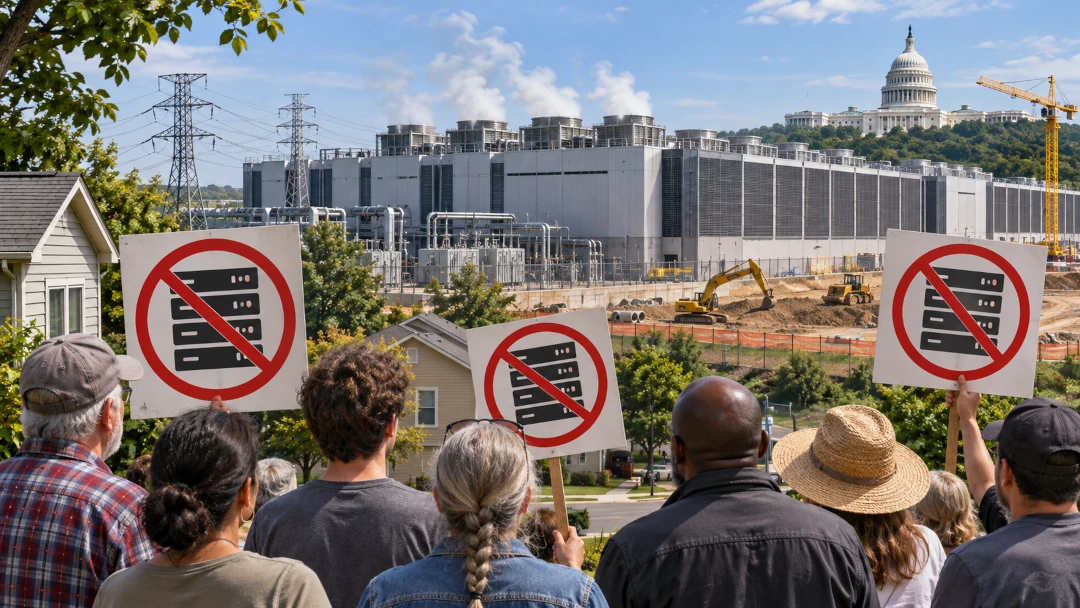
Two weeks after Americans rejected data centers at the ballot box, the Senate passed a 494-page rewrite of the nation’s environmental laws that never got a single hearing — smuggled inside a House bill about sexual-abuse survivors. It speeds pipelines, power plants and the data centers they will feed, shrinks what courts can do, ties the hands of the next administration, and leaves taxpayers on the hook. Senate Democratic Leader Chuck Schumer voted yes.
On November 3, the American people sent Washington a message about data centers that could not have been clearer. According to The Washington Post’s election-night reporting, voters in at least 38 jurisdictions approved bans or restrictions on data centers. Every one of the ten Ohio charter amendments drafted by Conserve Ohio to prohibit large-scale facilities passed. Nearly 80 percent of voters in Joliet Township, Illinois, backed restrictions. In Texas, Gina Hinojosa — who supports a moratorium on new projects — unseated Gov. Greg Abbott. In Ohio, Sherrod Brown defeated Sen. Jon Husted, one of the industry’s biggest champions in Congress. A Washington Post-ABC News-Ipsos poll had already found that roughly seven in ten Americans, including a majority of Republicans, oppose new data center construction in their own communities.
Sixteen days later, at about 9:30 on a Thursday night, the United States Senate answered that message. By a vote of 62 to 33, it passed the Bipartisan American Affordability and Jobs Act of 2026 — BAAJA — a sweeping rewrite of federal environmental and permitting law that, as conservation reporters noted, will expedite development on public lands while limiting public input and judicial oversight. Critics across the environmental movement and tribal nations say it will put data centers on federal land. It never received a hearing. It never received a committee vote. And it moved through the Senate wearing the name tag of an entirely different bill.
This is the story of how that happened, who made it happen, and why the House of Representatives — which returns November 30 — is now the last line of defense.
I. The Shell Game: How a Survivors’ Bill Became a Polluters’ Bill
BAAJA was introduced as S. 5653 on September 30, 2026 — the very day the Senate recessed to campaign for the midterms — by Sen. Shelley Moore Capito (R-W.Va.) with Sens. Mike Lee (R-Utah), Sheldon Whitehouse (D-R.I.) and Martin Heinrich (D-N.M.), according to the Bipartisan Policy Center. It was referred to committee, where it sat. No hearing was ever held on it.
Instead of sending it through the committee process, the sponsors reached for a parliamentary vehicle. As the Benton Institute documents, the Senate took H.R. 2347 — a House-passed tax bill — and used an “amendment in the nature of a substitute,” S.Amdt. 6883, to replace its text with BAAJA. That House bill, the Survivor Justice Tax Prevention Act, dealt with the tax treatment of damages paid to survivors of sexual abuse; the House had passed it by voice vote on April 27, according to the tracker More Than Just Parks. The amendment struck everything after the enacting clause and inserted the permitting overhaul, while, as Energy News Beat reports, a short division at the back kept the original tax title.
The practical effect is enormous. Because the Senate amended a bill the House had already passed, the finished product goes straight back to the House for a single up-or-down vote — no conference, no House committee markup required. Legal scholar Steve Vladeck called the maneuver a “transparent procedural ploy” that let BAAJA skip committee consideration altogether. The sponsors released the 494-page substitute on Saturday, November 7 — four days after Election Day — and had it on the floor within days.
Sen. Jeff Merkley (D-Ore.) put it bluntly: passing a bill of this magnitude without a single Senate hearing was, in his words reported by Common Dreams, “pretty damn outrageous and offensive.”
II. Sixteen Days in November
III. What the Bill Actually Does
Supporters sell BAAJA as an affordability bill. Read the text and a different picture emerges: a systematic narrowing of every check — public, judicial, state and executive — that stands between a developer and a finished project. The Bipartisan Policy Center’s section-by-section explainer, which is broadly sympathetic to the bill, lays out the mechanics.
Courts Lose Their Teeth
The window to sue over an environmental review shrinks from six years to 150 days. Even when the government loses a NEPA case, the only remedy is sending it back to the agency — the project keeps its permit. Courts must give agencies “substantial deference.” BPC
Trump-Era Permits Locked In
Agencies would be barred from revoking, suspending or materially changing permits in effect on or after November 6, 2026, except in six narrow cases — and the burden shifts to the government to justify any action. BPC
Taxpayers Pay the Developer
A sponsor that proves “bad-faith” interference can collect 25 to 50 percent of its development and construction costs from the U.S. Treasury’s Judgment Fund — and 50 to 100 percent for a pattern of denials or delays. BPC
States Lose Water Authority
States and tribes could deny a Clean Water Act certification only with “clear and convincing evidence” that no fix is possible, and any conditions must be the least burdensome available. Pipeline reviews are cut to nine months. BPC
Pipelines Skip Review
Pipeline expansions would be exempted from National Environmental Policy Act review, and the bill would restrict states’ and tribes’ ability to block projects under the Clean Water Act, Common Dreams reports.
Data Centers on Public Land
The bill would limit future presidents’ ability to rescind data center permits and could bar a president from imposing a moratorium on data center development on public lands, according to the Boston Globe.
Remove the branding and the architecture is plain: fewer reviews, faster clocks, fewer people with standing to object, weaker remedies when they win, and a financial penalty — paid by the public — for any future government that tries to change course. Under the bill’s standing rules, a plaintiff must show direct harm and must have filed a sufficiently detailed comment during the public comment period. A family that learns about a gas plant next door after the comment window closes may simply be out of luck.
Get Involved Today
Contribute to our mission and turn your concerns into action.
IV. The Data Center Promise — and the Loophole Waiting in the Wings
BAAJA’s defenders point to one provision above all: a requirement that the Federal Energy Regulatory Commission revise transmission pricing within 90 days so that data centers pay both their share of the existing grid and the new costs they impose, and that they post financial guarantees before utilities build for them. Sen. Whitehouse told the Boston Globe, “The day of data center freeloading ends when this bill passes.” Sen. Lee, quoted by the Deseret News, promised household bills would not rise because of a new data center.
Taken on its own terms, that ratepayer provision is a real reform. But notice what the bill does with the other hand: it makes those very data centers — and the pipelines and power plants that feed them — faster to approve, harder to challenge, and nearly impossible for the next administration to reverse. Making the industry pay its electric bill is the price of admission for a bill that otherwise clears its path.
And even that protection came under attack in the final hours. On November 17, a manager’s amendment surfaced that would have narrowed the definition of a covered “computational load site” by excluding facilities primarily used for internet access, cable, “information services,” telecommunications and VoIP. Earthjustice’s analysis warned the carve-out could reach cloud platforms like Microsoft Azure, Google Cloud and Oracle Cloud, as well as AI inference services, calling it a “significant loophole” that would push transmission costs back onto households and small businesses.
Here the record matters, and we want to be precise: according to Heatmap News, that exemption did not make it into the bill the Senate passed. Sens. Merkley and Ron Wyden (D-Ore.) refused unanimous consent to add the revised package — after, Heatmap reports, Republicans blocked their amendment to ban data centers on federal land. But Heatmap also reports that the bill’s authors still want the language added in the House, and sponsors Capito and Whitehouse have floated attaching their unfinished amendment to the December spending bill. The cloud carve-out is not dead. It is waiting for the House.
“Did anybody notice data centers were a big issue in this most recent election?”
— Sen. Jeff Merkley (D-Ore.), via Democracy Now!
V. Who Delivered the Votes
BAAJA did not pass on Republican votes alone. It needed 60 votes to break a filibuster, and Democrats supplied the margin. On final passage, nearly every Republican voted yes — only Sens. Josh Hawley (R-Mo.) and Mike Rounds (R-S.D.) broke ranks, per The Hill. Majority Leader John Thune, who called the bill “years in the making” in remarks to CBS News, kept the floor moving.
On the Democratic side, 31 members of the caucus voted no. Fifteen voted yes. Tribal-news reporting and Common Dreams list them:
Democratic caucus members who voted YES on final passage
- Sheldon Whitehouse (R.I.)*
- Martin Heinrich (N.M.)*
- Chuck Schumer (N.Y.)
- Chris Coons (Del.)
- John Fetterman (Pa.)
- Ruben Gallego (Ariz.)
- John Hickenlooper (Colo.)
- Amy Klobuchar (Minn.)
- Gary Peters (Mich.)
- Jack Reed (R.I.)
- Jacky Rosen (Nev.)
- Brian Schatz (Hawaii)
- Elissa Slotkin (Mich.)
- Mark Warner (Va.)
- Angus King (I-Maine)
*Co-authors of the bill. Sen. Andy Kim (D-N.J.) voted to advance it but voted no on final passage; earlier procedural votes drew as many as 22 Democrats.
Whitehouse and Heinrich are the bill’s Democratic architects, and they make no apology for it. Whitehouse, as Vladeck notes, has gone so far as to call BAAJA potentially the biggest climate bill ever actually implemented, on the strength of its transmission reforms. Heinrich and others point to projects like the SunZia transmission line, which spent 17 years in permitting limbo, as proof the system is broken — an argument LandDesk’s Jonathan Thompson, writing on Heinrich’s support, finds unconvincing as a justification for this bill.
Those opposing it included Merkley and Wyden, who fought the bill to the end; Sen. Adam Schiff (D-Calif.), whose amendment to restore tribal consultation under the National Historic Preservation Act drew only 36 votes; and Sen. Chris Van Hollen (D-Md.), who voted against advancing it.
VI. Chuck Schumer’s Choice
The most consequential yes vote belonged to the man who will lead the new Democratic majority — if his caucus lets him. Schumer did not merely decline to stop BAAJA; he voted for it at every stage. On November 9 he voted to open debate while telling New York outlets, per FingerLakes1, that he had “unresolved concerns” and would pursue amendments to protect the state’s water and communities. According to the National Association of Counties, no amendments were adopted beyond the sponsors’ own manager’s substitute. Schumer voted yes anyway — on cloture, and on final passage.
His justification, issued earlier in the month and reported by Common Dreams: “Americans are paying too much for energy, and we need to do something about it.” That is true. It is also a non-answer. Climate Justice Alliance’s legislative director estimated the bill might save households about $15 a month — fifteen years from now — while increasing exposure to pollution linked to asthma and cancer. Public health groups including the American Public Health Association have warned of exactly that. Food & Water Watch’s policy director, Jim Walsh, said Schumer’s decision to side with Republicans over most of his own caucus was reason enough for him to step down as leader.
Consider what leadership would have looked like here. Democrats had just won the Senate and the House. They will hold both chambers in six weeks. A leader confident in that mandate could have told the sponsors: hold hearings, and we’ll write this together in January with the votes we just won. Instead, Schumer lent his name to a lame-duck bill that 31 of his own members opposed, written in a rush, moved through a shell, and designed to bind the very majority he hopes to lead. Leading a party means reading the room it just won. On BAAJA, Schumer read the room of utilities and tech lobbyists instead.
His colleagues have noticed. Van Hollen, who opposed the bill, is challenging Schumer for majority leader, telling CBS12 “we need new leadership” in answer to what voters demanded. Sen. Bernie Sanders has endorsed Van Hollen. The secret-ballot vote, reportedly set for December 1, is now partly a referendum on this bill.
VII. Trump’s Fingerprints
BAAJA is described as bipartisan. It is also unmistakably President Trump’s bill. The substitute was negotiated with his administration. On November 9, as the Senate opened debate, Trump told reporters, according to Newsweek, that the White House stood fully behind the legislation — and in the same exchange, when reminded the bill contained wind provisions, said flatly he would not approve wind turbines, which he dismissed as a loser.
“We are behind it 100 percent.”
— President Donald Trump, Nov. 9, 2026, via Newsweek
Sit with that juxtaposition. The bill’s Democratic sponsors justify their votes on the promise of faster clean energy. The president who will implement it announced, on the day he endorsed it, that he will block one of the largest sources of clean power. Merkley raised precisely this fear, telling CBS News he expects Trump to keep blocking wind projects, while Rep. Jared Huffman (D-Calif.) warned the administration could fast-track fossil projects while slow-walking renewables.
This is consistent with Trump’s record. In July 2025 he signed an executive order, “Accelerating Federal Permitting of Data Center Infrastructure,” directing agencies to speed approvals for AI data centers. The Natural Resources Defense Council has said the White House’s guidance to senators on BAAJA emphasized fossil fuels and data centers, as reported by independent analysts. And the bill’s permit lock, keyed to November 6, 2026, means every approval his agencies grant over his remaining two years would be shielded from his successor. Vladeck’s summary is stark: the current administration gets roughly two years to approve projects under looser rules, and whoever comes next is largely stuck with the results.
What does it say about a president’s priorities when, in a month when voters named the cost of living and government corruption among their top concerns, his signature legislative push is a bill that hands the tech and fossil industries faster permits and taxpayer-backed guarantees against his successors? It says his loyalty runs to the builders of the data centers, not to the neighbors who voted against them.
Legal Doesn’t Mean Legitimate: Four Structural Problems With BAAJA
1. The Origination Clause as a Back Door
Article I, Section 7 requires revenue bills to originate in the House but allows the Senate to “propose or concur with Amendments as on other Bills.” That is why the Senate needed a House-passed tax bill as its vehicle. The tactic is lawful and used by both parties, as Becky Lynn’s procedural explainer notes. But the Framers built bicameral deliberation into the Constitution precisely so that sweeping laws would be examined. Using a survivors’ tax bill to carry 494 pages of environmental law that no committee in either chamber examined honors the letter of Article I while emptying out its purpose.
2. Shrinking the Courts’ Power to Remedy
Congress has broad authority to set limitation periods and remedies, so the 150-day clock and remand-without-vacatur rule are likely constitutional. But a right without a remedy is a hollow right. Vladeck warns these provisions would leave NEPA and the National Historic Preservation Act largely toothless, while challengers to environmental regulations get stronger remedies — a lopsided system of justice written into statute.
3. Federalism in Reverse
Section 401 of the Clean Water Act has, for over half a century, given states a real say over projects that discharge into their waters. BAAJA confines that review to narrow water-quality sections, excludes indirect effects, requires “clear and convincing evidence” to deny, and puts the burden on the state. Separately, FERC could permit major transmission lines itself — including across state-owned land — if a state doesn’t act within a year, and regional cost allocation could not count state policy goals (BPC). The party that claims to champion states’ rights is voting to override them.
4. Binding Future Executives With the Public Purse
The Judgment Fund (31 U.S.C. § 1304) is a permanent, indefinite appropriation: payments flow without Congress voting on them. BAAJA turns that fund into an insurance policy for developers against a future administration that re-examines a Trump-era permit — even one, Vladeck argues, that the new administration concludes was issued unlawfully, since none of the six exceptions clearly covers that case. That is a direct constraint on the next president’s duty under Article II to “take Care that the Laws be faithfully executed.”
VIII. What It Means for You — and for States
For the average American, BAAJA changes who gets a say. If a pipeline, gas plant or data center is proposed near your home, the comment window is shorter, the path to court is narrower, and a win in court may not stop the project. If your state wants to protect its rivers more strictly than Washington does, its hands are tied tighter. If the next president tries to revisit an approval rushed through in 2027, your tax dollars may pay the developer for the inconvenience.
For the dozens of communities that just voted to restrict data centers, the threat is indirect but real. Local zoning bans remain local. But the federal levers that sit behind those local fights — water permits, transmission siting, public-land leases and the presidential power to pause development on federal land — all tilt toward the builder. Merkley warned, as Democracy Now! reported, that the bill strikes down tools states rely on when they decide they don’t want a data center. Fairness requires noting that the BPC reads the bill as also preserving some state tools — states may charge data centers above cost, require on-site generation or cap power draw. Those are tools to price data centers, not to stop them.
And this pattern — Congress racing to act against the clearly expressed will of voters in the window before the voters’ choices take office — is not new. It is the lame duck as a loophole. The people elected a Congress to take office January 3. The outgoing Congress is trying to write the rules that Congress will inherit.
BAAJA's supporters argue sincerely that America cannot build its way to cheaper, cleaner power under today's permitting system. They point to the bill's transmission reforms — which even the Natural Resources Defense Council calls its principal strength, per Vladeck — and to projects stuck for over a decade. Sen. Capito called it "monumental" and legacy-setting to CBS News; backers in the House, as The Hill reports, tout more than 100,000 union jobs and the toughest data center cost rules on the books. House moderates like Reps. Scott Peters, Nikki Budzinski and George Whitesides told Heatmap that waiting for the next Congress is a mistake, since any bill will need Republican votes either way.
Those are real arguments, and the grid reforms deserve to pass. But nothing about them required a shell bill, a skipped hearing, a permit lock timed to Trump's term, or a taxpayer-funded guarantee for developers. A new Democratic majority could pass the transmission title on its own terms in 2027 — with hearings.
IX. What Happens Next — and Can It Be Stopped?
Because the Senate amended a House bill, BAAJA now needs only one House vote to reach Trump’s desk. Speaker Mike Johnson plans to bring it up the week after Thanksgiving under “suspension of the rules,” Heatmap reports — a fast-track procedure that requires a two-thirds vote. Even if every Republican votes yes, that means roughly 71 Democrats must join them. If suspension fails, Johnson can route it through the Rules Committee for a simple-majority vote, though thin GOP attendance has already forced leadership to cancel votes. A third option is attaching BAAJA to the government funding bill due December 11.
House Democrats are split. Minority Leader Hakeem Jeffries’ office told CBS News that the Senate bill “falls short in several areas” and that he would not rubber-stamp it without more caucus involvement — though he has since spoken only of a commitment to get permitting reform done. The Congressional Progressive Caucus, nearly 100 members strong, officially opposes the bill; the 114-member New Democrat Coalition’s leadership tentatively endorsed it. Huffman, poised to lead Democrats on the Natural Resources Committee, is urging colleagues to hold out for a better deal in January.
Heatmap’s assessment is that BAAJA has a strong chance of reaching Trump’s desk before year’s end, but is not a done deal. If the House changes a single word — such as adding the cloud carve-out — the bill must return to the Senate, and there may not be enough days left. If the House does nothing before January 3, the bill dies, and its sponsors must start over in a Congress Democrats control.
X. What You Can Do
Here is the plain-language version: the Senate is done; the House decides, probably between November 30 and December 11. The most realistic win is denying Johnson the two-thirds he needs, which pushes the bill into a slower process with less time. Running out the clock until January 3 kills it.
Call your House member before November 30
Ask them to vote no on suspension and no on final passage until BAAJA receives hearings. The Capitol switchboard is (202) 224-3121. Democrats’ votes are decisive here — about 71 are needed for suspension. Honest assessment: this is the highest-impact step.
Press Leader Jeffries to hold the line
Jeffries has said the bill “falls short.” Ask your representative to urge him to keep that position and refuse to whip votes for a bill that binds his incoming majority. Leverage is real: he controls much of the Democratic vote count.
Watch the December 11 spending bill
Sponsors have floated moving unfinished pieces, possibly including the cloud and “information services” carve-out, onto must-pass funding. Tell your representative and senators you oppose any permitting riders. This is where quiet changes get made.
Weigh in on Senate Democratic leadership
Senate Democrats vote on their leader by secret ballot. If you have a Democratic senator, tell their office how their leadership vote should reflect BAAJA and the election results. You can’t vote in it, but senators do listen to home-state pressure.
Build local and state defenses now
Support local data center ordinances and ballot measures, engage your state utility commission on data center rates, and — because the bill ties court standing to detailed public comments — file substantive comments on any project near you. If BAAJA becomes law, a comment on the record may be your only ticket to court.
Editorial Conclusion
Voters were not ambiguous. In town after town they said they want a voice over what gets built in their communities. BAAJA answers by taking that voice away — shortening the public’s time to object, narrowing its path to court, overriding its state governments, and charging its treasury when a future government tries to listen.
A law this sweeping, passed without one hearing, moved through a survivors’ bill, and timed to lock in one president’s approvals against the next, is not reform. It is a lame-duck end run around the election that just happened. The House must refuse it, and the new Congress must write permitting reform in the open, with the consent of the governed who elected it. Democracy delayed by one month is not democracy denied. Democracy circumvented is.
Sources & References
- NBC News — Senate passes sweeping bill simplifying permitting rules to build in America
- CBS News — Senate passes bipartisan permitting reform bill designed to boost energy projects
- CNBC — Senate passes BAAJA permitting reform bill backed by AI, energy sectors
- The Hill — Senate approves key permitting reform bill, sends to House
- The Hill — Senate further advances bipartisan permitting reform bill
- The Hill — Lawmakers break for Thanksgiving as year-end agenda looms
- Heatmap News — The Permitting Bill’s Next Battleground
- Heatmap News — The Freakout Over the Data Center Loophole That Wasn’t
- Heatmap News — House Moderates Say Now Is the Time for Permitting Reform
- Earthjustice — Analysis of November 17th Manager’s Amendments
- Bipartisan Policy Center — Explaining the Senate Permitting Bill (BAAJA)
- Benton Institute — Senate Sends Broadband Permitting Reform Bills to House
- One First (Steve Vladeck) — Congress Should Press Pause on BAAJA
- Common Dreams — 15 Senate Democrats Help Republicans Pass ‘Giant Giveaway’
- Common Dreams — Advocate calls on Schumer to step down after BAAJA vote
- Democracy Now! — Senate Passes Permitting Bill With Support of 14 Democrats, Including Schumer
- Newsweek — Trump on wind turbines and the bipartisan permitting bill
- Anchorage Daily News / Washington Post — A nationwide backlash against data centers erupts at the polls
- Boston Globe — Congress’s permitting bill and data centers
- FingerLakes1 — Schumer backs permitting debate, seeks changes
- CBS12 — Schumer or Van Hollen: Which voice will guide the new Democratic Senate?
- White & Case — Senate permitting bill bolsters data center provisions
- Deseret News — Permitting bill passes through the Senate despite some opposition
- Yahoo News — Despite Strong Tribal Opposition, U.S. Senate Approves BAAJA
- NACo — U.S. Senate passes Bipartisan American Affordability and Jobs Act
- The White House — Accelerating Federal Permitting of Data Center Infrastructure (EO, July 2025)
- More Than Just Parks — The Permitting Bill (BAAJA): what comes next and how Congress voted
- LandDesk via Coyote Gulch — Thoughts on Sen. Heinrich’s support for a bad bill
Related News