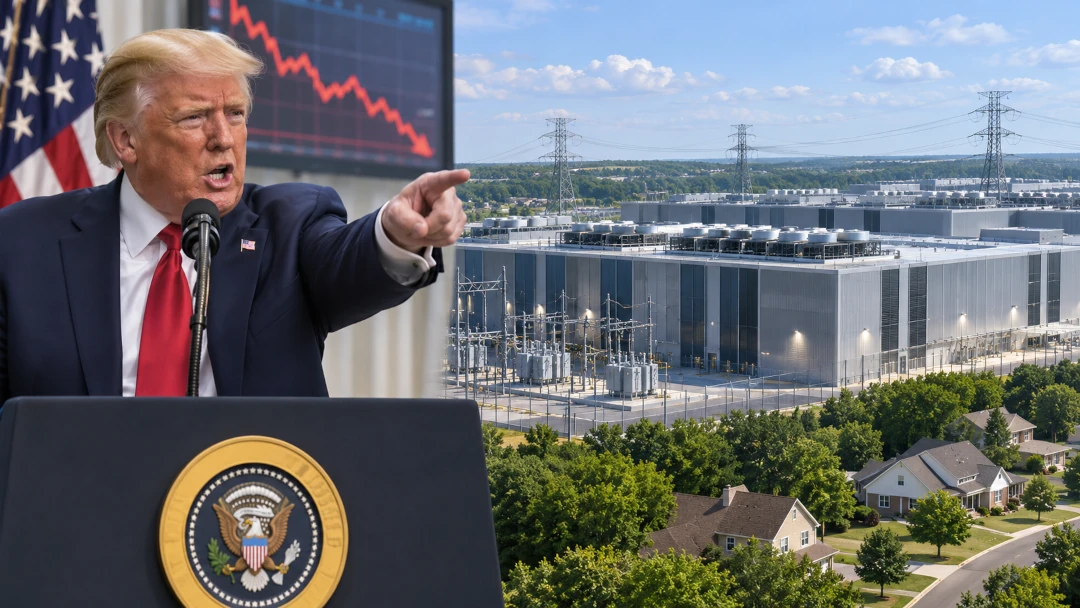
Seventeen days after Americans handed Democrats both chambers of Congress in an election shaped by anger over data centers, the president announced from the White House briefing room that U.S. companies will not be allowed to build them abroad, and that those who try will be taxed “tremendously.” He named no statute, no rate and no start date. His own staff had not heard the plan. By the closing bell, the S&P 500 was in a correction.
President Donald Trump opened his Friday news conference with a policy that, by his own account, he had not shared with the people who would have to carry it out. Speaking hours after returning from Asia, he told reporters the United States would not let American companies put data centers on foreign soil. “We’re not going to allow our companies to build data centers outside of our country,” he said, according to NBC News, adding that past leaders had let the same thing happen with chips, to the country’s detriment.
Then came the stick. Companies could still go abroad if they insisted, Trump said, but “we are going to put a tremendous tax on them,” as the Washington Times reported. It is the latest turn in a presidency that has embraced the massive, power-hungry facilities as an article of faith, even as a clear majority of Americans have said they do not want one next door.
I. What the President Said, and What He Didn’t
The announcement was long on adjectives and short on everything else. CNBC reported that Trump prefaced the policy by declaring, “We’re going to fight very hard for the data centers,” and that the plan apparently came as news to his own staff. Tom’s Hardware, citing Axios, reported that he had not discussed it with his cabinet or advisers at all.
His stated rationale was China. If American firms are allowed to build abroad, he argued, “China will take all of them.” He singled out Europe too. “They want to build now one in Finland,” he complained, according to Gizmodo, which noted he offered no mechanism for enforcement and that if Texas or California balked, West Virginia would gladly take the facilities. He also insisted that host communities profit handsomely, that the centers would generate their own power and that local taxes and electricity prices would fall.
What he did not offer was any detail that would let a company, a court, or a voter evaluate the policy: no tax rate, no penalty schedule, no effective date, no list of covered firms, and no explanation of which law gives a president the power to do any of it.
“We’re not going to allow our companies to build data centers outside of our country.”
— President Donald Trump, White House briefing room, Nov. 20, 2026, via NBC News
II.The Market Verdict
The timing could hardly have been worse for an industry already on its heels. A day earlier, Anthropic had completed the largest initial public offering on record, raising roughly $81.3 billion, according to Fortune. The debut was supposed to reassure investors that the AI boom still had legs. Instead, CNBC reported, it prompted traders to take profits, and by Friday’s close the rout had spread across the market.
Closing levels, Friday, Nov. 20, 2026. Source: CNBC.
The S&P 500 and the Dow both closed in correction territory, and the Nasdaq gave back everything it had gained this year. Fortune reported that BNP Paribas described the action as “panic selling” and that the S&P’s seven-session losing streak was its longest since February 2020. Richard Saperstein of Treasury Partners told CNBC the market was going through “an AI repricing” driven by slowing data-center buildouts and shrinking funding for AI projects.
Honesty requires a caveat: Trump’s remarks were one pressure among several, and nobody can precisely isolate their effect. But a president announcing, without warning or legal basis, that the largest technology companies in the world may be penalized for where they pour concrete is exactly the kind of policy chaos that unsettled markets punish. The firms most exposed to the threat, including Alphabet, Amazon, Microsoft, Meta and Oracle, all run data centers overseas.
III. Follow the Money: Who Benefits From “Build It Here”?
Any policy that forces the AI industry to concentrate its trillion-dollar buildout on American soil raises an obvious question: who owns the land, the power plants, the hardware and the financing that buildout will require? In the president’s case, the answer includes his own family. A Washington Post analysis of Trump’s financial disclosures and corporate announcements, published in September, found the family’s fortunes deeply intertwined with the AI boom.
The President’s Portfolio
Trump’s own disclosures show holdings in companies supplying AI infrastructure. The Post found the stakes create potential conflicts as his administration sets AI and data-center policy.
1789 Capital
Donald Trump Jr. is a partner at a firm that closed a $1.2 billion fund focused on real estate including digital infrastructure such as data centers, per Yahoo Finance.
American Data Centers
Don Jr. and Eric Trump joined the investment firm Dominari Holdings and helped launch a data-center venture after their father returned to the White House, Yahoo Finance reported.
Trump Media’s Power Play
The president’s media company announced a $6 billion merger with a nuclear fusion firm aimed at powering AI data centers, according to The Daily Beast.
The CoreWeave Bonds
Trump’s accounts bought up to $1 million in bonds of the AI cloud firm CoreWeave in the week before a major government announcement involving the company, per disclosures compiled by ProPublica and reported by The Daily Beast.
World Liberty & the Gulf
Emirati officials used $2 billion in cryptocurrency from the Trump family’s World Liberty Financial to invest in a crypto company during the same season they won access to U.S. AI chips, per reporting summarized from the Wall Street Journal.
Get Involved Today
Contribute to our mission and turn your concerns into action.
The White House insists there is no conflict and says Trump’s investments are handled by independent managers. To be precise about what the record shows: no reporting has established that this specific announcement was crafted to enrich the president’s family. But that is not the standard Americans should accept. A policy that steers more data-center construction, power demand and equipment spending into the domestic market directly expands the market for businesses the Trumps have bought into. Don Fox, a former acting director of the Office of Government Ethics, told the Post that no president under the modern conflict-of-interest regime “has ever conducted their finances this way.” When a president holds a stake in the industry he regulates, every improvised decree carries a question he refuses to answer.
IV. The Abu Dhabi Problem
If the president truly believes that overseas data centers are a gift to China, he will have to explain his own record. In May 2025, Trump and Emirati President Mohammed bin Zayed announced a 5-gigawatt AI campus in Abu Dhabi that the Commerce Department itself billed as the largest data center deployment outside the United States, CNN reported. American giants including OpenAI, Nvidia, Oracle and Cisco signed on to the “Stargate UAE” cluster, and the administration agreed to let the Emirates import up to 500,000 advanced AI chips a year, according to reporting cited by IEEE ComSoc.
That project is, by any plain reading of Friday’s remarks, precisely the kind of overseas buildout the president now says he will not allow. Either the new policy carves out an exception for deals he personally brokered with a government that did business with his family’s crypto venture, or it punishes the companies he urged to go there. Neither possibility describes a coherent national strategy. Both describe a policy whose real organizing principle is the president’s favor.
V. Can He Actually Do This?
The short answer is: not the way he described it.
The Power to Tax Belongs to Congress
“The Congress shall have Power To lay and collect Taxes, Duties, Imposts and Excises…” · U.S. Constitution, Article I, Section 8, Clause 1
- A “tremendous tax” requires a statute. The Constitution assigns the taxing power to Congress, not the president. As Tom’s Hardware and Gizmodo both noted, any new levy on overseas construction would need legislation. The Democratic majority taking office in January has no reason to write it.
- The emergency-powers shortcut is closed. In Learning Resources v. Trump (2026), the Supreme Court held that the International Emergency Economic Powers Act does not authorize the president to impose tariffs. A president who cannot use IEEPA to tax imports is on even weaker ground inventing a tax on domestic firms’ foreign investments.
- The one real lever is narrower. Export controls administered by the Commerce Department’s Bureau of Industry and Security can restrict where advanced chips go and who may access them remotely. Tom’s Hardware reports BIS is already moving on remote access, and the House passed the Remote Access Security Act in January 2026 to close the loophole that lets Chinese labs use foreign data centers running banned chips. That bill has stalled in the Senate. Targeted chip controls are a legitimate security tool. A blanket ban on American companies building anywhere abroad is something else entirely.
- What remains is pressure, not law. Without a statute, the administration’s leverage is informal: permits, contracts, merger reviews and the bully pulpit. Using those tools to punish disfavored corporate decisions, without rules announced in advance, invites exactly the kind of arbitrary enforcement due process and separation of powers exist to prevent.
VI. Congress and the Statehouses Have Already Spoken
The president is not announcing this policy into a vacuum. On November 3, voters gave Democrats full control of Congress, including what NBC News projected could be their largest House majority in nearly two decades and seven flipped Senate seats in places like Texas, Kansas and Ohio, according to NBC Bay Area. Data centers were a live issue in many of those races. And the Washington Times reports that the incoming majority plans to investigate the Trump family’s financial deals.
The incoming leadership has been explicit about where it stands. Senate Democratic Leader Chuck Schumer has promised to make data centers pay their fair share, and he did not mince words about the president’s approach.
“Not [President] Trump’s toothless, stupid pledge, but strong, enforceable consumer protections.”
— Sen. Chuck Schumer (D-N.Y.), via The Hill
Sen. Ron Wyden of Oregon, the top Democrat on the Finance Committee, has proposed a new excise tax on the data-center boom and the elimination of its tax breaks, saying communities are rightfully questioning whether the buildout will benefit them. Sen. Bernie Sanders and Rep. Alexandria Ocasio-Cortez have gone further, introducing legislation for a federal moratorium on new AI data centers.
The unease is not confined to one party. Republican Sen. Josh Hawley of Missouri teamed with Democratic Sen. Richard Blumenthal of Connecticut on the GRID Act, which would require new data centers to supply their own power so families don’t foot the bill. Of the status quo, Hawley said simply: “This is unacceptable.”
In the states, the rebellion is bipartisan and already law. Texas Gov. Greg Abbott, a Republican, ordered his environmental agency to stop issuing data-center permits until grid and water audits are complete, writing that “Data centers must pay their own way, protect our grid and water,” according to the Texas Tribune. New York has recommended that municipalities demand $1 million in community investment per megawatt, and data-center moratoriums nationwide have surpassed 500, Tom’s Hardware reports. In the midterms, according to Gizmodo, 41 ballot initiatives in 10 states sought to limit data-center growth, and 40 passed.
Read together, the message is unmistakable. Governors of both parties, a new congressional majority and voters themselves are asking for more control over where these facilities go and who pays for them. The president’s answer is to remove one of the industry’s alternatives and push the entire buildout back onto American communities.
VII. What It Means for Your Household
Strip away the China rhetoric and the policy’s practical effect is simple: if companies cannot build elsewhere, the pressure to build in your county intensifies. That matters because Americans have made their feelings plain. A Gallup survey found seven in ten Americans oppose data centers near their homes, up from 47 percent in late 2025, and that they now rank below nuclear power plants as neighbors, Tom’s Hardware reported.
Their reasons are concrete. A typical AI-focused data center uses as much electricity as 100,000 households, according to Fortune, and residents worry about water, noise and rising utility bills. Funneling every new facility onto the domestic grid adds to that demand without a single new protection for ratepayers.
Then there is the retirement account. Tens of millions of Americans hold the affected companies through index funds and 401(k)s. When the S&P 500 falls 3.7 percent in a day, partly on policy whiplash from the Oval Office, ordinary savers absorb the loss. Finally, there are jobs and competitiveness: Tom’s Hardware notes that many foreign governments require their citizens’ data to stay in-country, so a ban could simply lock American firms out of those markets and hand them to foreign competitors, the opposite of the stated goal.
VIII. The Administration’s Case, Taken Seriously
Fairness demands that we state the strongest version of the president’s argument. Supporters say data centers are vital to America’s lead in artificial intelligence and that keeping them home keeps billions in investment and thousands of jobs on U.S. soil, as the Washington Times summarized. There is also a genuine security concern: Chinese AI labs have reportedly exploited a gap in U.S. law to rent capacity in overseas data centers equipped with chips banned for export to China, as Tom’s Hardware reports. And the president argues that communities can negotiate valuable benefits from developers.
These points deserve answers, and they have them. The chip loophole is real, which is why a targeted bill to close it already passed the House. Congress can finish that job without banning every American cloud facility from London to Tokyo. Investment and jobs at home are worthy goals, which is why bipartisan bills would make data centers pay their own power costs so communities can say yes on fair terms. And the claim that host communities will see lower bills is one the public, by wide margins, simply does not believe. A blunt decree with no legal footing advances none of these goals better than the targeted tools already on the table.
IX. What This Says About His Leadership
Friday’s announcement fits a pattern. Policy arrives by press conference, unvetted by the officials who must implement it, unmoored from statute and timed without regard for markets. In the same appearance, Gizmodo reported, Trump said he would like to see former Nvidia CEO Jensen Huang apologize and said he had no plans to fire Commerce Secretary Howard Lutnick. This is governing as improvisation.
It also reveals priorities. Voters spent 2026 telling their leaders, through polls, ballot measures and a historic midterm, that they want a say over the land, water and power in their communities. The president has spent the same year dismissing that resistance, at one point declaring that “there is a SICK conspiracy going on against AI and Data Centers,” according to Yahoo Finance. When the people most affected say no and the president’s answer is to close the exits, it is fair to ask whose interests he believes he serves.
X. How We Got Here
- May 2025Trump and the UAE announce a 5-gigawatt Abu Dhabi AI campus, billed as the largest data center deployment outside the U.S.
- Feb. 11, 2026Sens. Hawley and Blumenthal introduce the GRID Act to shield ratepayers from data-center power costs.
- Feb. 2026Supreme Court rules in Learning Resources v. Trump that IEEPA does not authorize presidential tariffs.
- Mar. 25, 2026Sanders and Ocasio-Cortez unveil a federal data-center moratorium bill.
- Sept. 20, 2026The Washington Post details the Trump family’s AI and data-center investments; the White House denies any conflict.
- Sept. 2026Texas Gov. Greg Abbott halts state data-center permits pending grid and water audits.
- Nov. 3, 2026Democrats win both chambers of Congress; 40 of 41 data-center limits on state ballots pass.
- Nov. 19, 2026Anthropic’s record IPO fails to lift AI stocks; markets slide.
- Nov. 20, 2026Trump vows to bar overseas data centers and threatens a “tremendous tax.” The S&P 500 and Dow close in correction.
ACTION: What You Can Do
This policy will be decided in county commissions, state utility hearings and the halls of a new Congress far more than in the briefing room. Here are five real options, with an honest read on each.Show up where siting is decided
Zoning boards, county commissions and planning hearings decide whether a specific data center gets built. Sign up for your county’s meeting notices, read the application, and speak during public comment about water, noise, tax abatements and nondisclosure agreements.
Honest read: Your most powerful lever. More than 500 local moratoriums show it works.
Weigh in with your state utility commission
State regulators set the rules for who pays for new power plants and transmission lines. Search your public utility commission’s docket for “large load” tariffs and file a public comment urging that data centers cover the full cost of serving them, as Texas now requires.
Honest read: Technical and slow, but this is where your electric bill is actually decided.
Tell Congress to legislate, not let him improvise
Call the Capitol switchboard at (202) 224-3121 and ask your representative and senators to back binding ratepayer protections like the GRID Act, to close the chip-access loophole through legislation, and to state publicly that no data-center tax exists without a vote of Congress.
Honest read: The new majority arrives in January. Lame-duck action is unlikely, so build pressure now for the first 100 days.
Demand an ethics investigation
Ask your members to support the incoming majority’s planned review of the Trump family’s financial deals, with a specific focus on whether AI and data-center policy has moved the value of family holdings, and to back legislation requiring presidents to divest from industries they regulate.
Honest read: Oversight can expose conflicts quickly. Binding divestment rules will face a veto.
Know what your savings own
Check how much of your 401(k) or IRA sits in a handful of AI and big-tech stocks; broad index funds are now heavily concentrated in them. If policy chaos worries you, talk with a fee-only fiduciary adviser about whether your allocation matches your risk tolerance. This is not investment advice.
Honest read: You can’t stop the whiplash, but you can decide how exposed you are to it.
Editorial Conclusion
A president does not get to tax by announcement. The power to lay taxes belongs to Congress, the Supreme Court has already told this president that emergency statutes are not a blank check, and the say over land, water and power belongs to the communities that bear the cost.
Friday’s decree ignores all three. It was improvised without his own staff, it contradicts the overseas megaproject he personally brokered, and it would expand markets in which his family is invested, weeks after voters rejected his approach at the ballot box.
Congress must say plainly that no such tax exists without its vote, finish the targeted work of protecting ratepayers and securing chips, and investigate the president’s conflicts in full. The AI buildout will shape the American economy for a generation. Whether it is governed by law or by one man’s whim is the question this republic must answer now.
Sources & References
- NBC News · Trump threatens ‘tremendous penalties’ on companies that build AI data centers overseas
- CNBC · Trump vows to stop U.S. companies from building data centers abroad, threatens ‘tremendous tax’
- Gizmodo · Trump says he’ll prevent U.S. companies from building data centers overseas
- Tom’s Hardware · Trump wants to ban US companies from building overseas data centers
- The Washington Times · Trump flexes power by issuing America-first rules on data centers
- CNBC · S&P 500 and Dow close in correction; Nasdaq erases 2026 gain as AI rout picks up steam
- Fortune · BNP Paribas sees ‘panic selling’ as the AI selloff drags the S&P 500 into a correction
- The Washington Post via Anchorage Daily News · Trump and sons invest heavily in AI economy as he resists calls for slowdown
- Yahoo Finance · ‘SICK conspiracy’: Trump dismisses calls to rein in AI as his sons cash in
- The Daily Beast · Donald Trump cashed in one day after handing tech firm CoreWeave a major deal
- CNN via Yahoo News · Trump and Abu Dhabi ink partnership to build massive AI data center complex in UAE
- IEEE ComSoc Technology Blog · OpenAI partners with G42 to build giant data center for Stargate UAE project
- Cornell Legal Information Institute · Learning Resources v. Trump (2026)
- NBC Bay Area / NBC News · Democrats capture full control of Congress, NBC News projects
- The Hill via AOL · Schumer eyes green tax credits, data center reforms if Democrats retake majority
- NOTUS · Democrats’ split on AI grows as a new plan emerges
- Office of Sen. Josh Hawley · Hawley, Blumenthal introduce bill to prevent data centers from increasing electricity costs
- Fortune · Bernie Sanders and AOC launch bill to ban new data-center construction
- The Texas Tribune · Abbott halts state permits for data centers pending audits
- Tom’s Hardware · 70% of Americans oppose data centers near their homes (Gallup)
Related News