For more than four hours on Friday, departures were frozen at every airport in the United States. The administration blamed old routers, then a contractor, then “a defective piece of equipment,” while the president waved off AI and hacking before the investigation had finished. Twelve days before Thanksgiving, Americans deserve the truth about who let the nation’s air traffic backbone rot, and who keeps cutting the people who maintain it.
At 3:54 p.m. Eastern on Friday, November 13, the Federal Aviation Administration did something it has done only three times in the modern era: it stopped the country. A nationwide ground stop, issued “due to extraordinary circumstances and for reasons of safety,” froze departures at every U.S. airport. According to ABC News, Transportation Secretary Sean Duffy said roughly 3,500 planes were in the air when the order came down, and the stop was not lifted until 8:15 p.m. Every one of those aircraft landed safely. That is the good news, and it belongs to the controllers who brought them down with a communications network failing around them.
Everything else about this episode is an indictment. It was only the second nationwide stop since September 11, 2001. It came three days after the administration expanded a brand-new artificial intelligence traffic-management tool across the entire country. And in the 24 hours that followed, the official explanation changed shape at least twice, while President Trump went on Fox News to tell the public what didn’t cause it before his own investigators could say what did.
I. What Actually Broke
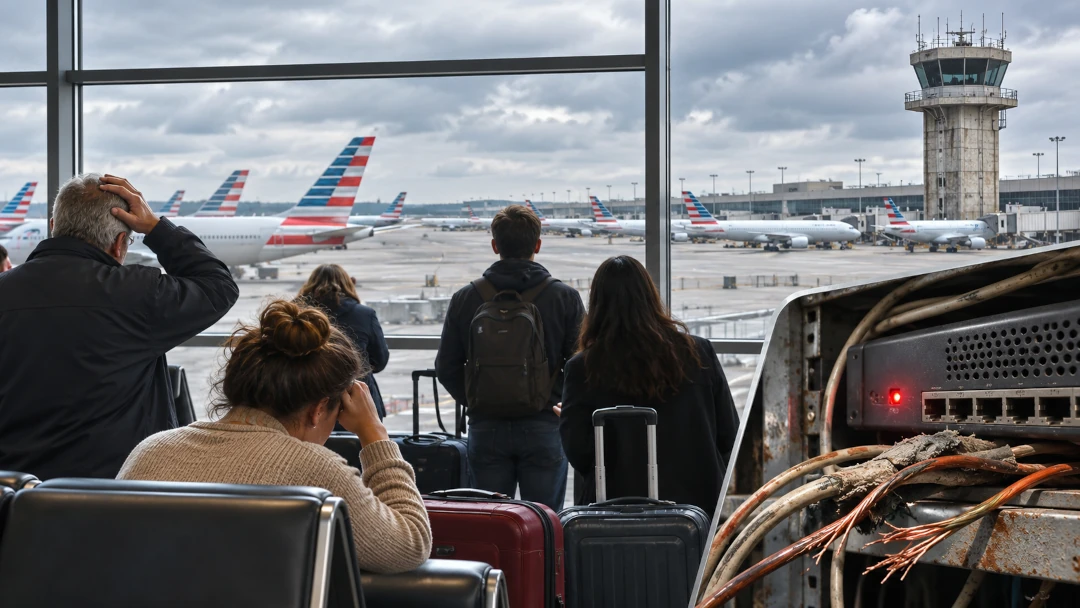
The failure was not in the sky; it was in the wires. As Yahoo News reported, the system at the center of the outage is the FAA Telecommunications Infrastructure network, which links air traffic control centers, towers and radar sites and has been run by defense contractor L3Harris (and its predecessor, Harris Corp.) since 2002. On Saturday, Duffy said a router installed during work at a remote FAA site began flooding other routers across the air traffic system with more than a thousand connection attempts every four to five seconds, scrambling communications with aircraft and radar.
The part that should alarm every traveler came from FAA Administrator Bryan Bedford himself. No facility went fully dark, he said, but the backup channels all ride on the same network. There is no second road. When the one road floods, the whole country stops.
“We don’t have two, but one.”
— FAA Administrator Bryan Bedford, on the network carrying the FAA’s backup communications — via Yahoo News
That single point of failure is not a secret. Yahoo News noted that a 2023 FAA-commissioned safety review had already called the network obsolete, that a Harris technician misconfigured a router during a similar fiber move in 2009 and disrupted 129 facilities, and that only this past August did the FAA select AT&T to build a replacement. The warning lights have been blinking for seventeen years.
Flights Lost Friday
Flights that could not be completed after the stop, roughly 9,000 commercial and 3,000 private, per Bedford’s account reported by Yahoo News.
Saturday’s Hangover
Cancellations Saturday, with about 5,300 more delays, according to FlightAware data cited by CBS News, as crews and aircraft sat stranded out of position.
The AI Tool
Value of the 12-year contract awarded in June for SMART, which the FAA expanded to all 22 en route centers three days before the outage, per The Washington Times.
The Copper Problem
Aging copper lines replaced with fiber as of May 2026, according to a GAO review summarized by Travel Noire. Full replacement isn’t expected until September 2027.
II. The SMART Question
It is entirely reasonable that Americans asked whether artificial intelligence was involved. The Strategic Management of Airspace, Routes and Trajectories system (SMART) ingests weather, flight paths, traffic and controller staffing data and recommends routings. The administration soft-launched it around Washington in September and, on November 10, pushed it to all 22 air route traffic control centers. Seventy-two hours later, every one of those centers was in trouble.
The company behind SMART, Boston-based Air Space Intelligence, moved fast. In a post on X, cited by The Hill, the firm said the ground stop was not based on or caused by SMART or its integration with the FAA. At his White House briefing, Duffy went further, saying the AI system “isn’t plugged in.” On Saturday, Bedford told reporters the government saw “zero evidence of anything AI-related” and nothing nefarious.
We take those statements seriously, and the weight of current evidence points to the telecom network, not the algorithm. But fairness cuts both ways. A system that “isn’t plugged in” was nonetheless announced as deployed at every center in the country days earlier, and the FAA describes a workflow in which specialists review SMART’s recommendations and local facilities choose whether to use them. The public has not been shown how SMART connects to the same communications backbone that failed, what data it pulls through it, or what load it adds. “Trust us” is not a root-cause analysis. The administration spent $875 million to put AI on top of a network it now admits is held together by copper; the more urgent question is not whether the AI broke the wires, but why the wires were left to break.
III. A Story Rewritten Overnight
Watch how the explanation moved. On Friday evening, officials pointed at new technology and security patches overwhelming aging routers; Duffy said the routers had been overloaded with data, and Homeland Security Secretary Markwayne Mullin said patches appeared to overwhelm them. Duffy’s message was simple and convenient: “This is an emergency. We have old switches, old routers.” Old equipment, inherited, someone else’s fault.
By Saturday morning, the story had changed. Now the trigger was a contractor, L3Harris, moving lines from copper to fiber at a remote site, and a single router that flooded the network. Officials told reporters they still did not know whether it was installed wrong, configured wrong, or simply defective. Meanwhile, SecurityWeek, citing Bloomberg, reported that the FBI was examining whether a software update was responsible, and Mullin, while saying investigators had seen no “footprints,” added that “we’re not going to rule that out.”
Into that uncertainty stepped the president. Within hours of the stop, Trump told Fox News correspondent Peter Doocy that the outage did not seem to be a cyberattack or AI, according to Yahoo News; Doocy relayed that Trump described the cause as a bunch of “old, broken stuff” in the FAA’s infrastructure. The FBI was still investigating. DHS was still not ruling anything out. And the commander in chief had already closed the case on air.
We do not allege a cover-up; we have no evidence of one, and the FBI and DHS findings so far align with the equipment explanation. What we allege is something more ordinary and, in its way, more dangerous: an administration that reaches for the most politically comfortable story first, an “old system” it can blame on predecessors, and revises only when the facts force it to. Bedford promised that the root-cause analysis will be shared when complete. The public should hold him to that, in writing, with a date.
Get Involved Today
Contribute to our mission and turn your concerns into action.
IV. What It Cost Travelers, and What It Threatens Next
The immediate damage is measurable. Yahoo News, citing FlightAware, counted more than 9,100 flights within, into or out of the U.S. canceled Friday, with American, Southwest, Delta and United each canceling more than 1,100. Bedford projected 4,000 to 5,000 more cancellations on Saturday and said airlines expected full schedules by the close of business Sunday. He apologized to the traveling public, and he deserves credit for that, which is more than the president offered.
The hidden costs fall on individuals. Because a ground stop is treated as outside the airlines’ control, hotel and meal vouchers are unlikely; travelers who lost a night, a wedding, a job interview or a funeral eat that cost themselves. Waivers vary by carrier and by date window. And the timing could not be worse: American Airlines alone told TravelPulse it expects to fly more than 8 million passengers between November 19 and December 1. The FAA has offered no assurance that the router behavior cannot recur; on Friday, ABC News reported, Duffy himself warned that more outages would come without new funding. A repeat on the Sunday after Thanksgiving, historically the busiest air-travel day of the year, would strand families by the hundreds of thousands.
The long-term costs are structural. By Bedford’s own description, primary and backup communications share one network. Until a genuinely redundant one exists, every contractor visit to a remote site is a roll of the dice for the national airspace.
V. The $25 Billion Question
Supporters of the administration have been quick to ask where “Biden’s $25 billion” went. It is a fair question with a factual answer. The 2021 Bipartisan Infrastructure Law did appropriate $25 billion for aviation over five years, but, as the American Association of Airport Executives laid out at the time, $15 billion was for airport infrastructure grants, $5 billion for airport terminals, and just $5 billion, or $1 billion a year, for FAA facilities and equipment, aimed largely at the physical condition of air traffic control buildings and the sustainment backlog. Hearst stations including KCRA made the same point: roughly $5 billion of the law went to air traffic control, beginning in 2022.
In other words, most of that money was never meant to replace the telecom backbone that failed Friday; it built terminals and runways, which travelers can see in airports across all fifty states. The honest critique of the Biden era is that the $5 billion facilities share was far too small for a system this old, and that a 2023 review flagged the network as obsolete without a replacement being in place by January 2025. The $25 billion was not intended for the FAA to fix this issue.
Since then, Republicans have controlled the White House and both chambers of Congress. The July 2025 reconciliation law gave the FAA $12.5 billion, including $4.75 billion for telecommunications upgrades, according to a Holland & Knight analysis. Duffy has called that a down payment on a plan he prices at $31.5 billion. On Friday, ABC News reported, he was asked directly why the administration hadn’t secured the rest with its own party running Congress. The question answers itself.
VI. What Trump Has Done to the FAA
The administration wants this to be a story about old equipment. It is also a story about choices made in the last 22 months, choices that thinned the agency’s expertise, stressed its workforce, and treated aviation safety as a lever in political fights.
None of these decisions, alone, routed a rogue router onto the network. Together, they describe a leadership that fired the people who maintain the system, cut the target for the people who run it, squeezed controllers through a shutdown, and then spent its scarce attention on a showcase AI launch while half the nation’s copper lines were still in the ground. That is a statement of priorities.
“Unprecedented breakdown.”
— House Democratic Leader Hakeem Jeffries, demanding answers from the administration — via ABC News
VII. What Congress Is Saying, and Not Doing
Democrats have moved first. Beyond Jeffries, ABC News reported that Sen. Tammy Duckworth of Illinois, the top Democrat on the Senate aviation subcommittee, stressed that the system’s safety depends on redundancies and vowed to demand answers, and that Sen. Maria Cantwell of Washington said the Commerce Committee would review the communication-frequency failures. Yahoo News reported that Duckworth has called for an investigation and that New York Gov. Kathy Hochul has called on Duffy to resign.
Republican leaders, who control both chambers until the new Congress convenes in January, have been largely absent from the reporting so far; Yahoo News found no specific Republican reactions to report. Congressional oversight of a nationwide aviation shutdown should not depend on which party holds the Department of Transportation.
On money, the administration’s own numbers don’t agree. Yahoo News reported that Trump has asked for $30 billion while Duffy says he wants $50 billion on top of the $12.5 billion already approved, and that Duffy relayed a promise from the president to commit “every resource” to the FAA. Congress should be willing to fund real redundancy. It should not write a blank check to a department that cannot yet tell the public what broke.
Who Answers for the Sky?
The power of the purse and the duty of oversight. Article I, Section 9 provides that “No Money shall be drawn from the Treasury, but in Consequence of Appropriations made by Law.” Every dollar for a new FAA network must come through Congress, and with that power comes a responsibility to condition funding on transparency. Congress can and should require a public root-cause report, an independent review by the DOT Inspector General, and a verified redundancy plan as conditions of any emergency appropriation.
The FAA’s statutory mandate. Federal aviation law, at 49 U.S.C. § 40103, charges the FAA Administrator with assigning the use of the navigable airspace as necessary to ensure the safety of aircraft and its efficient use. A national airspace whose primary and backup communications ride a single contractor-run network is not a system designed to meet that duty; it is a system designed to hope.
Passengers’ rights are law, not charity. Under the Department of Transportation’s refund rule, 14 CFR § 260.6, a passenger whose flight is canceled and who does not accept rebooking or a travel credit is owed a full refund of the fare, taxes and ancillary fees, issued automatically. That protection applies whatever the cause of the cancellation, including an FAA ground stop. Airlines’ “waivers” are not a favor; refunds are an obligation.
Accountability for contractors. If a contractor’s installation or configuration error triggered a nationwide shutdown, the contract terms, performance standards and penalties governing that work must be made public. Taxpayers paid for a network that was supposed to stay up. They are entitled to know why it didn’t.
VIII. The Problems Still Waiting on the Runway
Friday’s outage was the loudest symptom, not the disease. Half of the FAA’s legacy copper circuits were still in service as of the GAO’s May count. The controller workforce remains short, and the agency’s response was to redefine “fully staffed” downward. The roughly $20 billion the administration says it still needs for the overhaul remains unappropriated, and the replacement for the failed network has only just been awarded. On the evidence of the last week, the FAA cannot yet promise to get travelers through Thanksgiving.
The administration’s plan, as stated Friday and Saturday, amounts to three things: blame the old system, blame the contractor, and ask Congress for more money. Two of those may be partly true. None of them is a plan for the next four weeks. We have heard nothing about mandatory nighttime-only maintenance windows across all sites (Duffy said only that timing would be “reevaluated”), nothing about an interim independent backup path for the en route centers, and nothing about a public, dated root-cause report.
IX. What You Can Do
Most of the fix requires money and political will in Washington. But travelers are not powerless, and constituents have more leverage over a lame-duck Congress than they think. Here is a plain-language guide.
Claim your refund, not a voucher
If your flight was canceled and you didn’t travel, you’re entitled to your money back under federal rules. Accepting a rebooked flight or travel credit gives up that cash refund, so decide deliberately. If the airline stalls, file a complaint with DOT’s Office of Aviation Consumer Protection.
Document every expense
Keep receipts for hotels, meals and ground transport. Airlines are unlikely to reimburse them for an FAA ground stop, but many travel credit cards and trip-delay insurance policies will. Check your card’s benefits guide before you assume you’re out of luck.
Fly Thanksgiving defensively
Book the earliest flight of the day, avoid tight connections, travel a day earlier if you can, and keep your airline’s app ready for fast rebooking. Early flights have the most rebooking options if the system wobbles again.
Demand a public root-cause report
Call your House member and both senators (Capitol switchboard: 202-224-3121). Ask them to require a public, dated root-cause report from the FAA and an independent DOT Inspector General review of the L3Harris network and the SMART rollout, before any emergency money moves.
Back funding with strings attached
Tell your representatives you support paying for a genuinely redundant air traffic network, and that it must come with transparency, contractor accountability and a reversal of cuts to the technicians and controllers who keep the system running.
Your individual refund claim is fully within your control and backed by federal rule. The political asks are harder: a lame-duck Congress rarely moves fast, and the administration controls the investigation. But public pressure is exactly what produced hearings and redundancy commitments after the 2023 outage. Volume matters, and the incoming Congress will set its oversight agenda in the next eight weeks.
Editorial Conclusion
For four hours on Friday, the United States lost the ability to put a plane in the sky, and the only reason no one died is that air traffic controllers did their jobs better than the people who lead them.
This was not an act of God and it was not an act of a hacker. It was the predictable result of a single, aging network that everyone in charge knew was fragile, run by a leadership that fired the people who maintain it, cut the target for the people who operate it, and chose a press-friendly AI launch over finishing the plumbing. When it failed, the administration’s first instinct was to tell a story rather than to tell the truth.
The verdict is simple. Americans are owed a public root-cause report, an independent investigation, a real backup network, and a government that levels with them before it spins. Safety in the skies is not a partisan prize; it is a public trust. Right now, that trust is grounded, and it will not fly again until the people in charge earn it back.
Sources & References
- ABC News — Nationwide ground stop lifted after more than 4 hours as Trump administration blames old, overloaded tech
- ABC News — FAA ground stop live updates: ‘Zero evidence of anything nefarious,’ FAA head says
- Yahoo News — FAA ground stop latest updates: Saturday cancellations top 5,000; Duffy blames contractor L3Harris
- CBS News — Travelers stranded and thousands of flights canceled after FAA ground stop. Here’s what we know
- The Washington Times — Duffy says FAA’s new AI air traffic tool played no role in nationwide ground stop
- The Hill — AI company behind FAA’s SMART tool denies link to ground stop, Duffy confirms
- KCRA (Hearst) — FAA ground stop raises questions after rollout of new AI air-traffic system
- Yahoo News — Trump tells Fox News FAA ground stop doesn’t ‘seem like’ a cyberattack or AI
- SecurityWeek — No signs of hacking in FAA ground stop as FBI reportedly probes software update
- American Association of Airport Executives — FAA provides update on implementation of the Bipartisan Infrastructure Law
- WTTW / CNN — Trump administration fired hundreds of FAA probationary workers, union says
- Voice of America — Trump begins firings of FAA air traffic control staff weeks after fatal DC plane crash
- Washington Examiner — Senators warn of ‘fragile’ US air system after 43-day shutdown
- AVweb — Duffy vows to ‘fix Newark’
- Holland & Knight — The BNATCS state of play
- Washington Technology — Peraton wins air traffic control system overhaul contract
- AIN — FAA cuts 2,000 from certified controller goal in 2026 hiring plan
- Travel Noire — FAA fiber-optic cable cut and flight disruptions; GAO modernization review
- TravelPulse — American Airlines expects 8 million passengers over Thanksgiving
- Cornell Law School LII — 14 CFR § 260.6: Refunding fare for flights cancelled or significantly delayed or changed
Related News