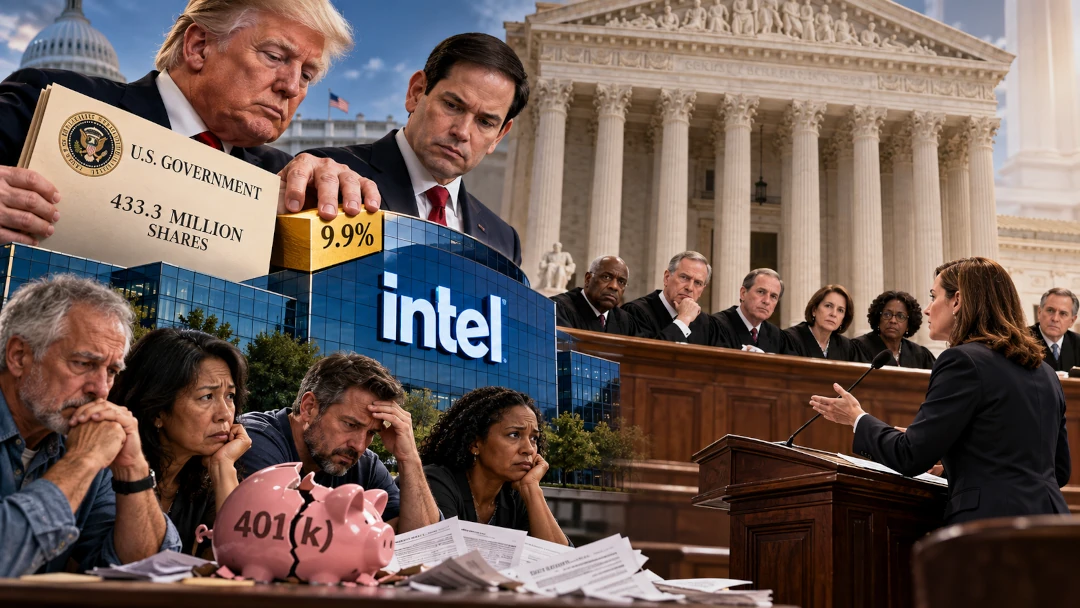
Washington bought 433.3 million Intel shares in August 2025. Fourteen months later, a lawyer from the Solicitor General’s office stood at the Supreme Court lectern on the side of Intel’s retirement-plan managers and against the former employees whose savings they invested. Whatever the motive, a government that is part-owner, pledged board ally, and courtroom advocate has stopped looking like a neutral guardian of anyone’s retirement.
Tuesday morning, October 6, the Supreme Court opened arguments in Anderson v. Intel Corporation Investment Policy Committee. At one table sat counsel for Winston Anderson and fellow former Intel employees, who say the company’s retirement committee poured their savings into costly hedge funds and private equity that dragged down returns. At the other sat Intel’s lawyers. And when the respondents’ half hour was divided, the second voice belonged to Aimee W. Brown, Assistant to the Solicitor General, arguing for the United States. The Supreme Court’s own docket lists her among the respondents’ advocates, and the government’s brief is captioned, without ambiguity, “supporting respondents.”
Now set that beside a document Intel itself filed with the SEC. In its August 2025 announcement, Intel disclosed that the federal government would purchase 433.3 million newly issued shares at $20.47 apiece, a 9.9 percent stake, and that the government agreed to vote with Intel’s board on shareholder matters, with limited exceptions. The country’s lawyer was defending the retirement decisions of a company the country partly owns, and whose board it has promised to back, against the people whose retirement money was on the line.
I. What the Case Is Actually About
Precision matters here, because the stakes are real without exaggeration. After the 2008 crash, Intel’s plan fiduciaries began folding hedge funds and private-equity vehicles into the company’s custom target-date and diversified funds, pitching the move as protection in falling markets at the cost of lagging in rising ones. The government’s own brief recounts that history. The workers allege the strategy produced heavier fees and weaker returns; by the end of 2013, according to PLANSPONSOR’s account of the complaint, more than a third of one Intel fund sat in private equity, hedge funds and commodities.
The question before the justices is narrower: whether a worker who alleges a fund underperformed must first identify a “meaningful benchmark,” a comparable fund with similar aims, before the case can survive dismissal and reach discovery. The Ninth Circuit said yes and threw the case out. The workers argue that rule lets fiduciaries who build bespoke, opaque portfolios escape scrutiny precisely because nothing on the open market looks like them. The government argues it is ordinary pleading law, and that participants can find comparators through disclosures and private-market data services.
The stake
Intel shares bought by the U.S. at $20.47 each, a 9.9% stake, funded largely by CHIPS Act grants Intel had been awarded but not yet paid. Intel 8-K
The pledge
The government agreed to vote alongside Intel’s board on matters requiring shareholder approval, with limited exceptions, while taking no board seat. SiliconANGLE
The brief
The Solicitor General and the Labor Department’s Solicitor jointly urged the Court to affirm dismissal of the workers’ suit. U.S. amicus brief
The room
Law360 reported the Court appeared likely to affirm, with multiple justices backing a comparison requirement. Law360
II. How the Government Became Intel’s Co-Owner
The stake did not arrive through an act of Congress. It came out of a pressure campaign. President Trump publicly demanded in early August 2025 that Intel CEO Lip-Bu Tan resign, the Associated Press reported, and within weeks the White House had converted $11.1 billion in previously promised funding into equity. The CHIPS Act had authorized grants to rebuild domestic chipmaking. It did not tell the executive branch to swap those grants for ownership.
Writing in Lawfare, analysts examining the deal’s legal footing observed that releasing Intel from prior obligations while accelerating payments sits uneasily with the CHIPS Act’s stated purpose of funding fabrication facilities. In effect, they noted, Washington received equity in place of the factories the statute was written to buy. Intel was not alone. The Council on Foreign Relations catalogued a golden share in U.S. Steel, a Pentagon investment in MP Materials, and a quasi-equity position in Lithium Americas. By the time Sen. Jacky Rosen filed her resolution last week, she counted more than 35 federal equity transactions worth over $27 billion since January 2025.
“I PAID ZERO FOR INTEL, IT IS WORTH APPROXIMATELY 11 BILLION DOLLARS.”
— President Donald Trump, Truth Social, as reported by Report.az
That framing tells you how the White House sees the arrangement: as a position on a balance sheet. In the same post, Trump promised to keep making deals like it for the country without end. The president speaks of the Intel stake the way an investor speaks of a winning trade, and investors defend their positions.
III. Owner, Regulator, Advocate: The Conflict Explained
The federal government was built to stand between citizens and concentrated power, not to stand beside it. ERISA itself, the law at issue in this case, declares its purpose as protecting the interests of participants in employee benefit plans; the Secretary of Labor is its chief enforcer. When the Labor Department’s lawyers co-sign a brief urging the Court to close the courthouse door on plan participants, the agency charged with guarding workers’ retirement money is arguing for the people who manage it.
To be fair, the government’s brief never mentions the Intel stake. Its position is consistent with a brief the Solicitor General filed at the Court’s invitation in a parallel case, Parker-Hannifin v. Johnson, in December 2025. We have found no evidence that the shareholding drove the government’s legal position. The more visible driver is policy: the administration’s campaign to move private equity, private credit and crypto into ordinary 401(k)s, discussed below.
That is not reassurance. It is a second problem layered on the first. A government that holds a block of a company’s stock, has promised to vote with its board, and benefits when its share price rises has a financial interest in that company’s litigation outcomes. Federal ethics rules would bar an individual official with that kind of holding from working the matter. No such rule binds the institution itself. The public cannot be certain whose interest the United States represented on Tuesday, and that uncertainty is itself the injury. Critics across the spectrum have said so. Adam Posen of the Peterson Institute called the Intel deal “a step toward state capitalism,” and Steve Corbin, writing in The Fulcrum, warned that federal ownership sets the government’s role as regulator against its role as shareholder.
IV. The Ripple Effects
The conflict does not stay inside one courtroom. The Cato Institute, hardly a progressive outfit, argued in an analysis of the Intel deal that investors had begun chasing the next likely federal target, and that some institutions now weigh a company’s political relationship with the state when deciding where to put money. Capital that should flow to the best ideas flows instead toward proximity to power.
Competitors notice too. The Council on Foreign Relations pointed out that a federally backed incumbent raises barriers for any upstart chipmaker or miner trying to compete against a rival with Washington on its cap table. And workers notice last, usually when the damage is done. When the government is the counterparty’s partner, every agency decision touching that company, from enforcement to procurement to amicus briefs, carries a question mark the public should never have to ask.
Get Involved Today
Contribute to our mission and turn your concerns into action.
V. The 401(k) Agenda Behind the Brief
The Intel brief fits a pattern. In August 2025, Trump signed an executive order titled “Democratizing Access to Alternative Assets for 401(k) Investors,” declaring that every American saving for retirement should have access to funds holding private markets, real estate, commodities and digital assets. On March 30, 2026, the Labor Department proposed a rule creating what CNBC described as a safe harbor to help shield plan sponsors from litigation when they add these products. The government’s Intel brief cites that very proposal as a reason workers should be able to find benchmarks for private-equity sleeves.
Put the pieces together. The administration is opening 401(k)s to the most opaque, highest-fee assets on the market, building a legal shelter for the sponsors who adopt them, and asking the Supreme Court to set a pleading bar that workers challenging such assets will find hardest to clear. Financial professional Jay Rogers, writing in the Bedford Gazette, described the result as a door thrown open for private assets paired with a request that nobody be held accountable once they walk through it. Christopher Tobe of the CommonSense 401k Project asked the question at the heart of the case: whether an investment can be made so customized that its design protects it from accountability.
- After 2008Intel’s plan committee adds hedge funds and private equity to its custom retirement funds.
- Feb. 2020In an earlier round, a unanimous Supreme Court sides with Intel worker Christopher Sulyma on a timing question, reviving the litigation.
- May 22, 2025Ninth Circuit affirms dismissal, requiring a “meaningful benchmark.”
- Early Aug. 2025Trump demands Intel CEO Lip-Bu Tan resign, then meets him at the White House.
- Aug. 2025Executive order directs Labor and the SEC to expand alternative assets in 401(k)s.
- Aug. 22, 2025U.S. takes 9.9% of Intel: 433.3 million shares, a pledge to vote with the board.
- Jan. 16, 2026Supreme Court grants review of the workers’ petition.
- Mar. 30, 2026Labor proposes safe-harbor rule for alternative assets in 401(k)s.
- Jun. 1, 2026Warren, Sanders and Scott demand Labor withdraw the rule.
- Jul. 9, 2026Solicitor General files brief supporting Intel’s fiduciaries.
- Sep. 30, 2026Sen. Rosen introduces S.Res. 929 on federal equity stakes.
- Oct. 6, 2026Argument day. Government’s lawyer argues with Intel; reporters say the bench leans Intel’s way.
What the Constitution Says About a Shareholder-State
No clause of the Constitution forbids the federal government from owning stock, but the document’s structure assumes a government that acts as trustee for the public, and the Intel arrangement strains that assumption at four points.
- The Take Care Clause (Art. II, §3)
- The president must “take Care that the Laws be faithfully executed.” ERISA’s stated purpose is protecting plan participants. Faithful execution of that law sits awkwardly with an executive that argues for the fiduciaries of a company in which it holds a financial stake and a board-voting pledge.
- The Spending and Appropriations Power (Art. I, §§8–9)
- Congress controls how public money is spent. Congress appropriated CHIPS dollars as manufacturing grants. Converting those grants into equity, with clawbacks waived, is an executive rewrite of a spending decision the legislature made; Lawfare’s analysis flagged the tension with the statute’s purpose.
- Due Process and the Neutral Sovereign (Fifth Amendment)
- The Supreme Court has long held that a decision-maker with a pecuniary interest in the outcome offends due process. The Solicitor General is an advocate, not a judge, and that rule does not apply directly. But the Court gives the Solicitor General’s views special weight precisely because it presumes the United States speaks for the public interest. That presumption weakens when the United States is also a shareholder.
- The Unwritten Rule That Officials Can’t Hold What They Oversee
- Federal ethics law forbids individual officials from working matters in which they hold a financial interest. The government as an institution faces no equivalent rule. That gap, not any single clause, is what Congress must close.
The legal exposure is mostly structural rather than litigable today: no court is likely to void the stake, and a party would struggle to show standing to challenge the Solicitor General’s brief. That is exactly why the remedy has to come from Congress.
VI. What Congress Is Doing
Less than the moment demands, but more than nothing. On September 30, Sen. Jacky Rosen (D-Nev.) introduced S.Res. 929, which would put the Senate on record that the president, cabinet, members of Congress and their families should be barred from profiting from federal equity deals. Its findings point to a Trump son’s venture firm investing in a company months before it won a federal loan commitment and equity deal, and to a Commerce Department stake announced the same day Cantor Fitzgerald, now run by the Commerce Secretary’s sons, led a private offering for the same company. Its central line deserves to be law: equity bought with taxpayer funds belongs to the people of the United States.
The concern is bipartisan. Sen. Jon Husted (R-Ohio) introduced S. 4798 in June to require that federal equity stakes be liquidated to pay down the debt. The Senate Armed Services Committee, per Defense One, drafted guardrails for Pentagon equity investments in next year’s defense bill. Cato’s analysts have urged Congress to prohibit such stakes under the Defense Production Act rather than write a framework that normalizes them. None of these measures yet addresses the specific problem on display Tuesday: a government litigating on behalf of companies it owns.
VII. What Democrats Are Doing
On retirement savings, Democrats have been clear. On June 1, Senate HELP ranking member Bernie Sanders, Senate Banking ranking member Elizabeth Warren, and House Education and Workforce ranking member Bobby Scott sent a 14-page letter demanding the Labor Department scrap its alternative-assets rule, according to TheStreet. Politico reported that the letter also raised conflict-of-interest questions about administration officials’ ties to the crypto and private-investment industries.
“The proposed rule is harmful to American workers and counter to statute.”
— Sens. Sanders and Warren and Rep. Scott, letter to Acting Labor Secretary Keith Sonderling, via Politico
On the courtroom front, allies of the workers filed in force. Former Obama-era Labor official Phyllis Borzi joined an amicus brief for the petitioners, alongside briefs from AARP, the Pension Rights Center, Americans for Financial Reform and the Consumer Federation of America, all listed on the Court’s docket. And Senate Democratic Leader Chuck Schumer used the recent fight over a congressional stock-trading bill to note, per The Hill, that the GOP measure did nothing about the president’s own trading. What Democrats have not yet produced is a bill that would require the Justice Department to disclose, and recuse from, litigation involving companies in which the government holds equity. That is the gap.
VIII. If This Becomes the Norm
To be precise: Anderson is a civil lawsuit, not a prosecution, and nothing in the record suggests Intel bought its way out of anything. The danger is the template. Imagine a future in which a company facing a wage suit, a pollution case or a pension claim can offer Washington a slice of its equity, and the government then finds reasons to file briefs on its side, slow-walk enforcement, or settle cheaply. No explicit bargain would ever be written down. It would not need to be.
For the average American, the cost arrives in quiet ways: a 401(k) loaded with high-fee products no one can benchmark; a lawsuit dismissed before discovery because the government told the Court the bar should be high; a regulator whose own portfolio rises when the company it oversees wins. Your retirement security, your workplace safety, and your day in court all depend on a government that has no stake in the other side. Once that independence is for sale, everyone who lacks a block of shares to offer is at a disadvantage.
IX. What You Can Do
An honest assessment: The Supreme Court will likely rule for Intel’s fiduciaries by next summer, and no reader can change that. What remains within reach is your own account, the Labor Department’s final rule, and the pressure on Congress to write recusal and disclosure rules before government ownership spreads further.
Read your plan’s fee and benchmark disclosure
Your employer must give you an annual participant disclosure listing each fund’s fees, returns and a comparison index. Look for funds labeled “custom,” “private markets” or “alternatives,” check their fees, and ask HR in writing which benchmark the plan committee uses to monitor them. Written questions create a record.
Track the Labor Department’s alternative-assets rule
The comment period closed June 1, but the final rule has not been issued. Follow it on the Labor Department’s Employee Benefits Security Administration news page, and when it is finalized, tell your representatives whether you want it challenged under the Congressional Review Act.
Call your senators about S.Res. 929 and a recusal law
Ask them to cosponsor Sen. Rosen’s resolution, and to back legislation requiring the Justice Department to disclose and step back from cases involving companies in which the U.S. holds equity. The Capitol switchboard is (202) 224-3121.
Support the groups litigating for savers
AARP Foundation, the Pension Rights Center, Americans for Financial Reform and the Consumer Federation of America all filed for the Intel workers. Membership and donations fund the next brief.
Report problems with your own plan
If you believe your plan is being mismanaged, you can file a complaint with the Labor Department’s Employee Benefits Security Administration. Even under this administration, complaints create a paper trail that future officials and congressional investigators can use.
X. Trump’s Role, and What It Reveals
We found no public statement from President Trump about Anderson v. Intel itself, and we will not invent one. His involvement is written into everything around it. He publicly demanded Intel’s CEO resign, then personally announced the government’s stake. He signed the executive order that launched the drive to put private equity into 401(k)s. His Labor Department wrote the safe harbor, and his Solicitor General, D. John Sauer, signed the brief. On Truth Social he celebrated the stake’s paper value and mocked the critics who objected.
What this reveals about priorities is not subtle. Asked to choose between the people whose retirement money was at risk and the institutions that manage that money, this administration chose the institutions, and it did so while holding a financial interest in one of them. A president who measures governance by the gains on a portfolio will come to treat the companies in that portfolio as partners and the citizens on the other side of the courtroom as obstacles. The founders designed a government answerable to the governed. Tuesday showed us one answerable to its holdings.
Editorial Conclusion
The United States cannot be both the owner of a corporation and the impartial guardian of the people that corporation affects. On October 6, the government chose a side, and it was not the side of Intel’s workers.
Congress must act now: require disclosure and Justice Department recusal whenever the government holds equity in a party, bar officials and their families from profiting from these deals, and return the CHIPS Act to the purpose its authors wrote. A republic that lets its government trade neutrality for dividends has stopped governing for its citizens. That is what is at stake, and it is what Americans must demand back.
Sources & References
- U.S. Supreme Court — Docket No. 25-498, Anderson v. Intel Corp. Investment Policy Committee
- U.S. Dept. of Justice — Brief for the United States as Amicus Curiae Supporting Respondents
- SEC / Intel Corp. — Form 8-K: U.S. Government to make $8.9 billion investment in Intel
- AP via Broadband Breakfast — Trump turns $11.1B in government funds into a 10% stake in Intel
- SiliconANGLE — Trump says US government will take 10% stake in Intel
- Report.az — Trump announces lucrative deal with Intel
- PLANSPONSOR — Supreme Court probes “meaningful benchmark” definition in Intel oral arguments
- 401(k) Specialist — Supreme Court signals support for meaningful-benchmark standard
- 401(k) Specialist — Anderson v. Intel case heads to Supreme Court Tuesday
- Law360 — Justices seem to support end to Intel 401(k) fund suit
- Bloomberg Law — Justices debate how much 401(k) benchmark guidance to give
- U.S. Court of Appeals, 9th Cir. — Anderson v. Intel Corp. Inv. Policy Comm. opinion (May 22, 2025)
- Lawfare — The legal bases for government stakes in private firms
- Council on Foreign Relations — State capitalism in America: the government as investor, broker, rentier
- Cato Institute — Intel exposes the hidden cost of state capitalism
- Cato Institute — Congress should stop, not enshrine, equity stakes in private companies
- The Fulcrum — Trump’s state capitalism marks a radical break in U.S. policy
- Tech Insider — Trump eyes U.S. stake in AI: the 9.9% Intel model
- Ballotpedia News — Department of Labor looks to enable private equity investments in 401(k)s
- CNBC — 401(k) alternative asset rule proposed by Labor Department
- Politico Pro — Democrats push Labor to scrap proposal to open 401(k)s to crypto, private equity
- TheStreet — Senators urge the Labor Department to scrap the alternative assets rule
- Bedford Gazette — Private equity’s Trojan horse is headed for your 401(k)
- CommonSense 401k Project — Intel’s 401(k) case: transparency and accountability, or enrich private equity?
- U.S. Senate / GovInfo — S.Res. 929: Sense of the Senate on federal equity stakes (Rosen)
- U.S. Senate / GovInfo — S. 4798: Liquidate federal equity stakes to pay down the debt (Husted)
- Defense One — NDAA provisions would reshape Pentagon’s use of ownership stakes
- The Hill — Democrats block bill restricting lawmakers from trading stocks
Related News