“A Small Price to Pay”: The President Who Offered Up Two American Cities
Defending a war Congress never authorized, Donald Trump told a cheering Nebraska crowd that Iran could “take out” Los Angeles and San Diego — and called the cost “very small.” The White House says he was misunderstood. Even on its own terms, the explanation reveals a commander in chief who treats American lives as a talking point, rejects peace offers, and answers to a Republican Congress that will not answer back.
There are sentences no American president should ever be able to say, and on Monday night in Grand Island, Nebraska, Donald Trump said one of them. Stumping for Sen. Pete Ricketts in an unexpectedly close race, the president turned to the war with Iran — now in its eighth month — and to the gasoline prices that have become his party’s midterm albatross. The prices, he insisted, were “artificial.” Then, according to NBC Los Angeles, he named the two largest cities in Southern California, called their destruction a “very small price to pay,” and promised the war was “essentially almost over.”
The crowd, Mediaite reported, applauded and cheered.
I. What He Said — and What They Say He Meant
“It’s a small price to pay for keeping the world safe, keeping our country safe. They can take out a city. Let them take out Los Angeles, let them take out San Diego. This is a very small price to pay and it’s going to be over very soon.”
— President Donald Trump, Grand Island, Neb., Oct. 5, 2026 · via NBC Los Angeles
By Tuesday morning the White House was in full cleanup mode. Communications Director Steven Cheung told reporters the president “was clearly stating U.S. cities would have been threatened if a nuclear Iran hadn’t been stopped,” and dismissed the backlash, per LAist, as a media freakout disconnected from reality. The official White House Rapid Response account went further, calling a Los Angeles Times reporter’s characterization the work of “buffoons” and insisting the war is being fought to stop Iran from gaining the ability to strike those cities, as Times of San Diego documented.
CNN fact-checker Daniel Dale argued that the viral paraphrase was not accurate, describing the passage as an especially rambling version of Trump’s familiar claim that high gas prices are worth it compared to what an unchecked Iran could do. But Axios put it plainly: an argument that the war was worth enduring to protect Americans came out sounding like an invitation to attack two U.S. cities.
II. The Charitable Reading Doesn’t Save Him
Grant the White House its interpretation in full. What remains is still damning. A president speaking about a hot war — one in which American sailors and Marines are deployed from San Diego at this very moment — chose to illustrate his point by naming specific American cities as targets, in the cadence of a dare, at a campaign rally, to applause. He did not say “we are fighting so that no American city is ever threatened.” He said “let them.” Words from the commander in chief are not rally banter; they are read in Tehran, in allied capitals, and by every adversary looking for a signal.
Los Angeles Mayor Karen Bass named the danger precisely. Trump’s statements, she said, “are dangerous and could potentially compromise our safety,” adding that a president’s role is to protect the country, not encourage attacks on it. She told MS NOW she was not aware of any active threats to Southern California tied to the war — which makes the president’s choice of examples all the more gratuitous.
And the deeper premise of the defense — that Iran was about to put a bomb on an American city — is itself contested. Trump launched the war in February insisting Iran was on the verge of a nuclear weapon, despite his own intelligence agencies’ findings to the contrary. The “small price” in his sentence is real: Iran’s closure of the Strait of Hormuz sent fuel costs soaring, with California gas averaging $6.39 a gallon, and nearly 70 percent of Americans telling AP-NORC the war is not worth fighting. The threat he used to justify that price is the speculative one.
III. California Answers: “We Are Not Expendable”
The response from the two cities Trump named was immediate and unsparing. Gov. Gavin Newsom, recalling the federal troops already sent into his state, wrote that after sending the National Guard and Marines to “occupy California,” Trump was now telling foreign enemies to take out its cities — calling him “deranged and dangerous.” His press office put the number at stake bluntly: the president, it said, was talking about an attack on more than 10 million U.S. residents.
“San Diego is not collateral damage. We are not expendable. And we are never a ‘small price to pay.’ Keep our city out of your reckless war talk.”
— San Diego Mayor Todd Gloria · via KTLA
Gloria followed with a longer statement Tuesday demanding an apology, insisting no American city, regardless of its politics, should ever be described as an acceptable price. San Diego City Councilmember Sean Elo-Rivera called on every elected leader in the city to condemn the remarks “without qualification,” while Councilmember Raul Campillo noted the sheer self-defeating absurdity of a commander in chief writing off the country’s premier military town, Times of San Diego reported.
IV. Congress: Democrats Speak — and Keep Forcing Votes
California’s congressional delegation tied the remark directly to the human cost of the war. Sen. Alex Padilla observed that at least 19 service members have died in what he called “Trump’s unauthorized war with Iran,” including Nebraska’s own Noah Tietjens — and accused the president of inviting an attack on U.S. soil in that same state. “What kind of Commander in Chief does that?” Padilla asked. Sen. Adam Schiff, per Yahoo News, questioned whether the president would even be troubled by an attack on two American cities.
Rep. Scott Peters, whose district anchors the Navy’s Pacific presence, reminded the president that San Diego is home to 115,000 active-duty service members and their families — many still awaiting the return of sailors and Marines stranded for months aboard the USS Abraham Lincoln. Rep. Sara Jacobs was blunter: her constituents, she wrote, are “not acceptable collateral damage in Trump’s stupid war.”
Words matter, but Democrats have also been doing the procedural work the Constitution assigns to Congress. They have forced vote after vote on war powers resolutions, and the record — summarized below — shows a House that has repeatedly told the president to stop and a Senate that keeps falling just short.
Get Involved Today
Contribute to our mission and turn your concerns into action.
V. What “Taking Out” a City Actually Means
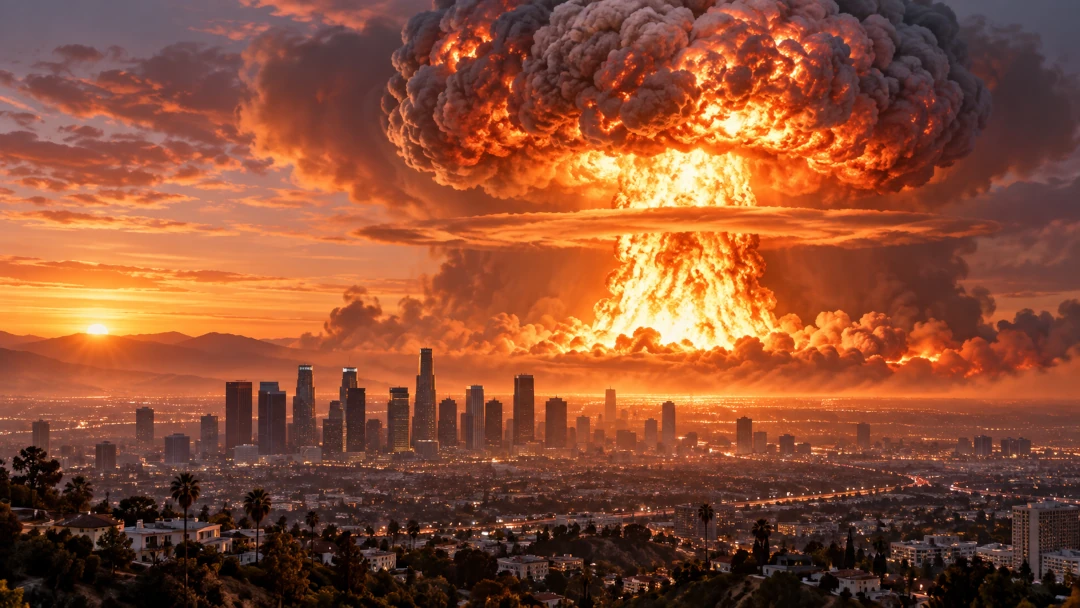
The phrase “take out a city” deserves to be translated out of rally-speak. If a nuclear weapon were detonated in Los Angeles or San Diego, the result would not be a news cycle; it would be the worst catastrophe in American history. The research on precisely this scenario already exists — some of it commissioned by the federal government about Southern California itself.
Port of Long Beach scenario
Immediate deaths from a single 10-kiloton device — a fraction of a modern warhead’s yield — with 150,000 more exposed to hazardous radiation, according to a RAND Corporation study reported by NBC News.
The national economy
The share of U.S. imports moving through the Los Angeles–Long Beach ports that RAND found could be destroyed, along with refineries supplying roughly a third of the gasoline west of the Rockies, per a summary by then-Rep. Ed Markey.
Burns with no beds
Radius of third-degree burns from a single 100-kiloton airburst over a major city, per ICAN’s modeling — in cities whose dedicated burn beds can number in the single digits.
No one coming to help
Hiroshima hospitals rendered non-functional in 1945, with 90% of doctors and nurses killed or injured, ICAN records. The Red Cross warns no humanitarian organization could respond effectively.
San Diego adds a dimension Trump seemed not to grasp. The region’s bases employ more than 136,000 active-duty members and civilians, including Naval Base San Diego, Camp Pendleton and Naval Amphibious Base Coronado. An attack there would not merely kill civilians; it would gut the nation’s Pacific fighting capacity in an instant. As The Daily Beast observed, no prior president appears ever to have described the bombing of an American city as an acceptable cost. There is a reason for that.
VI. The GOP: One Dissent, a Chorus of Silence
Against all of this, the Republican response has been notable mostly for its absence. The clearest GOP voice belonged not to a senator or party leader but to a candidate: San Diego County Supervisor Jim Desmond, a Navy veteran and Trump-endorsed House hopeful, who wrote that he “vehemently” disagreed and that “no American city is expendable, and no American family should ever be treated as collateral damage.” It was the right sentence. It should not have been rare.
The California Republican Party declined to comment. In coverage we reviewed through Tuesday afternoon, we found no public statement on the remark from Speaker Mike Johnson or Senate Majority Leader John Thune. Meanwhile, parts of the conservative media ecosystem moved to recast the backlash itself as the scandal, with RedState branding it a new media “hoax.”
This silence fits a pattern. When the Senate did briefly approve a war powers resolution on its tenth try, Republican senators reversed course the next day after Trump berated them at a closed-door lunch. On Sept. 24, all but four Senate Republicans voted to let him keep striking Iran. A party that will not use its votes to check an unauthorized war is unlikely to spend its words checking a president who jokes about its consequences.
Article I, the 25th Amendment, and a Congress That Won’t Use Either
The Constitution gives the power to declare war to Congress, not the president. Legal experts quoted in analyses of the conflict have argued that the “speculative pre-emptive” rationale for this war is unusually weak compared with past unauthorized uses of force. The 1973 War Powers Resolution requires withdrawal within 60 days absent authorization; the administration has claimed an April ceasefire satisfied that clock despite ongoing active fighting, per the American Society of International Law.
Section 4 of the 25th Amendment allows the vice president and a majority of the Cabinet — or “such other body as Congress may by law provide” — to declare a president unable to discharge his duties.
“We are at a dangerous precipice, and it is now a matter of national security for Congress to fulfill its responsibilities under the 25th Amendment.” — Rep. Jamie Raskin
Raskin’s bill to create that congressional body has 50 Democratic cosponsors and no Republican path to passage. As MS NOW noted, removal under the 25th Amendment is an even higher bar than impeachment and Senate conviction. But the question it poses is the right one: when a commander in chief speaks casually of American cities being destroyed while turning down offers to end the war, at what point does a pattern of statements become a question of fitness? Monday night belongs in that record.
VII. Priorities: A Peace Offer Rejected, a Rally Applauded
The most revealing context for Trump’s remark is what happened the week before it. Iran’s foreign minister, Abbas Araghchi, delivered a proposal through Qatari mediators to reopen the Strait of Hormuz and restart nuclear talks within seven days. Trump rejected it. “They want to make a deal, but it is not the deal that I want to make,” he told Axios, adding, when asked about resuming strikes, that he is “always thinking about it.” When Axios later reported he had floated sanctions relief, he called it a hoax and insisted he had offered Iran “NOTHING.”
Reasonable people can debate the terms of any settlement with Tehran. But the sequence matters: an offer to reopen the strait that is crushing American family budgets is turned away, and days later the president tells voters that the costs — up to and including hypothetical cities — are “small.” He has been promising the war is nearly over since its early weeks, as Times of San Diego noted; Monday he added that Iran might “keep going a little long” because they have “a big threshold for pain.” The pain being priced in, it bears repeating, includes 19 dead Americans and more than 750 wounded, per Rep. Meeks.
This is what leadership looks like when the measure of success is not the safety of the governed but the image of the governor: a war launched without Congress, extended against its votes, justified by a threat his own intelligence agencies questioned, and defended at a campaign rally with the names of American cities offered up as rhetorical props.
VIII. What You Can Do
The tools available to ordinary citizens are limited but real, and Nov. 3 is four weeks away. In plain terms: Congress can cut off or condition war funding and can create the 25th Amendment body Raskin has proposed, but only if enough members — especially Republicans — feel pressure from home.
- Call your senators and representativeUse the Capitol switchboard at (202) 224-3121. Ask one specific question: will they publicly condemn the president’s remark, and will they vote to end the unauthorized war in Iran? Then write down the answer.
- Target the Republicans who matterIf you live in a state or district represented by a Republican, your call carries the most weight. The Senate has repeatedly fallen one or two votes short; a handful of GOP senators are the margin between symbolism and law.
- Back the Raskin commission billAsk your House member whether they will cosponsor Rep. Jamie Raskin’s 25th Amendment commission legislation — and ask senators whether they would support a companion measure.
- Demand diplomacy on the recordUrge your members to press the administration, publicly and in hearings, to explain why it rejected Iran’s seven-day proposal and what terms it would accept to reopen the Strait of Hormuz and end the war.
- Vote — and move others to voteConfirm your registration and polling place today, then help three people do the same. Every war powers vote this year has been decided by a handful of seats.
No war powers resolution has ever survived a presidential veto, PolitiFact notes, and the 25th Amendment ultimately depends on the vice president and the Cabinet. None of these steps will end the war tomorrow. What they can do is make silence costly for lawmakers who have chosen it — and that is how majorities shift.
Editorial Conclusion
A president’s first duty is to protect the people he serves. Whatever Donald Trump meant to say in Grand Island, what he said was that American cities — millions of American lives — could be weighed against his war and found “small.” He said it while rejecting a path to peace, while American service members die in a conflict Congress never authorized, and to the sound of applause.
No American city is a bargaining chip. Congress must reclaim its constitutional power over war, Republicans must find the words that only one of their own could manage this week, and voters must make clear on Nov. 3 that a commander in chief who speaks of our cities as acceptable losses has forfeited the trust the office requires.
Sources & References
- NBC Los Angeles — ‘Let them take out Los Angeles’: President Trump defends ongoing war with Iran
- Mediaite — Rally-Goers Cheer as Trump Says ‘Let Them Take Out Los Angeles’ or ‘San Diego’
- Mediaite — CNN Fact Checker Daniel Dale on the ‘Let ‘Em Take Out’ Clip
- Axios — Trump under fire for saying Iran could “take out” LA, San Diego
- LAist — Trump’s ‘small price’ — White House clarification
- Times of San Diego — Trump offers up San Diego as ‘small price to pay,’ sparking bipartisan backlash
- KTLA — Newsom, Bass respond to Trump’s ‘take out Los Angeles’ comments
- MS NOW — LA mayor slams Trump’s comments suggesting Iran could ‘take out’ city
- FOX 5 San Diego — San Diego mayor demands apology after Trump remarks
- The Daily Beast — Trump Offers Up Two U.S. Cities in War Talk
- NBC News — California officials condemn Trump for saying Iran could ‘take out’ L.A. or San Diego
- Yahoo News — Trump sparks outrage for suggesting Iran could ‘take out’ US cities
- Forbes — Trump Draws Backlash For ‘Let Them Take Out Los Angeles’ Remarks
- FOX40 — ‘Deranged and dangerous’: Newsom slams Trump
- ABC7 Los Angeles — Trump suggests letting Iran ‘take out’ LA and San Diego at campaign event
- RedState — Conservative response framing the backlash as a ‘hoax’
- NPR — House passes war powers resolution directing Trump to end hostilities with Iran
- NPR — In symbolic vote, Congress directs Trump to remove forces from Iran war
- The Hill — House passes Iran war powers resolution (Sept. 15)
- Washington Post — How every senator voted on the Iran war powers resolution
- Al Jazeera — US House votes to end Iran war, 7 Republicans join
- PolitiFact — The war powers resolution on the Iran war: What’s next?
- ASIL — Congress Passes Resolution to End U.S. Involvement in Iran
- Axios — After nixing Iran proposal, Trump tells Axios he expects talks this week
- The Hill — Trump denies Axios report that he offered Iran sanctions relief
- Axios — Dems file long-shot 25th Amendment bill targeting Trump
- The Hill — Raskin introduces bill to assess president’s fitness under 25th Amendment
- MS NOW — Raskin offers bill setting up 25th Amendment process
- RAND Corporation — Considering the Effects of a Catastrophic Terrorist Attack (Port of Long Beach)
- NBC News — Study weighs impact of California nuclear blast
- Sen. Ed Markey — Summary of RAND findings on LA/Long Beach detonation
- ICAN — No Place to Hide: nuclear weapons and the collapse of health care systems
- ICAN — Hiroshima and Nagasaki bombings
- ICRC — Humanitarian impacts of nuclear weapons are beyond the capacity of any organization
- Wikipedia — Analysis of the 2026 Iran war
Related News