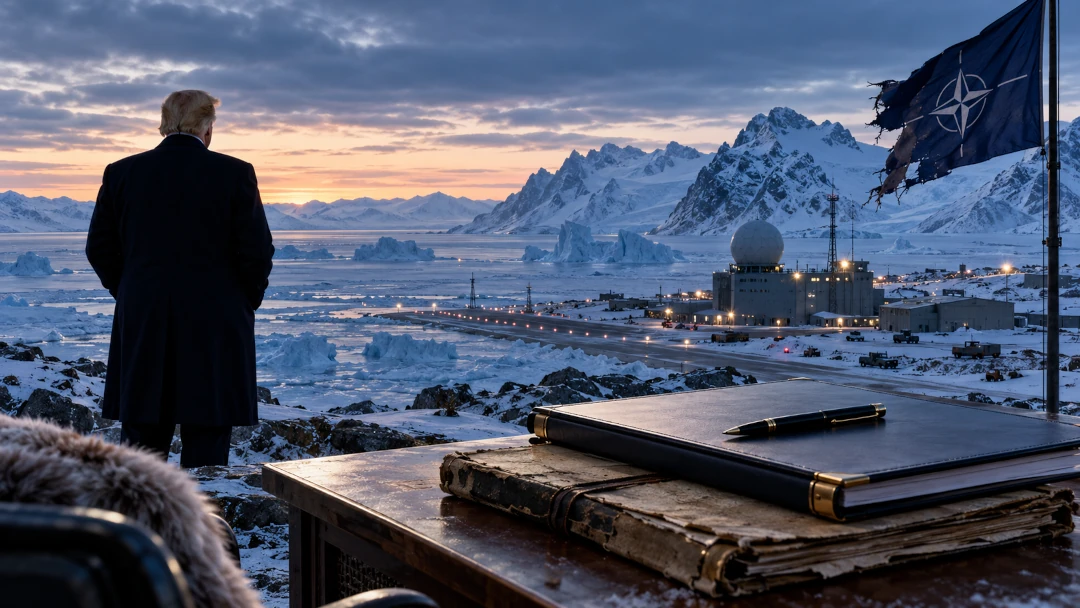
Trump’s Greenland “Victory” Is a Rebrand of a 75-Year-Old Agreement — Bought With the Ashes of the NATO Alliance
After threatening war with a Danish ally, alienating Europe, and driving his approval among the Danish to four percent, the president signed a deal that senators, scholars and Copenhagen itself describe as essentially restoring the status quo he shattered — while quietly setting the stage for a taxpayer-funded Arctic buildout he insists will cost nothing.
On Tuesday, September 22, 2026, on the sidelines of the United Nations General Assembly in New York, President Donald Trump held aloft a signed piece of paper and declared victory in a nine-month campaign of threats, insults and tariff blackmail against a founding NATO ally. The document, a trilateral agreement between the United States, the Kingdom of Denmark and the Government of Greenland, was framed by the president as delivering “permanent control over security, and all other needs” over the world’s largest island. Four days earlier, on Truth Social, he had already promised Americans that “there will be NO COST to the United States” and vowed to “immediately begin the process of developing a large Military presence in the appropriate part of Greenland, of which there are many.”
Read the Danish version of the same event and one begins to suspect a translation problem. Prime Minister Mette Frederiksen described a deal that “recognizes the sovereignty and territorial integrity of the Kingdom and the Greenlandic people’s right to self-determination.” Greenland’s Prime Minister Jens-Frederik Nielsen called it a “win-win-win.” The White House text, released hours after the signing ceremony, is explicit: the new agreement is a supplement to — not a replacement for — the 1951 Defense of Greenland Agreement that Presidents Truman and Eisenhower’s diplomats negotiated three-quarters of a century ago.
In other words, Donald Trump spent nine months threatening to invade a NATO ally, torched America’s standing in Europe, and appears to have secured, at long last, a defense agreement that Denmark had been ready to give him from the beginning. The verdict of the ranking Democrat on the Senate Foreign Relations Committee was cold and precise. This was not a triumph. It was a return.
I. A Deal As Big As the President’s Boasts
Reporters covering the signing found the actual text of the agreement rather thinner than the Truth Social advertisements. According to CNN’s analysis of the deal, the primary substantive additions are three: a prohibition on non-NATO countries basing forces in Greenland, permission for the Pentagon to open two additional defense sites at Narsarsuaq and Mestersvig, and a guarantee that U.S. access will survive should Greenland one day declare independence. That is essentially the entire scope of the “historic” agreement Trump has been demanding at the point of a rhetorical gun since January.
The Time magazine correspondent who spoke with Ole Wæver, one of the deans of Danish security studies, was told plainly that “the new deal is indeed very close to the 1951 treaty.” Under NATO’s founding compact, the United States is already legally obligated to defend Denmark and, by extension, Greenland. Wayne State University law professor Greg Fox pointed out to PolitiFact that the NATO treaty and the 1951 supplement together have blanketed the island in U.S. security guarantees for two generations. What Trump obtained this week was not “permanent control” — a phrase Denmark’s government explicitly disputes — but a modest expansion of an American footprint that already stretched across the ice cap.
“After months of threatening our NATO Ally Denmark and disregarding the will of the Greenlandic people, President Trump has reached a “deal” that essentially returns the U.S.-Greenland defense relationship to where it was before.”
— Sen. Jeanne Shaheen (D-N.H.), Ranking Member, Senate Foreign Relations Committee
Shaheen’s full statement is worth reading in its own right. She was not the only skeptic. Republican Rep. Don Bacon of Nebraska, an Air Force veteran and one of the few members of his caucus willing to speak plainly, told the Omaha World-Herald in January that the president’s whole Greenland performance amounted to “utter buffoonery.” Senate Minority Leader Mitch McConnell, no dove, called any actual seizure “an especially catastrophic act of strategic self-harm to America.”
II. What the 1951 Treaty Already Gave the United States
To appreciate how little Trump’s rebranding exercise added, it is necessary to understand what the United States has quietly enjoyed in Greenland since Harry Truman was in office. Signed at Copenhagen on April 27, 1951, and entered into force on June 8 of that year, the Defense of Greenland Agreement gave U.S. forces near-total operational latitude across the island — the right to build installations, house troops, operate with “near-total immunity” in designated defense areas, and control “landings, takeoffs, anchorages, moorings, movements, and operation of ships, aircraft, and waterborne craft,” as Al Jazeera’s review of the treaty text noted this month.
The 1951 pact remains, as Denmark’s own foreign ministry has repeatedly stressed, the legal foundation of the American military presence on the island. Its Article XIII allows amendments by mutual consent. The Trump administration’s new deal, by its own explicit language, is precisely such an amendment. What it does not do is unwind, replace or supersede the underlying framework Denmark and the United States negotiated when Trump was five years old.
Basing rights since 1951
The 1951 Defense of Greenland Agreement already permits U.S. bases, overflights, and operational control across designated “defense areas.” Established while Truman was president.
NATO Article 5 covers Greenland
As a Danish territory, Greenland is already covered by the North Atlantic Treaty’s mutual-defense clause. The U.S. is legally obligated to defend it.
Pituffik Space Base already operational
The northernmost U.S. installation has hosted the Space Force’s early-warning radar for decades. The Air Force already funds a 12-year, $3.95 billion contract to operate it.
Marginal additions, not a revolution
Two new defense areas at Narsarsuaq and Mestersvig, a bar on non-NATO military presence, and a continuity clause should Greenland gain independence. That is the sum, per expert analysis.
None of these additions required nine months of threatened invasion, a 25 percent tariff blackmail scheme against European allies, or a diplomatic rupture that pushed Danish favorability toward the United States down twenty points in a single quarter. Denmark’s former prime minister Helle Thorning-Schmidt reminded the record last spring that “there’s nothing stopping the Americans from getting more engaged militarily in Greenland, having more bases, if that’s what they want.” There was, and there wasn’t. All Trump had to do was ask.
III. The Oil Under the Ice
If the new agreement is largely a repackaging of an existing one, the obvious question is why any American president would risk a NATO rupture, a European trade war, and a collapse of transatlantic goodwill to pursue it. The stated answer — Russian and Chinese encroachment in the Arctic, and the “Golden Dome” missile defense scheme — is coherent enough on its face. It is also incomplete.
The subtext of the Trump obsession with Greenland is not secret. In early 2024, the president’s own former national security adviser Mike Waltz told Fox News that the administration’s focus on the island was “about critical minerals” and “natural resources.” According to the U.S. Geological Survey, Greenland sits atop the world’s eighth-largest deposits of rare earth minerals — the metals essential for battery technology, semiconductors and modern weapons systems — and, per a 2007 USGS estimate cited by Reuters Foundation reporting, the equivalent of 31.4 billion barrels of oil under northeast Greenland alone.
This is the Arctic paradox, and the president has embraced it with a fervor unmatched by any modern American leader. As climate change melts the polar ice at four times the global rate, Inside Climate News has explained, formerly inaccessible reserves of oil, gas, uranium and rare earths become suddenly reachable. Shipping lanes open. Drilling platforms become feasible. The very catastrophe the administration officially dismisses as a “hoax” is what makes Greenland a potentially lucrative prize.
“The Arctic paradox means that as climate change warms the planet, ice melts and more Arctic areas are open for exploration and drilling. That means more consumption, more global warming and more competition among the great powers.”
— Robert English, University of Southern California, on Trump’s Arctic strategy
The University of Southern California’s Robert English, a longtime Arctic scholar, put it bluntly in April 2025: “President Trump wants to add Greenland to America’s domestic sources of oil, gas and minerals.” The Greenland Ice Sheet has shrunk for twenty-eight consecutive years. In 2023 alone it lost roughly 80 gigatons of water. Every gigaton is an invitation to drill.
There is a bleak elegance to the theory circulating among climate historians and geopolitical analysts: that a president who ridicules climate science privately understands its economic consequences perfectly well, and has crafted a foreign policy around the assumption that the ice will melt whether Washington acknowledges it or not. If Greenland’s oil becomes reachable within a decade, whoever controls the security perimeter around that oil controls the terms on which it flows to market. That is the prize. Not a Nobel Peace Prize, whatever the president may have texted to the Norwegian prime minister. A resource frontier.
Get Involved Today
Contribute to our mission and turn your concerns into action.
IV. A Treaty By Any Other Name
Here the constitutional architecture becomes uncomfortable for the White House. Under Article II, Section 2 of the Constitution, the President “shall have Power, by and with the Advice and Consent of the Senate, to make Treaties, provided two-thirds of the Senators present concur.” Those twenty-four words have been the bedrock of American treaty-making since 1789. The Framers, having watched the Articles of Confederation collapse into interstate disorder, deliberately made the making of binding international obligations a shared responsibility.
The Trump administration has moved to sidestep that requirement entirely. Its lawyers characterize the new agreement not as a treaty, but as an executive amendment to the 1951 pact — itself, they argue, an executive agreement rather than a treaty requiring Senate ratification. The label matters. If the new deal is not a treaty, no two-thirds vote of the Senate is required. No hearings before the Foreign Relations Committee. No public debate. No reservations attached. The document Trump held over his head at the U.N. becomes, in this framing, the president’s personal handshake, exempt from the constitutional check the Framers built into the system.
This is not a technical dispute. It is a governance question of the first order. An “infinite life” agreement — the president’s own phrase — that binds the United States to Arctic military commitments for the rest of the century, and potentially requires billions in construction outlays, is precisely the kind of enduring obligation Article II envisioned as requiring Senate concurrence. When PolitiFact asked constitutional experts whether the deal qualified as a treaty, the answer was: unclear, and unlikely to be tested unless Congress asserts itself.
That the administration’s supporters have openly celebrated the bypass — cheering that senators such as John Cornyn and Thom Tillis have been “denied a chance to showboat” — should not comfort anyone who reads the Constitution seriously. The Founders did not invent the treaty clause to give senators theatrical opportunities. They invented it to ensure that the promises of one man could not become the shackles of a nation.
V. The Invoice Trump Doesn’t Want You to See
The president’s “no cost” claim has already collapsed under scrutiny. Reporting by the defense-industry press this week found no line item in the Department of War’s fiscal 2027 budget for the two new Greenland bases the deal authorizes. The existing Pituffik Space Base already consumes roughly $329 million a year under a twelve-year, $3.95 billion operations and maintenance contract awarded to a Greenlandic joint venture in 2022. Two new “defense areas” at Narsarsuaq and Mestersvig — remote, ice-bound, thousands of miles from any American supply chain — will cost, at a conservative estimate, hundreds of millions more per year in construction, logistics, personnel and life-support infrastructure.
Those costs land at a moment when the United States is drowning in the interest on its own debt. According to the Peter G. Peterson Foundation, net interest payments on the national debt crossed the one-trillion-dollar-per-year threshold in August 2026 for the first time in American history — a figure that, as multiple fiscal analyses now confirm, exceeds the entire annual national defense budget. The gross national debt hit $39.39 trillion in July, up $2.81 trillion in a single year. That works out to roughly $7.7 billion of new federal debt every day.
$1 trillion in interest, annually
Net interest on the national debt surpassed $1 trillion in August 2026 — a first in U.S. history.
Interest now eclipses the Pentagon
For the first time in the modern era, net interest payments exceed the national defense budget — about $1.05 trillion projected in FY2026.
$7.7 billion of new debt each day
The gross national debt rose to $39.39 trillion by July 2026, roughly $115,000 for every American, growing $7.7 billion per day.
Greenland: “no cost,” no price tag
The FY2027 defense budget lists no Greenland construction line item, despite Trump’s pledge to build two new bases.
Against that backdrop, the president’s insistence that the American taxpayer will pay nothing to garrison a semi-autonomous Danish territory the size of the sub-continent of India strains credulity beyond any reasonable measure. This is a country whose ranking Republican senator, Mitch McConnell, has publicly warned that its rising interest burden will crowd out every domestic priority for a generation. It is a country whose Federal Reserve Chair, Jerome Powell, has repeatedly urged Congress to have “a serious discussion” about deficits. Into that fiscal winter, the president has now inserted a fresh Arctic construction program that the Pentagon itself has not yet budgeted.
VI. The Path to Tuesday’s Signing
The road from January’s threats of military conquest to September’s ceremonial handshake was strewn with damage that will take years to repair. Consider what has occurred, in sequence, over nine months.
What the founders built for a moment like this
The 25th Amendment, ratified in 1967 in the shadow of the Kennedy assassination, provides two mechanisms for addressing a president unable to discharge his duties. Section 3 allows a president to voluntarily transfer power. Section 4 — the one that has been debated with growing urgency across 2026 — allows the vice president, together with a majority of the Cabinet, to declare the president incapable and elevate the vice president to acting president. Congress makes the final determination if the president contests his removal.
In April, House Judiciary Ranking Member Jamie Raskin introduced legislation to establish a Commission on Presidential Capacity — the legislative counterpart to the Cabinet that Section 4 explicitly contemplates. Rep. Jasmine Crockett (D-Tex.) wrote to Vice President Vance declaring it “indisputably apparent” that the president is “deranged, likely suffering from dementia.” Rep. Raja Krishnamoorthi, Rep. Eric Swalwell, Rep. Yassamin Ansari, Sen. Ed Markey, and Rep. Sydney Kamlager-Dove have all publicly called for Section 4 to be invoked.
The Greenland episode is a case study in why they are right to raise the question. A president who commits a NATO alliance to nine months of gratuitous crisis in pursuit of a deal his own diplomats could have negotiated in a week, who tells the Norwegian prime minister his territorial claims are tied to his personal grievance over a peace prize, who insists that a 4 percent favorability rating in the target country represents a diplomatic triumph — this is not merely bad policy. It is behavior that raises legitimate questions about the discharge of the presidential office.
The practical barriers are real. Section 4 requires the acquiescence of Vice President Vance and a majority of a Cabinet Trump himself hand-picked. Neither has shown any inclination to act. A Republican-controlled Congress will not pass Raskin’s Commission bill, and even if it did, Trump would not sign it. The Amendment was designed to address medical incapacity — a stroke, a coma — not an elected president whose judgment his party’s leadership continues, whatever their private misgivings, to defend.
But those barriers do not negate the constitutional case. The 25th Amendment exists because the Framers, and the generation that added it, understood that the presidency confers powers so vast that a chief executive’s fitness to wield them cannot be left to the calendar of the next election. The Greenland saga — the tariff extortion, the invasion threats, the cognitive lapses, the fixation on a Nobel Prize denied him — is a public record. That record is the answer to those who ask what would justify the mechanism’s invocation. The answer, whether or not the political system is presently capable of hearing it, is: this.
VII. Congress in the Fog
Where, in all of this, is the legislative branch? The answer, largely, is: watching. The Republican majority in both chambers has, with the exceptions of Sens. Lisa Murkowski of Alaska and Thom Tillis of North Carolina, declined to publicly challenge the president on Greenland. Sen. John Kennedy of Louisiana, asked by MS NOW whether he’d support a war powers vote on any Greenland incursion, allowed only that he’d “have to look at the resolution and the circumstances.” Sen. Cynthia Lummis of Wyoming told the same outlet she didn’t know “that there is a page” among Republicans on Greenland at all.
Democrats, in the minority and with the midterms weeks away, have concentrated their fire on process: the treaty question, the war powers question, the constitutional question. Sen. Shaheen’s statement was a template. Sen. Mark Kelly of Arizona has warned that Republicans will not check the president’s authority even when they privately disapprove. Sen. Tim Kaine of Virginia, the party’s most consistent voice on executive war-making, has drawn the connection to the broader pattern of unauthorized military action in Venezuela and Iran.
The failure to push a formal treaty vote on the Greenland deal is, in this analysis, the most consequential Congressional decision no one is talking about. If the Senate were to demand its Article II role — to insist that a permanent, “infinite-life” military commitment to a foreign territory is precisely the sort of pact the Framers required two-thirds ratification for — it would force a public reckoning. It would also, in the fiscal environment described above, force a public accounting of what the two new bases will actually cost. Silence on both fronts is a choice.
A president spending taxpayer money the country cannot afford, on an obsession his own allies find puzzling, in pursuit of an outcome most experts say the 1951 treaty already secured, without submitting the resulting commitment to the constitutional check the Framers designed for exactly this circumstance — this is not a small story. It is the story of a democracy that is being tested and, in this instance, is failing the test.
Editorial Conclusion
Donald Trump did not deliver Greenland. He delivered a rebranding. What he actually delivered, at ruinous cost to America’s alliances, its European standing and the constitutional order at home, was a lesson: that a president who threatens war with a NATO ally for nine months in pursuit of a deal Denmark had already offered him will be met with congressional silence, party-line rationalization, and a signing ceremony.
The republic cannot afford to normalize this pattern. Every executive commitment that binds the nation for the rest of the century belongs before the Senate under Article II, whatever the White House chooses to call the piece of paper. Every dollar spent constructing bases in the Arctic ice belongs on the ledger, alongside the trillion dollars in annual debt interest that is quietly hollowing out every other national priority. And every episode of erratic, grievance-driven foreign policy — from the Nobel Prize text to the “infinite” deal — belongs in the public record from which Congress and the Cabinet must one day answer the question the 25th Amendment was written to force them to answer.
What is at stake is not one Arctic island. It is whether the machinery of American self-government still works when a president decides it should not.
Sources & References
- The White HouseFull text of the U.S.–Denmark–Greenland trilateral security agreement, September 2026
- CBS NewsTrump signs Greenland deal giving U.S. broad military authority on the island
- CNN PoliticsWhat Trump’s Greenland deal could realistically change
- TIMEUnderstanding Trump’s Deal With Denmark — and what it means for Greenland’s sovereignty
- Al JazeeraTrump says U.S. has ‘permanent control’ of Greenland security: Does it?
- PolitiFactGreenland deal: What Trump said about ‘permanent control’ and what’s next
- History.comThe 1951 Agreement Allowing U.S. Military in Greenland
- Yale Avalon ProjectFull text: Defense of Greenland Agreement between the United States and Denmark, April 27, 1951
- Sen. Jeanne Shaheen (D-N.H.)Ranking Member Statement on the Greenland-Denmark Agreement
- U.S. SenateAbout Treaties — Article II, Section 2 of the Constitution
- Constitution AnnotatedArticle II, Section 2, Clause 2: The Treaty Clause
- Peter G. Peterson FoundationInterest Costs on the National Debt — Monthly Tracker
- USA Gov PolicyWhen the Interest Bill Eclipses the Pentagon Budget
- Yahoo/Defense OneTrump’s ‘no cost’ Greenland deal has no price tag, records show
- Inside Climate NewsAs Trump Eyes Greenland, What Could That Mean for the Island’s Mineral Wealth?
- Context / Reuters FoundationGreenland, Trump and the race for critical resources
- USC DornsifeExpert on Arctic politics explains Greenland’s strategic appeal
- YouGovHow popular is Donald Trump in Europe? January 2026 tracker (Danish favorability: 4%)
- House Judiciary DemocratsRanking Member Raskin demands cognitive evaluation, calls for 25th Amendment consideration
- Rep. Jasmine Crockett (D-Tex.)Crockett letter to VP Vance urging invocation of Section 4
- MS NOWDemocrats’ strategy on Trump’s Greenland threats: Put Republicans in the hot seat
Related News