Rotten from the Top: How a $1 Million Check, a Killed Safety Rule, and 9,000 Sick Americans Expose a Presidency for Sale
A record-shattering cyclospora outbreak has killed two, hospitalized nearly 400, and sickened thousands. The lettuce supplier at the center of it wrote a seven-figure check to Donald Trump’s super PAC six days after his administration gutted the very rule designed to stop it. This is what state capture looks like at the dinner table.
Nine thousand four hundred and eighty-one Americans, and counting. That is the confirmed case count in what the U.S. Centers for Disease Control and Prevention now calls the largest cyclosporiasis outbreak on record — a foodborne siege stretching across seventeen states, with 398 people hospitalized and two dead in Michigan. According to the CDC’s August 13 update, the source is contaminated iceberg lettuce processed by Taylor Farms de Mexico at a facility in Guanajuato that, as CBS News first reported, has not been inspected by the U.S. Food and Drug Administration since 2019 — seven years of unwatched production, ending in a national parasitic outbreak.
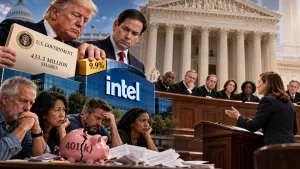
That is the surface of the story. The deeper story is uglier. It is the story of how the company at the center of America’s worst-ever cyclospora outbreak wrote a $1 million check to a super PAC supporting Donald Trump exactly six days after the president’s Food and Drug Administration delayed a signature food-safety rule that would have made this very outbreak easier to trace, contain, and end. It is the story of a federal food-safety apparatus so aggressively gutted by the Department of Government Efficiency that former FDA officials describe it as “beyond short-sighted” — of an agency that used to have eleven scientists tracking food parasites and now has three, according to the former director of FDA’s food safety center. And it is the story of a president whose relationship to the machinery of public protection has become a naked transaction: pay, and the guardrails come down.
This is not a partisan interpretation. It is a chronology, and the chronology is on the public record.
I. The Outbreak and the Supplier
Taylor Farms is not a folksy family produce stand, despite what its name suggests. It is a $7 billion agribusiness that, according to CBS News, produces roughly 40 percent of the salad kits sold in the United States and owns the organic label Earthbound Farms. When federal investigators traced the current outbreak’s iceberg lettuce back to a single supplier, that supplier was Taylor Farms de Mexico. The company issued a voluntary recall on July 17, 2026 — but as the CDC has noted, most of the illnesses linked to the outbreak began before the recall was issued. The parasite had already moved through the food chain and into the bodies of thousands of Americans.
Jennifer McEntire, founder of the food-safety consulting firm Food Safety Strategy, told CBS News that “nothing about this outbreak is typical.” The scale — CDC surveillance data puts the increase over prior years at an order of magnitude — is unprecedented for a parasite whose annual U.S. case count normally sits between 200 and 1,000. This year, contaminated Taylor Farms iceberg reached at least 31 states through Taco Bell restaurants and Marketside-brand retail at Walmart. Two people are dead. Both were in Michigan. Both fell ill before the company pulled its product.
II. The Six-Day Sequence
Here is the timeline, exactly as it exists in Federal Register filings, Federal Election Commission records, and congressional correspondence.
In fiscal Q1 of 2025, according to OpenSecrets data compiled by Snopes, Taylor Foods paid the elite law firm Sidley Austin $380,000 to lobby Congress and the Department of Agriculture. The company had no prior lobbying record. According to a demand letter from Sen. Richard Blumenthal — more on which shortly — Taylor Farms has spent a total of $810,000 on lobbying regarding “regulation of food safety” since the beginning of the current administration.
Bruce Taylor, the company’s founder and CEO, told Forbes in an interview published July 24 that his company “wholeheartedly” supports the Food Traceability Rule and that the $1 million contribution to MAGA Inc. was unrelated to the rule delay. He said the check “earned me a seat at a dinner to discuss the ramifications of the tariff” Trump had announced on Mexican produce imports. He did not specify who else was at that dinner.
“Taylor Farms donated millions to President Trump, met privately with the White House the night the FDA identified their lettuce as the source of this outbreak, and then reportedly tried to distance themselves from this outbreak. Thousands of Americans became sick. Trust in our public health system is on the line.”
— Rep. Robert Garcia (D-CA), Ranking Member, House Oversight Committee, July 27, 2026
III. Why Traceability Is the Rule That Saves Lives
To understand what was killed, it is necessary to understand what it was. The FDA’s Food Traceability Final Rule — known formally as Section 204 of the Food Safety Modernization Act, or FSMA 204 — was finalized in 2022 after more than a decade of bipartisan legislative work. President Obama signed the underlying FSMA statute into law in 2011 after it passed both chambers of a divided Congress. It is not, in any meaningful sense, a partisan document.
What the rule requires is straightforward. Every company that manufactures, processes, packs, or holds food on the FDA’s high-risk Food Traceability List — a list that includes leafy greens, shell eggs, soft cheeses, seafood, and ready-to-eat deli salads — must maintain digital records of standardized “Key Data Elements” at each “Critical Tracking Event” along the supply chain. When a request comes in from federal investigators, the company has 24 hours to hand those records over in a sortable, machine-readable format. According to the FDA’s own summary, the goal is nothing more or less than what its name suggests: to enable the agency to trace contaminated food to its source in hours rather than weeks.
Weeks matter. The current cyclospora outbreak is a textbook case. Contaminated lettuce moved through Taco Bell’s supply chain and onto shelves at Walmart while investigators struggled to isolate the source. Under a fully implemented traceability rule, that supply chain would have been searchable in a single afternoon. Instead, more than 9,000 Americans got sick.
Seven checkpoints, one search
FSMA 204 tags food at each of seven critical tracking events in the supply chain — creation, transformation, shipping, receiving, and so on — so the FDA can query the whole chain in a single 24-hour window.
The “we don’t know where it came from” outbreak
The FDA has said end-to-end traceability enables “faster identification and removal of potentially contaminated food from the market, resulting in fewer foodborne illnesses” — the agency’s own words.
A “narrow” industry cluster
Per the Safe Food Coalition, opposition to the rule is “narrow” — led largely by the food-retailer trade group FMI. The International Fresh Produce Association has publicly called for “stronger federal food safety infrastructure and end-to-end traceability.”
Consumer advocates, public health, food scientists
Consumer Reports, joined by the Safe Food Coalition, has urged Congress to reject industry efforts to weaken or delay the rule, warning that delay leaves consumers “at risk when unsafe food enters the marketplace.”
IV. Why a Company Like Taylor Farms Would Want the Rule Buried
Taylor Farms insists it “wholeheartedly” supports the traceability rule and, indeed, already complies with much of it. That may be true. But motive in questions of regulatory capture is not established by declarations of virtue; it is established by structural incentive. And the structural incentives for a company of Taylor Farms’ size and shape to prefer a weaker traceability regime are enormous.
Consider what the rule would put on the public record. It would require standardized digital tracking that exposes, in machine-readable form, every point at which contaminated product moved through a company’s supply chain. That means: faster identification of the offending facility, faster and more sweeping recalls, faster legal liability, faster reputational damage, and faster class-action exposure. It means the difference between a quiet, contained recall and a full-color newspaper graphic showing exactly which of your Mexican facilities processed the lettuce that killed a grandmother in Michigan.
It also means implementation cost. Full compliance with FSMA 204 requires integrated digital systems that talk to trading partners on both sides of the border. For a mid-sized producer, that is a meaningful capital expenditure. For a $7 billion multinational, it is a rounding error — but it is also a competitive moat once implemented, which is one reason larger companies frequently prefer to slow implementation while their smaller competitors are the ones bearing early compliance costs.
And it means transparency about cross-border supply chains that companies like Taylor Farms have every commercial reason to keep opaque. When contamination hits a facility in central Mexico owned by a U.S. brand, the delay between contamination and identification is where corporate value is either preserved or destroyed. The traceability rule shrinks that delay. A company preferring the delay to remain long has an obvious financial incentive to prefer it — whatever it says on the record.
Get Involved Today
Contribute to our mission and turn your concerns into action.
V. A Pattern of Poison: The Deregulation Body Count
The cyclospora outbreak is not an isolated failure. It is the latest and largest entry in a body count that has grown steadily as the Trump administration has methodically dismantled the federal food-safety apparatus. A partial ledger of the past two years reads like a bill of indictment.
VI. The Gutted Watchdog
Behind every one of those outbreaks is a story about capacity — and capacity, at the federal food-safety agencies, has been the explicit target of the second Trump administration since day one.
Per data from the Office of Personnel Management compiled by FoodNavigator, the FDA lost 3,859 employees in 2025 alone under DOGE-driven reductions in force — nearly one in five staffers. The CDC has been cut by roughly a quarter. The USDA’s Food Safety and Inspection Service has lost 913 full-time positions. The USDA’s Animal and Plant Health Inspection Service has lost approximately 20 percent of its workforce, per the National Sustainable Agriculture Coalition.
In February 2025, FDA Deputy Commissioner for Human Foods Jim Jones resigned in protest, writing in his resignation letter that the “indiscriminate firing of 89 staff in the Human Foods Program is beyond short-sighted” and warned it had eliminated staff with expertise in “nutrition, infant formula, food safety response and even 10 chemical safety staff hired to review potentially unsafe ingredients in our food supply.”
Susan Mayne, the former director of the FDA’s food safety center, put the operational impact plainly in her August 2026 interview with CBS News: the CDC used to have eleven scientists tracking food parasites. It now has three. A joint FDA-USDA-CDC national advisory committee on microbial contamination in food was disbanded. The entire team that had convened with Mexican counterparts on cross-border food safety was let go. FoodNet — the joint foodborne-disease surveillance network — has been reduced.
“The indiscriminate firing of 89 staff in the Human Foods Program is beyond short-sighted.”
— Jim Jones, resigning FDA Deputy Commissioner for Human Foods, February 2025
This is not an accident of overzealous efficiency. It is the stated goal. The Trump-Kennedy HHS restructuring — branded “Transformation to Make America Healthy Again” — explicitly targeted 10,000 department-wide positions for elimination. The FDA has since announced it will revoke 52 food product standards of identity as part of what it openly calls “Trump Administration’s deregulatory initiative.” USDA has withdrawn a proposed rule that would have set — for the first time in American history — enforceable limits on certain Salmonella strains in raw poultry, according to Food Safety News. The Department of Justice’s Consumer Protection Branch — the unit that historically prosecuted food and drug safety cases on behalf of the FDA — has been disbanded.
In 2024, the FDA had 443 food safety inspectors responsible for every food processing facility in its jurisdiction. The agency itself estimates it would need 1,500 to do the job adequately, according to April 2025 correspondence from House Oversight Democrats. The Trump administration’s response has been to cut more.
VII. What This Forecasts for the American Table
The forecast is not complicated. The country is going to get sicker.
With the traceability rule frozen until at least 2028, outbreaks will continue to take weeks longer than necessary to trace. With FDA inspection staff at roughly one-third of the level the agency itself considers adequate, foreign and domestic processing facilities — the Taylor Farms Guanajuato plant is the paradigm case, unvisited by the FDA since 2019 — will continue to escape federal eyes for years at a stretch. With CDC parasite-surveillance staff reduced from eleven scientists to three, outbreaks like this summer’s cyclospora crisis will be identified later, tracked less thoroughly, and communicated to the public with fewer voices. With the USDA’s proposed Salmonella limits on poultry withdrawn and its longstanding food-safety advisory committees disbanded, the informal expert infrastructure that has kept the modern American food supply among the world’s safest is being systematically dismantled.
Former FDA Commissioner Scott Gottlieb, a Trump appointee in his first term, warned on CBS’s Face the Nation on July 26 that the loss of institutional memory now under way at the FDA will take years to reverse even if it ends tomorrow. It is not ending tomorrow. The Continuing Appropriations Act codified the traceability delay through 2028. The FDA’s “Simple Reform” reorganization, which as NOTUS reported takes effect October 1, 2026, will de-specialize the agency’s field inspectors — the exact staffers whose expertise on leafy greens, seafood, and infant formula has kept those categories from generating body counts an order of magnitude larger than the ones we are already seeing.
In practical terms, this means: more outbreaks. Bigger ones. Longer ones. More cross-border produce chains operating outside meaningful federal oversight. More hospitalizations. More deaths — particularly of the very young, the elderly, the pregnant, and the immunocompromised, for whom listeria, E. coli, and cyclospora are not stomach complaints but existential threats. And it means that when the next Boar’s Head, the next McDonald’s Quarter Pounder, the next Taylor Farms lettuce reaches store shelves, the machinery that is supposed to catch it will be smaller, slower, and less experienced than it was a year before.
That is not a policy trade-off. That is a policy choice. The Trump administration has been repeatedly, publicly warned by consumer groups, industry stakeholders, former commissioners, current inspectors, congressional oversight, and its own resigning officials that the choices being made will translate directly into American deaths. It has made them anyway.
VIII. What This Says About Leadership
A presidency can be judged on many dimensions, but there is one that admits of very little partisan disagreement: does the officeholder use the power of the executive branch to protect the physical safety of the American people, or does he use it to reward those who pay him?
The record here is not ambiguous. A company writes a $1 million check to the president’s super PAC six days after his administration delivers the regulatory delay the company’s lobbyists have been paying elite Washington counsel to secure. The company then meets privately at the White House on the very night the FDA identifies its lettuce as the source of a national outbreak — a detail that, according to Rep. Garcia’s demand letter, is the subject of documented reporting the House Oversight Committee is now investigating. Meanwhile the agency responsible for protecting the American public from precisely this scenario has been cut nearly a quarter, its most senior food-safety official has resigned in protest, and the specific rule that would have shortened the outbreak from weeks to hours has been frozen until 2028.
This is what corruption looks like when it is systematized. It does not require an envelope of cash. It requires only a coincidence of interest: a president whose reelection machine runs on donations from those who benefit from deregulation, and a regulatory apparatus he controls that can be induced to look the other way. The transaction is legal. The consequences are lethal.
The 25th Amendment and the Duty to Protect
Section 4 of the Twenty-fifth Amendment, ratified in 1967 after President Kennedy’s assassination, permits the Vice President and a majority of Cabinet officers — or of “such other body as Congress may by law provide” — to transmit to Congress a written declaration that the President “is unable to discharge the powers and duties of his office,” at which point the Vice President assumes them. It is the Constitution’s answer to a presidency that has become dangerous to the country it governs, whether by physical infirmity, mental decline, or the more difficult case of a president whose judgment has become so compromised by self-interest that he cannot faithfully execute the office.
On April 14, 2026, Rep. Jamie Raskin (D-MD), Ranking Member of the House Judiciary Committee, introduced legislation with 50 Democratic co-sponsors establishing a bipartisan independent commission — the “such other body” the Amendment expressly contemplates — to assess President Trump’s fitness. Sen. Ed Markey (D-MA), Rep. Eric Swalwell (D-CA), Rep. Sydney Kamlager-Dove (D-CA), and Rep. Yassamin Ansari (D-AZ) have all publicly called for the Amendment to be invoked. On May 5, 2026, a group of more than thirty neurologists, psychiatrists, and physicians filed a statement into the Congressional Record declaring the President “mentally unfit” and urging removal “with the greatest urgency.”
The Argument the Cyclospora Outbreak Sharpens
Section 4 is not, and has never been, limited to comas and strokes. It speaks to the President’s ability to “discharge the powers and duties” of the office. Those duties include the faithful execution of laws Congress has passed to protect the physical safety of the American public — the Pure Food and Drug Act, the Federal Meat Inspection Act, the Food Safety Modernization Act. A president who systematically dismantles the enforcement infrastructure of those laws, and who does so in temporal proximity to seven-figure political contributions from beneficiaries of the dismantlement, is not “discharging” those duties. He is subverting them.
The Practical Barriers
The barriers to invocation are real and should be named plainly. Section 4 requires the assent of the Vice President and a majority of Cabinet officers — every one of whom serves at the President’s pleasure and has been selected specifically for loyalty. It requires, if the President contests the finding, a two-thirds vote of both chambers of Congress. In a Congress where the president’s party controls both houses and where fear of primary challenges disciplines dissent, this is not a mechanism likely to be exercised in the immediate term.
Why the Barriers Do Not Negate the Case
The framers of the Twenty-fifth Amendment did not include Section 4 because they expected it to be easy. They included it because they knew a democratic republic must possess the constitutional machinery to remove a president whose continuation in office endangers the public — even if the political conditions for that removal have not yet ripened. The cyclospora outbreak, and the pattern of corruption and abdication of duty it exemplifies, is precisely the sort of ripening event the Amendment was written to address. It is Congress’s constitutional obligation to name that fact plainly, to hold the hearings, to establish the commission Rep. Raskin has proposed, and to build the public record that will be required when the political conditions change. That work does not wait for a majority. It begins now.
IX. Congress Is Now Investigating
The oversight machinery, at least, is moving. On July 27, 2026, Rep. Robert Garcia (D-CA), ranking member of the House Committee on Oversight and Government Reform, sent a formal demand letter to Bruce Taylor requesting all Taylor Farms communications with federal agencies since the outbreak began, all communications with the White House since January 21, 2025, and all documentation of the company’s food-safety protocols. Days later, on July 30, Sen. Richard Blumenthal (D-CT), ranking member of the Senate Permanent Subcommittee on Investigations, sent his own letters to both Taylor Farms and FDA Acting Commissioner Kyle Diamantas. Blumenthal’s request specifically names Signal and WhatsApp — the encrypted communication channels his subcommittee has previously found used to conceal executive-branch coordination with private interests.
As of this writing, according to longtime food-safety attorney Bill Marler’s public tally, eleven letters have been sent from Congress in seventeen days regarding the cyclospora outbreak. None have been answered. Four deadlines have passed. The FBI is separately reviewing whether Taylor Farms lobbied the White House to delay the recall itself.
Editorial Conclusion
The cyclospora outbreak did not happen because iceberg lettuce is inherently dangerous. It happened because a president auctioned off the federal food-safety apparatus to the highest bidder and the highest bidder, in this instance, was a $7 billion produce company whose Mexican processing facility had not been federally inspected in seven years. Two Americans are dead. Nearly four hundred have been hospitalized. Nearly ten thousand have been sickened. The rule that would have shortened the outbreak from weeks to hours has been frozen until 2028 — six days after which delay, the company at the center of it wrote a million-dollar check.
This is not a policy disagreement. It is a constitutional emergency dressed as a produce recall. Congress must rescind Section 780 of the Continuing Appropriations Act and restore the Food Traceability Rule. It must restore the FDA and CDC staffing the administration has stripped away. And it must move — through hearings, through the Raskin commission, through the machinery the Twenty-fifth Amendment gives it — to establish on the public record that a presidency conducted as an ongoing transaction between the officeholder and those who pay him is not a presidency the Constitution permits. The stakes are not partisan. They are literally what Americans eat.
Sources & References
- CDC — Investigation Update: Cyclospora Outbreak, July 2026 (August 13, 2026)
- CDC — Surveillance of Cyclosporiasis (August 11, 2026)
- CBS News — How Trump admin cuts have compromised food safety (July 2026)
- CBS News — What to know about Taylor Farms, the produce giant tied to the cyclospora outbreak
- Politifact — What we know on Taylor Farms donations to pro-Trump groups (August 13, 2026)
- Snopes — Did Taylor Farms or its CEO donate to Trump? We followed the money
- Snopes — Making sense of claims about Taylor Farms, CEO’s Trump donations and meetings
- Forbes — Taylor Farms Founder Speaks Out for First Time Amid FDA Investigation (July 24, 2026)
- Federal Register — Food Traceability Rule Compliance Date Extension (August 7, 2025)
- FDA — FSMA Final Rule on Traceability Records for Certain Foods
- Congressional Research Service — The FDA’s Food Traceability Rule: Overview and Issues for Congress
- House Oversight Democrats — Ranking Member Garcia Demands Answers from Taylor Farms (July 27, 2026)
- Sen. Blumenthal / HSGAC — Letter to Taylor Farms CEO Bruce Taylor (July 30, 2026)
- House Oversight Democrats — Oversight Democrats Urge HHS Secretary RFK Jr. to Halt FDA Purge (April 8, 2025)
- FoodNavigator — FDA and USDA staff cuts under Trump raise food safety risks (Feb. 16, 2026)
- Food Safety News — Trump, aided by RFK Jr., is dismantling the U.S. food safety network (Sept. 2025)
- Food Safety News — Coalition wants Congress to rescind delay of food traceability rule (August 2026)
- Food Safety Magazine — A 2025 Timeline of U.S. Federal Food Safety Changes Under the Trump Admin
- CDC — Listeria Outbreak Linked to Boar’s Head Deli Meats (2024)
- FDA — Outbreak Investigation of E. coli O157:H7 — Onions (McDonald’s, 2024)
- Consumer Reports — CR Urges Congress to Oppose Bills Undermining FDA Response
- NOTUS — The FDA Is Officially Codifying DOGE-Era Changes (July 28, 2026)
- Mediaite — House Democrats File Bill to Form 25th Amendment Commission (April 14, 2026)
- The Hill — Concerns Grow Over Trump’s Mental Fitness for Presidency (June 2026)
Related News