The Smoke, the President, and the Meaning of Willful Negligence
Donald Trump blames Canada for the poisoned air choking the American Midwest and Northeast. The record — Paris, the endangerment finding, the One Big Beautiful Bill, the gutting of FEMA and the Forest Service — names a different culprit.
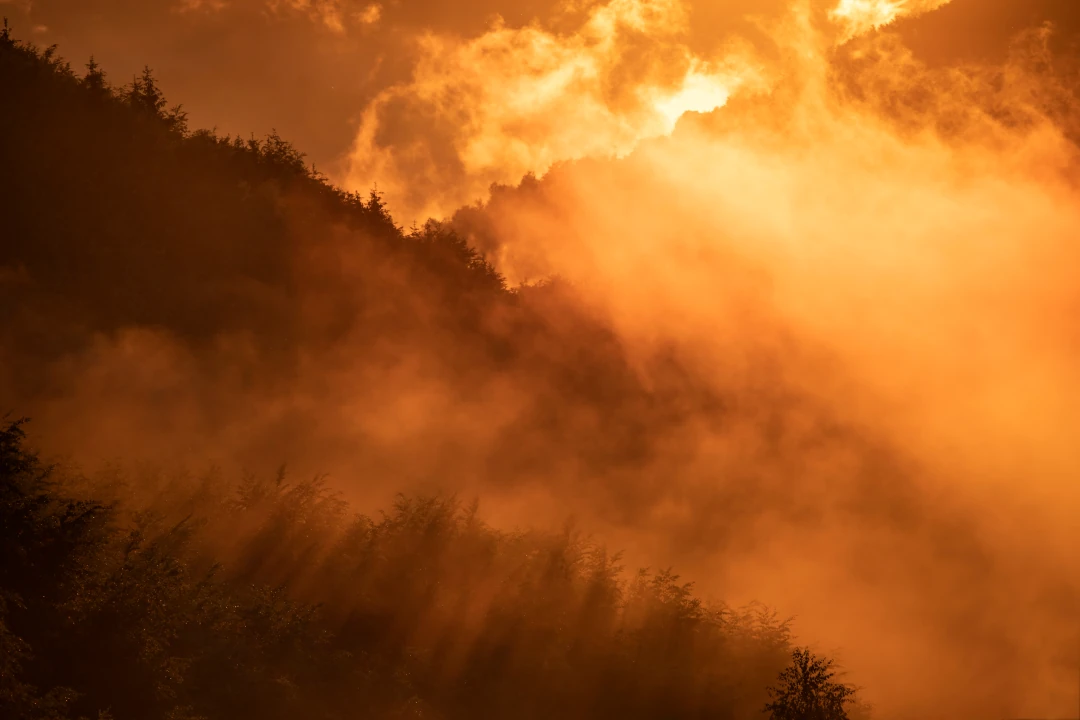
On Thursday, July 16, the New York City skyline vanished behind an orange haze that turned the Brooklyn Bridge into a silhouette and pushed the Air Quality Index into the “hazardous” band across a stretch of the country that included Chicago, Detroit, Milwaukee, Toledo, and Washington, D.C. By Friday, according to CNN’s reporting, more than 120 million Americans were breathing air the federal government classifies as dangerous. By Saturday, per NBC News, that number was above 100 million and climbing.
The President of the United States responded on Truth Social. He did not address the underlying planetary system that has turned the boreal forest into a tinderbox. He did not visit an affected city, or convene the Cabinet on public health. Instead, according to The Globe and Mail and NBC News, he accused the government of Prime Minister Mark Carney of “Willful Negligence” and threatened to add the “incalculable” cost of the smoke to the tariffs already in force on Canadian goods.
The phrase is worth holding onto. Willful negligence — a deliberate refusal to act on a known danger. In what follows, we will demonstrate that no one in North America has better earned that description this week than the man who typed it.
“We are holding Canada responsible for the fact that they are not properly maintaining their Forests, and Brush therein, and the United States is being unnecessarily invaded by filthy, polluted, and unhealthy air… This is Willful Negligence.”
— Donald J. Trump, Truth Social, July 17, 2026
I. An Invasion He Didn’t Cause, But Welcomed
Canadian wildfires are not new. Neither is smoke drifting south. What is new — and what climate scientists have said in print for a decade — is the tempo. Climate Central reports that human-caused warming now adds hundreds of smoke-related deaths a year in the affected states, and that the majority of the wildfire particulate Americans breathe locally arrives from fires burning in other states or other countries. A 2025 Nature study projects roughly 71,000 excess U.S. deaths per year from wildfire smoke by 2050 under a high-warming scenario — a 73 percent increase over the current baseline. A Science Advances analysis puts the current annual U.S. mortality burden from wildfire smoke PM2.5 at roughly 24,000 deaths per year and finds that this pollution is approximately five times more toxic than ordinary particulate.
The president is not personally responsible for the ignition of a fire in Ontario. He is, however, the head of state of the country that has emitted more cumulative greenhouse gas than any other in history — and, more directly, he is the sitting American executive who has spent the past eighteen months systematically dismantling every federal instrument built to reduce that emission, prepare for its consequences, and protect the public from the smoke, floods, heat, and fires the science predicted.
That is the record. It is documentable, and it is documented.
II. The Demolition: Eighteen Months of Deliberate Unmaking
Begin at the beginning. On January 20, 2025 — his first day back in office — President Trump signed Executive Order 14162, ordering the United States to withdraw from the Paris Agreement for the second time in a decade. The withdrawal took formal effect on January 27, 2026, making the United States the only nation to have quit the accord twice, and the largest historical emitter to stand outside the global framework built to constrain the very warming that is drying Canada’s forests into fuel.
Six months later, on July 4, 2025, the president signed the One Big Beautiful Bill Act, which — as tax counsel across the industry documented — collapsed the runway for the Inflation Reduction Act’s clean-energy credits from nine years to one, killing the 30 percent residential solar credit at the end of 2025 and setting a July 4, 2026 wall for utility-scale wind and solar. Three days later, an executive order instructed Treasury to “strictly enforce” the termination and tighten the definition of “beginning of construction” beyond what the statute required. PBS NewsHour reported that average household electricity costs are projected to rise by more than $100 per year as a direct consequence.
Then came the endangerment finding. On July 29, 2025, EPA Administrator Lee Zeldin — appearing on the conservative Ruthless podcast — described the coming action as “driving a dagger straight into the heart of the climate change religion.” The 2009 finding, born of Massachusetts v. EPA, is the entire legal scaffolding by which the federal government regulates greenhouse gases under the Clean Air Act. Its formal repeal, finalized in February 2026, was — in the words of the Natural Resources Defense Council’s Manish Bapna — “the single biggest attack in U.S. history on federal authority to tackle the climate crisis.” The Sierra Club called it “a major blow” to global climate action. In April, at a Heartland Institute gathering of climate skeptics, Zeldin called the day “a day to celebrate vindication.”
“Arguing that greenhouse gas emissions don’t put us in danger by causing climate change is like saying that a lit match can’t put us in danger by burning down the house.”
— Sen. Edward J. Markey (D-Mass.), July 29, 2025
Nor did the demolition stop at emissions law. As The Hill reported, roughly a third of FEMA’s 6,100-person workforce has left or been removed since January 2025; the agency’s former acting head was fired one day after telling Congress that eliminating FEMA “wouldn’t be in the best interest of the American people.” The Center for American Progress documents that a March 2026 analysis found it three times harder for blue states to obtain disaster funding under the current White House than under the previous one. The Building Resilient Infrastructure and Communities program — designed to blunt exactly the kind of cascading disaster the country is now experiencing — was killed in April 2025. The U.S. Forest Service, per USDA Inspector General data, lost 16 percent of its workforce in a single year. Governor Gavin Newsom of California, in a June 2025 statement, said the president had pulled roughly three-quarters of California National Guard fire-response resources off wildfire prevention to serve his militarization of Los Angeles.
Timeline: A Deliberate Dismantling
III. The Denialist-in-Chief
None of this happened in a haze of good-faith disagreement. It happened because the President of the United States rejects the underlying science, and has publicly said so, on the record, for more than a decade. In May 2026, per the Bulletin of the Atomic Scientists, Trump posted on Truth Social that “After 15 years of Dumocrats promising that ‘Climate Change’ is going to destroy the Planet, the United Nations TOP Climate Committee just admitted that its own projections… were WRONG!” The Nobel-laureate-associated climate scientist Michael E. Mann, writing with Genevieve Guenther, called this a “weaponized” distortion of a narrow scientific debate about a single high-emissions scenario, “muddying” public understanding at the precise moment it needs to be sharpened.
The Center for American Progress, in its March 2026 audit, documents that 119 members of the current Congress meet the analytical definition of climate denier — and that “the two highest offices in the U.S. government are held by climate deniers.” The Natural Resources Defense Council, in February 2026, described the administration’s approach as “baking climate denial into how federal agencies conduct their basic duties.” NRDC federal climate legal director Meredith Hankins called the endangerment finding repeal “the worst-case scenario — to just take a sledgehammer to all EPA climate regulations from the last two decades.”
Because the science is what it is, denialism has costs measured in bodies. Because the executive orders are what they are, those costs are now being paid.
Get Involved Today
Contribute to our mission and turn your concerns into action.
IV. The Cost: Lungs, Hearts, Ledgers
What does it mean, in practice, to breathe wildfire smoke? Wildfire PM2.5 is fine enough to pass from the alveoli into the bloodstream. It correlates in the peer-reviewed literature with cardiovascular events, respiratory illness, neurological injury, adverse birth outcomes, and — as a recent U.S. study found — measurably lower test scores among students aged 8 to 14. It is not a partisan disagreement whether these harms are real. They are.
People in the U.S. under active air quality alerts as smoke from more than 900 active Canadian wildfires drifts south, per NBC News reporting.
Air Quality Index levels exceeded the “hazardous” threshold of 300 in three major U.S. cities on July 16, per TIME. AQI above 500 is off the standard scale.
Estimated all-cause mortality burden from wildfire smoke PM2.5 in the contiguous United States, per a causal-modeling study in Science Advances. Wildfire particulate is ~5× more toxic than ordinary PM2.5.
Excess U.S. deaths per year from wildfire smoke PM2.5 projected under a high-warming scenario, per a 2025 Nature study. A 73% increase over today’s baseline.
Projected increase in average annual U.S. household electricity costs from the accelerated phase-out of clean-energy credits under the One Big Beautiful Bill, per PBS NewsHour.
Roughly a third of FEMA’s 6,100-person workforce has left or been removed since inauguration, per The Hill. The Forest Service has lost 16% of positions in the same period.
These are not abstract projections. They are the ledger the president is choosing to run up on behalf of a country that did not vote to be poisoned. What the administration frames as “restoring consumer choice” — the phrase Zeldin used at an Indiana auto dealership as he unveiled the endangerment finding proposal — is, in the specific case of a Michigan grandmother with COPD looking out her window at an orange sky, a decision to take one federal instrument after another that might have protected her lungs and to break it.
V. A Constitutional Reckoning
The 25th Amendment is not, and has never been, a partisan tool. It was ratified in 1967, in the aftermath of the Kennedy assassination, precisely because the founders had left the machinery of presidential succession dangerously vague. Its Section 4 has never been formally invoked. That silence is now itself a democratic problem — because the mechanism is only useful if it can be used before, not after, a catastrophic breakdown of executive judgment.
“Unable to discharge the powers and duties of his office.”
Those are the words. The drafters of the Twenty-Fifth Amendment did not define unable. They did not define inability. As a Yale Law School Rule of Law Clinic reader’s guide documents, they “purposefully set forth a flexible standard intentionally designed to apply to a wide variety of unforeseen emergencies.” The legislative record makes clear: the vagueness is the point. The framers of 1967 could not anticipate every way a president might become incapable of the office, and so they wrote a text broad enough to reach any of them.
On April 10, 2026, Rep. Jamie Raskin, ranking member of the House Judiciary Committee, wrote to the White House physician demanding a comprehensive neuropsychological evaluation of the president. Four days later, on April 14, Raskin introduced legislation to establish an independent commission on presidential capacity — the “such other body as Congress may by law provide” that Section 4 explicitly contemplates. On April 30, Senators Sheldon Whitehouse and Jack Reed entered into the Congressional Record a statement by 36 physicians — neurologists, psychiatrists, cognitive-disorder specialists from Harvard, Tufts, Columbia, and George Washington University — warning of the president’s “rapidly worsening, reality-untethered, increasingly dangerous decline” and calling for his removal “with the greatest urgency.”
“Public trust in Donald Trump’s ability to meet the duties of his office has dropped to unprecedented lows… We are at a dangerous precipice, and it is now a matter of national security for Congress to fulfill its responsibilities under the 25th Amendment.” — Rep. Jamie Raskin, April 14, 2026
The constitutional argument, plainly stated: the President of the United States is charged, by Article II, with taking care that the laws are faithfully executed and with protecting the American people. When a president is presented with a documented, scientifically settled, actively unfolding threat to public health — 100 million citizens breathing hazardous air, tens of thousands of projected annual deaths, warming trends visible in every satellite and every state — and responds by (a) denying the mechanism, (b) dismantling the agencies charged with responding, and (c) blaming a neighbor while extending the incapacity, that is not merely a policy disagreement. It is a functional inability to discharge the duty the office describes.
Are the practical barriers real? Yes. Section 4 requires the vice president plus a majority of the Cabinet — appointees selected for loyalty — to make the initial declaration, and a two-thirds vote of both houses of Congress to sustain it against the president’s objection. Raskin himself acknowledges the White House is highly unlikely to comply with the physician request; the current Republican House and Senate are unlikely to muster the supermajorities required. Cass Sunstein has noted the vice president is the effective “gatekeeper,” and this vice president will not open the gate.
Why the barriers do not negate the case. The purpose of naming a constitutional standard is not only to trigger a specific vote count on a specific day. It is to establish, in the historical and political record, that a threshold has been crossed. Raskin’s commission bill exists precisely so that the mechanism the amendment envisions — an independent body of medical and constitutional judgment, not a partisan cabinet — can exist for future presidents, of either party, when the country next needs it. The 25th Amendment was written in flexible language because its authors understood that inability arrives in forms no one has yet imagined. It has arrived in this form. Naming it is not a fantasy of removal. It is the first, indispensable act of a democratic society that refuses to pretend that everything is fine.
VI. What This Means, and to Whom
To the average American, this administration’s climate posture is not an abstraction. It is a Toledo grandmother with an inhaler, without which, she cannot breath outdoors. It is a Chicago construction worker sent home because the AQI is 400. It is a Detroit family whose electricity bill will be $100 a year higher because rooftop solar just got more expensive, whose home insurance is either being canceled or repriced upward because insurers now understand what the White House pretends not to, and whose child’s asthma is measurably worse in a July with sky like this. It is an economy that the peer-reviewed literature tells us bore $432 to $456 billion in health costs from wildfire smoke in California alone over eleven years.
To the future of this country, it is the abdication of a leadership role — the moral, technological, and diplomatic role — that the United States has held on climate since the Obama administration first negotiated Paris. It is a Supreme Court that may soon rule that federal climate regulation under the Clean Air Act is dead absent new statutory authority no current Congress will provide. It is a durable political arrangement in which the executive branch has decided, on the record, that the crisis is not a crisis.
To the world, it is the largest historical emitter walking away — again — while pressuring other countries to weaken their own commitments. It is the Prime Minister of Canada being told, in a Truth Social post, that the smoke of his country’s boreal forest — the same forest whose burning is a documented downstream effect of the warming America refuses to name — will be added to his tariffs. It is a diplomacy of blame in place of a diplomacy of shared consequence.
And to what this reveals about the president’s priorities and his leadership: the record answers. A leader confronted with an unmistakable emergency does not spend eighteen months breaking the instruments built to respond to it. A leader does not read the phrase “willful negligence” out of the dictionary and post it about a neighbor as smoke pours through his own capital’s air. A leader does not, in the middle of a public health crisis, use his social media platform to insist that the underlying science is a fraud. A president who does all of those things is not exercising the office, he is neglecting it.
Editorial Conclusion
The smoke over Detroit and Washington is not Canada’s fault. It is what the arithmetic of a warming atmosphere looks like when it meets the tinder-dry forests of the North. The President of the United States knows this, or he is unfit to know it. Either possibility is a constitutional emergency.
What is required is not complicated. Congress must pass Raskin’s commission bill so that the machinery the 25th Amendment describes actually exists for the next president who needs it. The states, cities, and utilities that have kept their climate commitments must double them. The endangerment finding repeal must be litigated in every forum available. And the American people must remember, at the next available electoral moment and every one after it, that they were told the air was invaded — by their own president, on the day his own policies made the invasion certain.
The Constitution provides a word for a chief executive who cannot or will not discharge the powers and duties of his office. The drafters did not define it because they wanted us to be able to see it when it arrived. It has arrived.
Sources & References
- CNN — Wildfire smoke drives poor air quality across Midwest and Northeast (Jul 14, 2026)
- TIME — How Long Will This Wildfire Smoke Last? (Jul 17, 2026)
- NBC News — Canada wildfire smoke map & health risks (Jul 17, 2026)
- NPR — Air quality improving in Northeast; smoke lingers over Midwest (Jul 18, 2026)
- Globe and Mail — Trump threatens new tariffs on Canada over wildfire smoke (Jul 17, 2026)
- NBC News — Trump fumes over Canadian wildfire smoke, issues tariff threat
- CNN — Ontario premier calls Trump’s threat “unacceptable”
- Sabin Center — Trump Administration Orders Withdrawal from Paris Agreement (EO 14162)
- AP via Yahoo — U.S. officially leaves the Paris Agreement (Jan 27, 2026)
- American Journal of International Law — Trump Administration Steps Back from International Environmental Cooperation
- Politico Pro — Zeldin confirms EPA will repeal the endangerment finding
- NBC News — EPA to repeal endangerment finding (Feb 10, 2026)
- Inside Climate News — Zeldin celebrates endangerment repeal with climate skeptics
- Sierra Club — EPA Moves to Roll Back Endangerment Finding
- American Prospect — EPA’s Endangerment Finding Repeal Stands on Shaky Foundations
- Sen. Ed Markey — Statement on EPA endangerment finding proposal
- EPA — Zeldin proposal to rescind endangerment finding (Indianapolis release)
- Canary Media — Clean-energy tax credit changes under Trump’s new law
- Pierce Atwood — Congress Phases Out Energy Tax Credits (OBBBA)
- Thomson Reuters Tax — Trump Orders Treasury to Axe Clean Energy Credit Guidance
- PBS NewsHour — What the energy credit rollback means for households
- E&E News (Politico) — Trump gutted climate rules in 2025; could make it permanent in 2026
- NRDC — How the Trump Administration Bakes Climate Denial into U.S. Policy
- Center for American Progress — Climate Deniers of the 119th Congress and the Second Trump Administration
- Bulletin of the Atomic Scientists — Mann & Guenther on Trump’s RCP8.5 disinformation
- The Hill — Budget cuts hit FEMA and NOAA ahead of wildfire season
- Center for American Progress — Trump’s cuts to FEMA and NWS
- NewsNation — Concerns about Trump cuts to U.S. Forest Service
- Office of Gov. Newsom — Statement on wildfire resources diverted by militarization
- Inside Climate News — Trump budget proposes massive cuts for climate programs
- Nature — Wildfire smoke exposure and mortality burden under climate change (2025)
- Science Advances — Wildfire smoke PM2.5 and mortality rate in the contiguous U.S.
- Science Advances — Mortality attributable to PM2.5 from California wildland fires 2008–2018
- Climate Central — Climate Change Worsens Wildfire Smoke (2025)
- Rep. Jamie Raskin — Letter to White House physician (Apr 10, 2026)
- Rep. Jamie Raskin — Independent Commission on Presidential Capacity (Apr 14, 2026)
- The Hill — Concerns Grow Over Trump’s Mental Fitness for Presidency
- Just Security / Yale Rule of Law Clinic — How the 25th Amendment Applies Today
- ACS / Yale Rule of Law Clinic — The 25th Amendment: A Reader’s Guide
- National Affairs — The Limits of the 25th Amendment
- Cornell Law — Text of the 25th Amendment
- MSNBC — “Trump’s climate denial collides with America’s apocalyptic summer” (Chris Hayes)
Related News