The $25 Billion Mistake: How Trump Built the Alliance He Promised to Prevent
A sweeping new Iran–Russia nuclear cooperation pact, signed during a year of American bombs and bluster, is the most measurable verdict yet on a presidency that mistakes destruction for diplomacy — and a leader whose erratic conduct has triggered renewed bipartisan calls for the 25th Amendment.
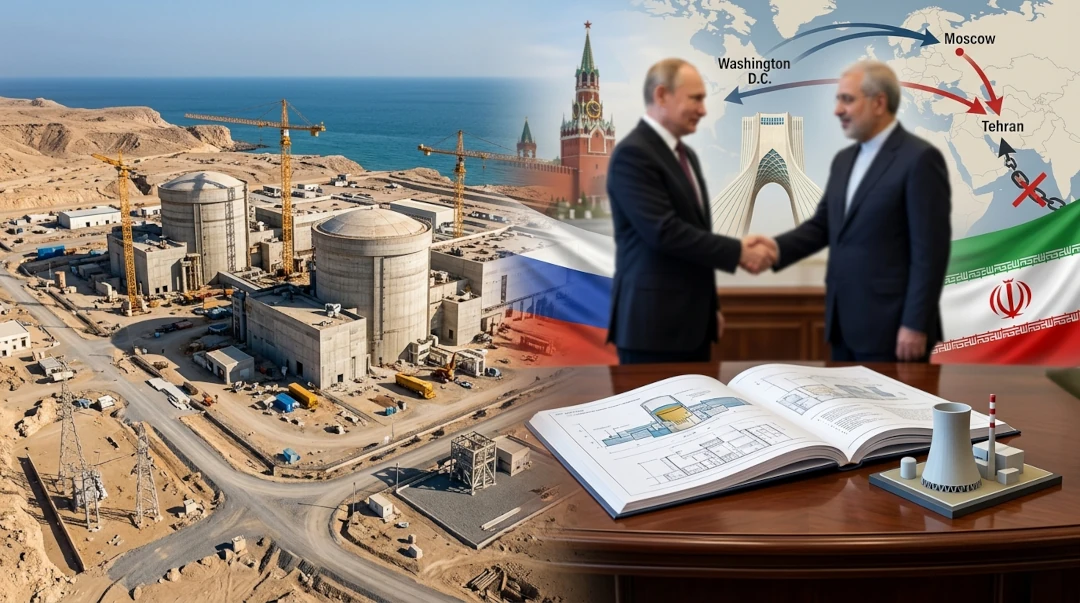
There is a particular kind of failure that happens when a leader spends years insisting he is the only person tough enough to stop a danger — and then, through his own conduct, accelerates it. That is the failure now staring back at Americans from Moscow, where Iran’s ambassador, Kazem Jalali, announced this month that Tehran and Russia have formally consummated a $25 billion memorandum of understanding for cooperation in the nuclear sector, anchored by a four-reactor, 5-gigawatt plant on Iran’s southern Hormozgan coast and the continued expansion of the Bushehr nuclear station. Jalali described it, in remarks reported by Iranian state media, as the largest atomic project in his country’s history.
That announcement is not happening in a vacuum. It is happening eleven months after President Donald Trump ordered Operation Midnight Hammer, the June 2025 strikes on Fordow, Natanz, and Isfahan that he claimed had “obliterated” the Iranian nuclear program. It is happening roughly four months after a second joint U.S.–Israeli campaign, branded “Epic Fury,” renewed the bombing in late February 2026. It is happening as Iranian and American negotiators try, again, to lower expectations and patch together an interim arrangement — while the actual physical infrastructure for Iran’s nuclear future is being signed, sealed, and engineered by Rosatom, the state nuclear corporation of the Russian Federation.
The president promised maximum pressure. What the world is watching, in real time, is maximum failure.
1. What Was Actually Signed
The agreement, first signed in 2025 and reaffirmed by Iran’s ambassador to Moscow at a conference on June 4, 2026, commits Russia to build four Generation III reactors on a 500-hectare site near Sirik, in Hormozgan Province, directly across the Persian Gulf from the United Arab Emirates and Oman. According to Tasnim News Agency, the project is being structured through “Iran’s private sector in cooperation with Rosatom” — an arrangement that conveniently muddies the lines of state responsibility for what is, in fact, the deepest civilian nuclear partnership in the Islamic Republic’s history.
The deal also calls for the expansion of Bushehr — Iran’s only operating nuclear power station, also Russian-built, currently producing 1 GW — with second and third reactor units already under construction. As The Algemeiner reported, additional collaboration is planned on small modular reactors and radiopharmaceutical production. Tehran insists the program is peaceful. The point, however, is not what Tehran says. The point is what the agreement physically enables.
Four reactors, 5 GW capacity, on a 500-hectare site in Sirik, Hormozgan Province. Built by Rosatom in partnership with Iran’s “private sector.” Reported by Al Jazeera.
Units 2 and 3 under construction at Iran’s only operational nuclear power plant. Russian-built and managed since 2011. Confirmed by Iranian state media.
Roughly 440 kg of uranium enriched to 60% U-235 remains unaccounted for, reportedly buried near Isfahan, per the Arms Control Association.
Inspectors have not assessed Iran’s facilities since the June 2025 strikes, per FactCheck.org’s review of expert testimony. The world is now, by design, flying blind.
2. The Bomb Question, Answered Honestly
The administration and its loudest media allies will tell you civilian reactors are not weapons. That is technically correct and analytically lazy. A $25 billion deepening of Iranian–Russian nuclear infrastructure — built with Rosatom personnel, Russian fuel cycle expertise, and a network of contracts that make Tehran more, not less, central to Moscow’s strategic calculus — does not put a warhead in Iranian hands tomorrow. What it does is something subtler and, in the long run, more dangerous: it permanently embeds the know-how, the supply chain, and the political insurance Iran would need to make a weapons decision later, on its own timetable.
That is precisely the trajectory experts warned would follow from the June 2025 strikes. Writing for the London School of Economics, Professor Rupal Mehta argued that the U.S. campaign may have transformed Iran from a state with latent capability into one with a nuclear grievance — a regime that now reads weapons acquisition as a survival imperative rather than a discretionary ambition. The Arms Control Association has been blunter still: bombs can damage infrastructure, but they cannot destroy expertise, and they cannot account for the 440 kilograms of 60% enriched uranium Iran already possessed before the first missile flew.
Inside the administration, the contradictions are now in public view. The president continues to insist Iran’s program was “obliterated.” His own Middle East envoy, Steve Witkoff, suggested in February that Iran was a week away from having bomb-making material — a claim then walked back by Press Secretary Karoline Leavitt at the same White House podium where, the day before, the strikes had been declared “an overwhelmingly successful mission.” CNN’s analysis was unsparing: an administration cannot simultaneously have obliterated a program and need to bomb it again, and the failure to keep its own story straight is becoming the story.
“If I were in Trump’s Cabinet, I would spend Easter calling constitutional lawyers about the 25th Amendment. This is completely, utterly unhinged. He’s already killed thousands. He’s going to kill thousands more.”
— Sen. Chris Murphy (D-Conn.), April 5, 2026, in remarks reported by The Hill
3. The Balance of Power, Rewritten
For two decades, the central project of American Middle East policy — under presidents of both parties — was the prevention of an axis built around Tehran and Moscow. Every administration understood that a deep Russian footprint inside Iran’s nuclear, energy, and military supply chains would constrain U.S. options across the region: in the Gulf, in the Levant, in the Strait of Hormuz, and at the United Nations Security Council, where Russia holds a veto.
That project is, for the moment, dead. The Trump administration’s decision to wage war on Iran, analysts at Tufts University have noted, directly contradicts its own November 2025 National Security Strategy, which had declared the Middle East a receding priority. The Brookings Institution’s analysis is even sharper: a president who “rolled the dice” without a plan for what came next has trapped the United States in a costly war, damaged the credibility of American military power, and accelerated the global adjustment to what they describe as a post-American order. Foreign Policy magazine, hardly a left-wing publication, has now branded the Iran war Trump’s greatest foreign-policy failure.
The president told the country in February that the strikes had brought peace. In the four months since, the Strait of Hormuz has been periodically contested. Qatar — whose territory hosts the al-Udeid air base hit by Iranian retaliation in June 2025 — faces an 8.6 percent economic contraction. European allies, asked to help reopen Hormuz, declined. NATO is fracturing on Greenland and on Trump’s tariff threats against eight European nations. And in Moscow, Iran’s ambassador is announcing the largest atomic project in his country’s history, brokered with the same Russian state that the United States is meant to be containing.
This is not balance of power. This is its inversion.
Get Involved Today
Contribute to our mission and turn your concerns into action.
4. The President’s Responsibility
It is fashionable in establishment commentary to treat outcomes like the Iran–Russia memorandum as the impersonal product of “structural forces.” That is, in this case, an evasion. The deepening of the Tehran–Moscow nuclear partnership is the direct, traceable consequence of presidential choices — most of them made by one man, across two terms.
The first choice was the May 2018 withdrawal from the Joint Comprehensive Plan of Action. The JCPOA, however imperfect, had capped Iranian enrichment at 3.67 percent, limited the stockpile to 300 kilograms, and embedded the most intrusive inspection regime in nuclear history. Trump tore it up over the objections of his own military leadership — Joint Chiefs Chairman Gen. Joseph Dunford and Defense Secretary James Mattis had publicly testified that Iran was in compliance — because, in his own words, the deal had Barack Obama’s name on it. As Sen. Bernie Sanders warned at the time, withdrawal would teach the world that “a reckless president might simply discard that agreement a few years later.” The world learned the lesson.
The second choice was the launching of Operation Midnight Hammer in June 2025 without a congressional authorization for the use of military force — a war of choice the Arms Control Association argues violated both Article I of the Constitution and the 1973 War Powers Act. The third was the February 2026 escalation, justified by intelligence assessments that even the president’s own envoy could not keep straight. Each choice narrowed Iran’s diplomatic options and widened Russia’s commercial ones.
The Tehran–Moscow nuclear MOU is the receipt.
Trump withdraws the United States from the JCPOA, despite testimony from his own Joint Chiefs and Defense Secretary that Iran was in compliance.
Operation Midnight Hammer: U.S. strikes Fordow, Natanz, and Isfahan. Trump declares Iran’s program “obliterated.” A leaked DIA report estimates the setback at a few months, not years.
Iran and Russia announce the $25 billion Hormozgan reactor MOU, alongside small modular reactor cooperation with Rosatom.
“Epic Fury”: joint U.S.–Israeli strikes resume. Steve Witkoff publicly states Iran is a week from weapons-grade material; the White House contradicts him the next day.
Trump’s Easter Truth Social posts warn that “a whole civilization will die tonight.” Rep. Jamie Raskin introduces the Commission on Presidential Capacity bill with 50 co-sponsors.
Ambassador Jalali confirms in Moscow that the $25 billion memorandum is operational — “Iran’s largest atomic project,” executed in partnership with Rosatom.
5. Priorities, Leadership, and the Question of Capacity
What does it say about a president’s priorities that, in the same week his administration was insisting Iran’s nuclear program had been destroyed, that program was being expanded by a $25 billion Russian contract? What does it say about his leadership that the most important constraint on Iran’s enrichment in a generation — the JCPOA’s inspection regime — was sacrificed in 2018 to settle a personal score with a predecessor, and that no comparable framework has replaced it eight years later? What does it say about his fitness for office that the same week his Middle East policy was unraveling, the president was posting publicly about the extinction of a civilization?
These are not partisan questions. They are the questions the Constitution asks the executive branch and the Congress to keep asking, in perpetuity, of any president. And they are the questions that, increasingly, members of Congress are answering aloud.
The Twenty-Fifth Amendment, and Why Its Difficulty Is Not Its Refutation
Section 4 of the Twenty-Fifth Amendment, ratified in 1967 in the wake of the Kennedy assassination, provides a constitutional mechanism for situations in which a sitting president is “unable to discharge the powers and duties of his office.” It empowers the Vice President, acting with a majority of the Cabinet — or “such other body as Congress may by law provide” — to transfer authority to the Vice President as Acting President. It was designed by its authors not as a partisan weapon but as a continuity-of-government safeguard.
On April 14, 2026, House Judiciary Committee Ranking Member Rep. Jamie Raskin (D-Md.) introduced legislation, co-sponsored by 50 House Democrats, to establish a Commission on Presidential Capacity — the “other body” the amendment explicitly contemplates. Days earlier, Rep. Raja Krishnamoorthi (D-Ill.) had publicly called on Vice President JD Vance and the Cabinet to invoke Section 4 in response to the president’s threat that “a whole civilization will die tonight.” Sen. Chris Murphy, Sen. Bernie Sanders, Sen. Ed Markey, and Reps. Alexandria Ocasio-Cortez, Eric Swalwell, Yassamin Ansari, and Sydney Kamlager-Dove have all, at various points in 2026, publicly questioned the president’s capacity to fulfill the constitutional duties of his office.
The Constitutional Argument
The case is not that the president holds policies progressives oppose. The case is narrower and graver: that the pattern of conduct documented across 2026 — the public threats of civilizational extinction, the contradictory statements about active military operations, the abandonment of allies in the middle of a war, the inability of his own spokespeople to keep one day’s account consistent with the next — meets the plain-language test the framers of the amendment set. A president who cannot maintain a coherent posture toward an active nuclear adversary, while that adversary signs a $25 billion deal with another, is a president whose capacity to discharge the powers of his office is in legitimate question.
The Practical Barriers
Honesty requires acknowledgment of what stands in the way. Vice President JD Vance and the Cabinet are unlikely to act against the president who appointed them. The Republican Senate would not provide the two-thirds majority required to make a Section 4 transfer permanent. As Fox News noted, Raskin’s bill itself faces a Republican-controlled chamber unwilling to advance it. The political path is, at present, foreclosed.
Why the Barriers Do Not End the Argument
Constitutional duties do not become obsolete because they are inconvenient. The framers of the Twenty-Fifth Amendment understood that a presidency unable to govern would always be defended by those whose power depended on its continuation; that is why they wrote Section 4 with multiple actors and an explicit congressional override. The political math of 2026 does not absolve Vance, the Cabinet, or the Republican Senate of the obligation to apply the test honestly. Their refusal to do so is itself a constitutional choice — one that history will adjudicate, even if a Senate vote does not.
6. What This Says About the Country
The Iran–Russia memorandum is, in the end, a document about American leadership — or its absence. It documents what happens when a president treats foreign policy as a vehicle for grievance rather than strategy, when sanctions are imposed without an endgame, when bombs are dropped without a theory of what they accomplish, when allies are humiliated and rivals are gifted with the strategic openings they have spent two decades trying to manufacture.
It documents what happens when the constitutional checks built precisely for moments like this — the War Powers Resolution, the advice and consent of the Senate, the oversight authority of the Congress, and yes, the Twenty-Fifth Amendment — are treated as quaint relics by the party that controls them. It documents what happens when a country forgets that the alternative to American leadership is not a vacuum but a replacement. In this case, that replacement is being signed in Russian, on Iranian letterhead, for $25 billion.
The verdict is not that Donald Trump caused every cause and condition that led to this moment. The verdict is that he had every opportunity, across two terms and eight years, to choose a different path — and that on each occasion, he chose the path that made this outcome more likely. The Iran–Russia nuclear MOU is the bill coming due.
Editorial Conclusion
A president whose policies have driven a sanctioned adversary into a $25 billion nuclear embrace with a strategic rival, whose public conduct provokes bipartisan calls for the Twenty-Fifth Amendment, and whose own administration cannot keep its account of an active war straight, has forfeited the presumption that he can be trusted with the nuclear file. The question is not whether the political path to constitutional accountability is open today. The question is whether the Vice President, the Cabinet, and every member of Congress sworn to uphold the Constitution will continue to pretend that the test set in 1967 does not apply to the conduct documented in 2026. It does. And the country is owed an answer.
Sources & References
- The Algemeiner — “Iran, Russia Sign $25 Billion Nuclear Cooperation Deal as Tehran Presses Ahead Amid US Talks”
- Tasnim News Agency — “Iran, Russia Sign $25 Billion Nuclear Cooperation Memorandum: Envoy”
- Press TV — “Iran, Russia push ahead with $25 billion nuclear plant, trade corridor”
- Wikipedia — “2025 United States strikes on Iranian nuclear sites”
- LSE USAPP Blog (Rupal Mehta) — “US strikes may have turned Iran from a state with latent nuclear capability into one with a nuclear grievance”
- Arms Control Association — “Trump’s Chaotic and Reckless Iran Nuclear Policy”
- Arms Control Association — “The U.S. War on Iran: New and Lingering Nuclear Risks”
- CNN — “Trump said Iran’s nuclear program was ‘obliterated.’ So why is he looking to strike again?”
- FactCheck.org — “Assessing Trump’s Claims on Iran’s Nuclear and Missile Capabilities”
- Al Jazeera — “US re-asserts 2025 strikes ‘obliterated’ Iran’s nuclear programme”
- CSIS — “Options for the United States to Resolve the Iran Nuclear Challenge”
- Tufts Now — “How the War in Iran Has Weakened the U.S. in the Great Power Game”
- Brookings — “Ukraine, Iran, and the strains on Russian and American power”
- Foreign Policy — “The Iran War Could Be Trump’s Greatest Foreign-Policy Failure”
- CNBC — “Inside the Obama-era Iran nuclear deal that Trump withdrew from”
- Office of Sen. Bernie Sanders — “Sanders Response to Trump’s Decision on Iran Nuclear Deal” (2018)
- House Judiciary Democrats — “Ranking Member Raskin Demands White House Physician Immediately Evaluate Donald Trump’s Cognitive Fitness”
- Deseret News — “Democrats want a medical check on Trump’s fitness for office”
- Fox News — “Rep. Jamie Raskin introduces bill to assess Trump’s fitness for office”
- Office of Rep. Raja Krishnamoorthi — “Krishnamoorthi Calls for President Trump’s Removal Under 25th Amendment”
- The Hill — “Sanders slams Trump’s Iran threats as ‘ravings'”
Related News