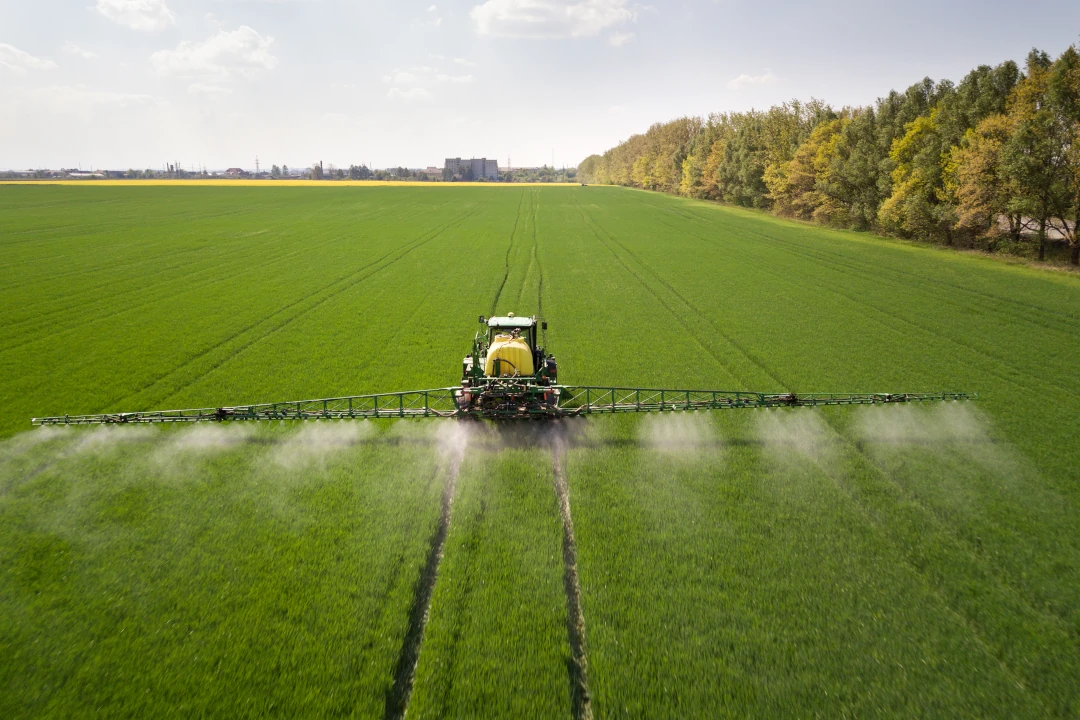
When Donald Trump invoked wartime law to shield Roundup’s maker from cancer lawsuits — and sent his Solicitor General to argue Bayer’s case at the Supreme Court — he did not merely betray a movement. He revealed what his presidency has always been: a vehicle for corporate power dressed in the language of patriotism and public health.
On February 18, 2026, in a move that stunned even his most ardent supporters in the Make America Healthy Again movement, President Donald Trump signed an executive order invoking the Defense Production Act — a law designed for genuine wartime emergencies — to declare glyphosate, the active ingredient in Bayer’s Roundup weedkiller, a matter of national security. Less than ten weeks later, his administration dispatched its Solicitor General to argue alongside Bayer’s lawyers before the United States Supreme Court, as hundreds of protesters chanted “people vs. poison” on the courthouse steps. Together, these two acts represent something more than a policy choice. They constitute a case study in the corruption of American leadership.
What makes this episode so damning is not merely what Trump did — it is what he promised he would not do. He promised, implicitly and explicitly through his alliance with Robert F. Kennedy Jr. and the MAHA movement, to take on corporate interests that had poisoned the American food supply and environment. He ran, in part, on a platform of health sovereignty. That promise lasted until Bayer needed a favor.
1. The Executive Order: Wartime Law in Service of Corporate Profit
The February 18 executive order, formally titled Promoting the National Defense by Ensuring an Adequate Supply of Elemental Phosphorus and Glyphosate-Based Herbicides, invoked Section 101 of the Defense Production Act to mandate continued domestic production of glyphosate and elemental phosphorus. Its Section 3 is the most consequential and most troubling clause: it explicitly confers all immunity provided under Section 707 of the Act upon domestic producers who comply with its terms.
In plain language: the President of the United States used powers designed to mobilize the defense industrial base during wars — the same act invoked during World War II and the Korean War — to insulate a German-owned pharmaceutical conglomerate from civil liability in American courts. The order also directs the Secretary of Agriculture to protect the “corporate viability” of glyphosate producers from regulatory pressure, effectively turning the USDA into a legal shield for Bayer’s balance sheet.
Rep. Chellie Pingree of Maine, a Democrat and member of the House Agriculture Committee, did not mince words. “Calling glyphosate production a matter of ‘national security’ is absurd,” she said in a February 20 press release. “Invoking wartime authorities to ramp up production while opening the door to liability shields for chemical companies is dangerous and indefensible. This Executive Order has nothing to do with protecting farmers or feeding the country — it’s about protecting corporate profits and insulating polluters from accountability.”
Pingree was joined — in rare, bipartisan solidarity — by Rep. Thomas Massie, a libertarian-leaning Republican from Kentucky. Together, they introduced the “No Immunity for Glyphosate Act”, legislation designed to block the order’s liability shield. “Congress should ensure that Americans retain their right to seek a remedy in court if they believe they have been injured by this product,” Massie wrote in the same press release. That a Republican who consistently supports deregulation found the order legally unconscionable tells you something important.
“Elevating glyphosate to a national security priority is the exact opposite of what MAHA voters were promised. It’s a shocking betrayal to protect all of us — but especially the people who live and work near farm fields where glyphosate is used.”
— Ken Cook, President, Environmental Working Group, Feb. 18, 2026
2. Monsanto v. Durnell: The Supreme Court as Corporate Instrument
To understand why Trump’s executive order landed with such force, you must understand the case it was designed to influence. Monsanto Company v. Durnell began in 2019, when Missouri resident John Durnell sued Monsanto — now owned by Bayer — alleging that decades of Roundup exposure caused his non-Hodgkin lymphoma. A Missouri jury agreed, awarding him $1.25 million in damages on the grounds that Monsanto had failed to warn him of the risks.
Bayer’s argument to the Supreme Court, heard on April 27, is straightforward and sweeping: because the Environmental Protection Agency has registered Roundup’s label — a label that includes no cancer warning — under the Federal Insecticide, Fungicide, and Rodenticide Act (FIFRA), state juries are categorically preempted from finding the company liable for failing to include one. In other words, Bayer wants the EPA’s bureaucratic sign-off to serve as a permanent legal shield against accountability to any American citizen, in any state, for any harm caused by a product the company has known for decades carries serious cancer risk.
As The New Lede reported, Bayer has spent the last decade fighting more than 100,000 such lawsuits, paying out billions of dollars in jury awards and settlements. Food & Water Watch notes that since purchasing Monsanto in 2018, Bayer has spent over $11 billion settling more than 100,000 cancer lawsuits. Glyphosate was classified a probable human carcinogen by the World Health Organization’s International Agency for Research on Cancer in 2015. The evidence has only grown since.
What makes the administration’s involvement uniquely scandalous is this: Trump’s Solicitor General, D. John Sauer, filed a brief in support of Monsanto and was granted oral argument time at the court — meaning the United States government sat beside Bayer’s lawyers and argued that cancer victims cannot sue. Food & Water Watch Legal Director Tarah Heinzen summarized the stakes succinctly: “Bayer is intent on preserving its right to harm at all costs — a pursuit the Trump administration is all too willing to endorse.”
John Durnell sued Monsanto in 2019 after developing non-Hodgkin lymphoma. A Missouri jury awarded him $1.25 million. Monsanto argues FIFRA preempts state failure-to-warn claims. Source: NPR
A Monsanto victory would effectively ban tens of thousands of cancer lawsuits nationwide, closing the courthouse door for anyone harmed by Roundup. Source: Legal Planet
On February 17, Bayer proposed a $7.25 billion class settlement — one day before Trump’s executive order — as part of a coordinated multi-pronged strategy to contain litigation. Source: Lawsuit Information Center
Glyphosate was classified as a “probable human carcinogen” by the WHO’s IARC in 2015. The EPA’s contrary finding was vacated by the 9th Circuit in 2022 for failing to follow cancer-risk guidelines. Source: The New Lede
House Republicans embedded a nationwide pesticide preemption provision in H.R. 7567, the Farm, Food, and National Security Act of 2026, effectively codifying Bayer’s legal argument into federal statute. Source: C&EN
Solicitor General D. John Sauer argued beside Bayer’s lawyers at SCOTUS on April 27, 2026 — the United States government formally advocating to strip cancer victims of their legal rights. Source: Common Dreams
3. The MAHA Betrayal and What It Reveals
The rupture between Trump and the Make America Healthy Again movement over glyphosate is not merely an intra-coalition squabble. It is a diagnostic test result. When the administration’s actions collide so violently with the values it publicly claimed, what remains is the truth of whose interests it actually serves.
Outside the Supreme Court on April 27, hundreds of protesters gathered for what they called “The People vs. Poison” rally. The crowd was unusual by Washington standards: MAHA influencers standing beside environmental justice advocates, Republican Rep. Thomas Massie sharing a platform with Democratic Sen. Cory Booker, and former Rep. Dennis Kucinich warning that a Monsanto victory would mean states lose “a fundamental right to be able to stand up for the health and safety of their people.” As CNN reported, the rally drew both MAHA supporters and environmentalists in an alliance born of common betrayal.
Notably absent: Secretary of Health and Human Services Robert F. Kennedy Jr. The man who built his legal career suing Monsanto over Roundup — who in 2018 won a landmark $289 million settlement for DeWayne “Lee” Johnson, a San Francisco school groundskeeper who developed non-Hodgkin lymphoma after spraying Roundup — declined to stand with the protesters. Kennedy has since offered the administration cover, arguing that the executive order is necessary to avoid disrupting the food supply. His silence is its own kind of verdict.
Kelly Ryerson, the MAHA advocate known online as “Glyphosate Girl,” put the broader failure plainly: “The combination of the executive order and going to bat for Bayer at the Supreme Court are really inexcusable. And I think it showed a deep disconnect between what the administration thinks that MAHA cares about and what is actually true.” Her optimism, she told NPR, had curdled as those tied to the chemical industry filled key positions at the EPA under Administrator Lee Zeldin — an official who, as NPR documented, has pursued deregulation with such zeal that he invited corporations to email his agency to request exemptions from air pollution standards.
“You cannot claim to care about health while protecting poison. These companies must have accountability — and it starts today.”
— Zen Honeycutt, Founder, Moms Across America, April 27, 2026
4. A Coordinated Corporate Campaign — With White House Backing
What the glyphosate episode exposes is not a mistake or a miscalculation. It is a coordinated, multi-front corporate strategy unfolding with the full participation of the executive branch. Within a single week in February, Bayer proposed its $7.25 billion class settlement, Trump signed the executive order conferring immunity, and House Republicans unveiled a farm bill draft mandating nationwide pesticide label uniformity — each element reinforcing the others.
As Legal Planet observed, the case represents “one part of a multi-pronged effort by Bayer, together with its allies in Congress and the Trump administration, to contain that exposure.” Bayer itself called the proposed settlement and the Supreme Court appeal “mutually reinforcing steps in the company’s multipronged strategy.” This is not how a democratic government operates on behalf of its citizens. It is how a captured regulatory state operates on behalf of its largest clients.
The timeline is important.
January 16, 2026The U.S. Supreme Court announces it will hear Monsanto v. Durnell, granting Bayer the platform it sought after the Missouri Supreme Court declined review.
February 13, 2026House Republicans unveil a draft farm bill mandating uniform pesticide labels nationwide, preempting any state requirement for additional cancer warnings — effectively codifying Bayer’s legal argument into statute.
February 17, 2026Bayer announces a proposed $7.25 billion class settlement covering current and future non-Hodgkin lymphoma claims — framed as a goodwill gesture while the company simultaneously pursues full immunity at the Supreme Court.
February 18, 2026President Trump signs the glyphosate executive order, invoking the Defense Production Act and explicitly conferring liability immunity on domestic producers — generating immediate condemnation from public health experts, environmental groups, and MAHA activists.
February 20, 2026Reps. Chellie Pingree and Thomas Massie introduce the No Immunity for Glyphosate Act, attempting to block the order’s liability shield. The bipartisan bill goes nowhere in a Republican-controlled House.
April 27, 2026The Supreme Court hears oral arguments in Monsanto v. Durnell. Trump’s Solicitor General argues alongside Bayer. Hundreds protest outside in the “People vs. Poison” rally. A decision is expected in June 2026.
5. What Leadership Failure Looks Like
The word “leadership” carries constitutional weight. The president is not merely an administrator; the Constitution charges the executive with faithfully executing the law and acting in the national interest. When an administration systematically deploys the instruments of government — wartime production statutes, the Solicitor General’s office, the regulatory power of the EPA — in the exclusive service of a single foreign-owned corporation facing tens of billions of dollars in legitimate legal liability, the question of fitness for office is not rhetorical. It is constitutional.
Get Involved Today
Contribute to our mission and turn your concerns into action.
Consider what coherent leadership would have looked like. A president genuinely committed to public health — as Trump publicly claimed through his alliance with Kennedy and MAHA — would have directed the EPA to complete its court-ordered review of glyphosate’s safety rather than allow a Farm Bill provision to delay that review until 2031. A president committed to the rule of law would not have invoked emergency wartime authority to insulate a corporation from civil liability while the Supreme Court was actively considering whether to do precisely that through legitimate legal channels. A president committed to his own stated “America First” principles would not have assigned his Solicitor General to argue the case of a German multinational against American cancer victims in American courts.
Instead, Trump chose to do all three of the opposite things simultaneously. This is not incompetence. It is a governing philosophy — and the philosophy is: those with power and money will be protected; those without will be told to file a lawsuit that his administration is actively working to ensure they cannot win.
When Policy Failure Becomes a Question of Presidential Fitness
The 25th Amendment, ratified in 1967, exists to address a gap in the original Constitution: what happens when a sitting president is unable, rather than unwilling, to discharge the duties of the office? Section 4 is the provision most relevant to the present moment. It provides that if the Vice President and a majority of the Cabinet — or of “such other body as Congress may by law provide” — transmit to Congress a declaration that the President is unable to discharge the powers and duties of his office, the Vice President shall immediately assume those powers as Acting President.
In April 2026, Rep. Jamie Raskin, Ranking Member of the House Judiciary Committee, formally demanded that White House Physician Captain Sean Barbabella conduct a comprehensive cognitive and neurological evaluation of President Trump and report the findings to Congress. Raskin followed that letter with legislation establishing the “Commission on Presidential Capacity to Discharge the Powers and Duties of Office” — a 17-member body of physicians and former officials that Section 4 explicitly contemplates but which Congress has never created.
The glyphosate episode adds a distinct and underappreciated dimension to the fitness debate. The 25th Amendment is not solely about cognitive decline in the clinical sense. It addresses a president’s ability to faithfully execute the duties of the office — duties that include protecting the public welfare, maintaining the integrity of the regulatory state, and exercising independent judgment free from the capture of private interests. A president who demonstrably cannot distinguish between national security and corporate liability management, who cannot perceive that invoking wartime authority to shield a cancer defendant from civil court is a profound abuse of executive power, raises legitimate questions about whether the judgments he makes meet the constitutional standard of discharging the “powers and duties of his office.”
Lawmakers Who Have Called for Action
- Rep. Jamie Raskin (D-MD) — Formally demanded cognitive testing and introduced Commission legislation, citing “increasingly incoherent, volatile, profane, deranged, and threatening” public statements.
- Rep. Alexandria Ocasio-Cortez (D-NY) — Called for Trump’s removal following his threats to “extinguish a civilization” on social media in April 2026.
- Rep. Maxine Waters (D-CA) — Called for invocation of the 25th Amendment following Trump’s removal of Federal Reserve Governor Lisa Cook.
- Rep. Chellie Pingree (D-ME) — Called the glyphosate EO “indefensible” and introduced the No Immunity for Glyphosate Act, arguing it represents a fundamental failure to protect public health.
The Constitutional Argument
The argument is not that policy disagreement with an administration triggers the 25th Amendment — it does not and should not. The argument is structural: a president who systematically deploys the emergency authorities of the executive branch, the advocacy power of the Solicitor General, and the influence of the regulatory apparatus in the service of a single foreign-owned company facing mass cancer liability — while publicly claiming to champion the health of Americans — exhibits a disorientation of priorities that the amendment’s drafters would have recognized as executive incapacity.
The Barriers — and Why They Don’t Settle the Question
The practical barriers are formidable. Vice President JD Vance has shown no indication of willingness to act. No Cabinet official has publicly dissented. The Republican majorities in both chambers would almost certainly resist. A presidential veto of Raskin’s Commission legislation is guaranteed. These barriers are real. But the 25th Amendment’s value is not solely in its activation. It is in the civic obligation it places on those around the president to assess, honestly and continuously, whether the person holding the office is actually capable of discharging its duties. The glyphosate episode — the executive order, the Solicitor General, the Farm Bill provision, the EPA’s deferred review — is a set of facts that demand that assessment. The barriers to action do not diminish the moral and constitutional case for conducting it.
6. The Stakes: Courts, Cancer, and Democratic Accountability
The Supreme Court’s decision in Monsanto v. Durnell, expected in June 2026, will determine whether tens of thousands of Americans retain the right to seek justice in state courts when a corporation’s product causes them cancer. The court’s eventual ruling will apply not just to glyphosate, but to every pesticide manufacturer operating under a federal label. A win for Bayer would mean that EPA approval — however procedurally flawed, however long overdue for scientific review — becomes a definitive shield against accountability in any American courtroom.
What the glyphosate episode ultimately reveals is the gap between the government Americans were promised and the government they have. It reveals an administration that will invoke the language of national security to protect private profit, the language of farmers’ rights to protect a German corporation, and the language of public health to preside over one of the most aggressive rollbacks of environmental and chemical safety standards in modern history.
Vani Hari, the food and wellness influencer known as “Food Babe” and a prominent MAHA voice, offered a prediction at the April 27 rally: “Glyphosate is going to be a midterm issue because the Trump administration made it an issue. This is what we’re marching towards, this is what we’re thinking about. We got to make some meaningful change.” She is right about the politics. But the stakes are larger than a midterm election. The stakes are whether the American legal system will remain open to ordinary citizens harmed by powerful corporations — or whether it will be closed, one executive order, one amicus brief, one Farm Bill provision at a time.
Editorial Conclusion
Donald Trump did not stumble into the glyphosate scandal. He chose it — chose the executive order, chose the Solicitor General’s brief, chose to let the Farm Bill liability shield advance. Those choices reveal a presidency that has substituted corporate service for public leadership. Whatever the Supreme Court decides in June, the record is already complete: this administration used the full power of the federal government to protect a foreign corporation’s ability to sell a probable carcinogen to American farmers without warning them of the risk. That is not a policy disagreement. That is a failure of the constitutional obligation to protect the public welfare. The American people deserve a president whose conception of “national security” includes their right to know what is killing them — and their right to hold accountable those who withheld that knowledge. That president is not the one currently in office.
Sources & References
- White House: Executive Order — Promoting the National Defense by Ensuring an Adequate Supply of Elemental Phosphorus and Glyphosate-Based Herbicides (Feb. 18, 2026)
- White House Fact Sheet: Trump Ensures Adequate Supply of Elemental Phosphorus and Glyphosate-Based Herbicides (Feb. 18, 2026)
- Chemical & Engineering News: “Farm Bill and Trump’s Glyphosate Order Magnify Pesticides’ Watershed Moment” (March 2026)
- Waterkeeper Alliance: “A Bad Week for Clean Water and Public Health” (Feb. 20, 2026)
- Bayer AG: “Bayer Welcomes the U.S. Supreme Court Decision to Review the Durnell Case” (Jan. 16, 2026)
- NPR: “Supreme Court Heard Case About Labels for Bayer’s Roundup” (April 27, 2026)
- The New Lede: “Supreme Court Justices Weigh Monsanto Bid to Block Warning Lawsuits” (April 27–28, 2026)
- Investigate Midwest: “Monsanto Argues for Lawsuit Immunity in Case Before Supreme Court” (April 27, 2026)
- Common Dreams: “Bayer Continues Push to ‘Close the Door’ on Glyphosate Victims at US Supreme Court” (April 27, 2026)
- Food & Water Watch: “Supreme Court Hears Oral Argument in Bayer Case Seeking to Block Pesticide Lawsuits” (April 27, 2026)
- Legal Planet: “Roundup at the Supreme Court” (April 27, 2026)
- Chemical & Engineering News: “Supreme Court Hears Bayer Roundup Liability Case with Billions at Stake” (April 27, 2026)
- CNN Politics: “A Supreme Court Case Over Pesticides Is Bringing Out the ‘MAHA Moms'” (April 27, 2026)
- CNBC: “MAHA vs. Trump Over Supreme Court Glyphosate Case, Farm Bill” (April 27, 2026)
- Civil Eats: “Supreme Court Weighs in on Weedkiller, Spurring MAHA Protest” (April 27, 2026)
- NPR: “The MAHA Movement Is Mad About the Weedkiller Glyphosate and Trump’s EPA” (April 28, 2026)
- House Judiciary Committee Democrats: Rep. Raskin Demands Cognitive Evaluation of President Trump (April 10, 2026)
- House Judiciary Committee Democrats: Raskin Introduces 25th Amendment Commission Legislation (April 14, 2026)
- Axios: “Raskin Calls for Trump to Take Cognitive Test in 25th Amendment Push” (April 10, 2026)
- Lawsuit Information Center: Monsanto Roundup Lawsuit — April 2026 Update & Settlement
Related News