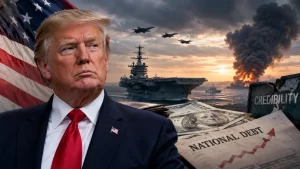
Reports from The Wall Street Journal, The Jerusalem Post, and multiple senior administration officials confirm that Donald Trump was deliberately barred from his own Situation Room during an active combat rescue operation in Iran — because his aides judged his presence too dangerous to the mission. The constitutional implications cannot be ignored.
The constitutional premise is stark and unambiguous: the President of the United States is the Commander in Chief. That title is not ceremonial. It carries with it the legal authority and solemn responsibility to direct the armed forces in times of war. When two American airmen were shot down over Iran in early April 2026, and U.S. special operations forces launched a complex, 150-aircraft rescue operation into hostile territory, the man with that title was not in the room. He was not kept away by illness, by travel, or by circumstance. He was kept away by his own aides — intentionally, deliberately — because senior officials feared that Donald Trump’s emotional volatility would endanger American lives.
That is not a partisan framing. It is the account given by senior administration officials to The Wall Street Journal and corroborated by The Jerusalem Post, the Middle East Eye, the British Brief, and the Times of Israel. It is, in a word, disqualifying.
1. What the Reports Actually Say
The Wall Street Journal’s account — published April 18–19, 2026, and drawing on multiple senior administration officials — paints a portrait of a president whose psychological reaction to the crisis rendered him operationally unworkable. When Trump learned that an American F-15E had been shot down by Iranian forces, with two crew members missing in hostile territory, he did not convene his national security team. He did not review options with the Joint Chiefs. He did not project the steadiness that a commander-in-chief moment demands.
He screamed at aides for hours.
“Aides kept the president out of the room as they got minute-by-minute updates because they believed his impatience wouldn’t be helpful.”
— Senior Administration Official — The Wall Street Journal, April 2026
According to the Journal’s reporting, Trump’s emotional state during those critical hours was consumed not primarily by concern for the missing airmen, but by the political ghost of 1979. He privately warned aides: “If you look at what happened with Jimmy Carter… it cost them the election.” The president of the United States, with two service members in mortal danger, was running 47-year-old electoral calculations while his staff managed a live combat rescue without him.
The Jerusalem Post confirmed the details, noting that military advisers made the active, premeditated decision to exclude Trump from the command room, providing him updates only at “meaningful moments” rather than the tactical, minute-by-minute feeds being monitored by the National Security Council. While Trump was sidelined, Vice President JD Vance and White House Chief of Staff Susie Wiles were dialed in to receive critical operational updates. The chain of command, in effect, bypassed the person at its head.
Get Involved Today
Contribute to our mission and turn your concerns into action.
2. A Pattern, Not an Episode
What makes the Situation Room exclusion so alarming is not that it happened once. It is that it reveals a pattern of governance-by-circumvention that has become normalized inside this White House. According to the Wall Street Journal’s reporting, Trump’s approach to the entire Iran conflict has been characterized by improvisation, distraction, and emotional volatility that consistently blindsides his own advisers.
Trump’s Easter Sunday Truth Social post — threatening to destroy Iran’s bridges and power plants and signing off with “Praise be to Allah” — was sent without input from his national security team, according to the Journal. Republican senators and Christian leaders called the White House to complain. Times of Israel
Trump’s threat that “a whole civilization will die tonight” was also issued off-the-cuff, again without coordination with advisers. Administration officials said it was intended to “spook” Iran by “seeming unstable” — a strategy that, if deliberate, raises its own grave questions. Times of Israel
As Trump’s own deadline for Iran approached, aides told the Journal he was focused on an Indiana state election, cryptocurrency, and the White House ballroom renovation — not the war. He directed his envoy Steve Witkoff to simply “push Iran to make a deal.” Times of Israel
Trump reportedly resisted sending troops to seize Kharg Island despite being told the mission could succeed, while simultaneously threatening civilian infrastructure strikes that his own Republican allies called potential war crimes. There was no coherent strategic doctrine. Middle East Eye, NBC News
The Wall Street Journal — a publication owned by Rupert Murdoch, not a progressive outlet — described Trump’s conduct of the Iran war as driven by “conflicting caprices that blindside his aides.” That language, from that source, should land with full weight. This is not the account of ideological opponents. These are the characterizations of officials who serve in or adjacent to Trump’s own administration.
3. The Chronology of a Crisis Managed Around Him
4. What It Means for Leadership
The role of Commander in Chief is not primarily about signing orders after a mission succeeds. It is about the capacity to be present, rational, and decision-capable when lives hang in the balance. When the Joint Chiefs and the National Security Council are conducting a 150-aircraft rescue operation on a hostile nation’s soil — with communications blackouts, armed firefights, and an A-10 pilot ejecting over enemy territory — the President must be a stabilizing force. Not an additional hazard.
What the Wall Street Journal describes is a president whose senior staff made an operational risk calculation and concluded that his presence in the command room increased danger to American servicemembers. That is not a damning liberal editorial position. It is the judgment rendered, in real time, by the people who work most closely with him. The rescue mission succeeded — because it was managed around the man at the top.
“The President of the United States is a deranged lunatic, and a national security threat to our country and the rest of the world.”
— Rep. Yassamin Ansari (D-AZ) — Statement, April 7, 2026
Rep. Yassamin Ansari of Arizona, the Iranian-American president of the House Democratic freshman class, was among the first to name what others were thinking. Rep. Ro Khanna of California — one of the most measured voices in the progressive caucus — posted directly: “We need to invoke the 25th Amendment and remove Trump. Threatening war crimes is a blatant violation of our Constitution and the Geneva Conventions.” Former House Speaker Nancy Pelosi stated: “If the Cabinet is not willing to invoke the 25th Amendment and restore sanity, Republicans must reconvene Congress to end this war.”
Critically, this was not a partisan chorus alone. Former Trump ally and then-Georgia Representative Marjorie Taylor Greene posted “25TH AMENDMENT!!!” on X, calling his threats “evil and madness.” Right-wing podcaster Candace Owens echoed the call. Sen. Ron Johnson of Wisconsin — a reliable Trump loyalist — publicly broke with the president, saying he could not support attacks on civilian infrastructure. Former Trump communications director Anthony Scaramucci described the moment as precisely the scenario the Founders designed the amendment to address.
Section Four and the Question of Fitness: What the Constitution Actually Provides
The mechanism: Section Four of the Twenty-Fifth Amendment provides that when the Vice President and a majority of Cabinet officers transmit a written declaration to congressional leadership that the President is “unable to discharge the powers and duties of his office,” the Vice President immediately assumes the role of Acting President. The President may contest the declaration, triggering a congressional review requiring a two-thirds vote in both chambers to sustain the removal. The section has never been formally invoked, though it was discussed within the Trump Cabinet after January 6, 2021.
The legal argument being made: Lawmakers including Rep. Ro Khanna, Rep. Yassamin Ansari, and Rep. Rashida Tlaib argue that Trump’s documented conduct during the Iran crisis — including the Situation Room exclusion, the improvised threats of civilizational destruction, and the uncoordinated escalation that blindsided his own NSC — constitutes exactly the kind of incapacity the amendment was designed to address. “Unable to discharge the powers and duties of his office” does not require physical incapacitation. Scholars have long argued it encompasses a president whose judgment is so compromised as to make him operationally unfit.
Who has called for it: More than 70 congressional Democrats formally called for invocation following Trump’s April 7 threats. They were joined by voices from the right: Marjorie Taylor Greene, Candace Owens, Tucker Carlson, and former White House officials including Anthony Scaramucci. Former House Speaker Nancy Pelosi named the Cabinet directly as the responsible party. Remarkably, Trump himself acknowledged publicly in March that his conduct might invite the amendment’s use.
The practical barriers: Invocation requires VP Vance and a Cabinet majority — both demonstrably loyal to Trump and publicly praising him through the crisis. Vance was in Budapest lauding Trump even as Democrats demanded removal. The threshold for a sustained removal is two-thirds of both chambers, an arithmetic near-impossibility with a Republican congressional majority. The amendment’s architects foresaw incapacity as a medical or cognitive fact; the political culture of 2026 has not yet established a consensus that behavioral volatility and improvisational war-making meet the bar.
Why the barriers do not nullify the moral and constitutional argument: That the mechanism is politically difficult to use does not mean it is constitutionally inapplicable. The drafters did not place “unable to discharge the powers and duties of his office” in the Constitution solely to describe presidents in comas. A president whose own senior officials exclude him from a live combat rescue operation because his emotional volatility endangers American lives has, by definition, become unable to discharge the most fundamental duty of the office — the command and protection of the armed forces. The constitutional case is sound. The political will is the only missing element, and that absence is itself a crisis.
5. The Broader Accountability Failure
What has emerged from this crisis is a structural pathology at the heart of the executive branch: a system that has adapted to route around its own president. Senior officials manage Trump like a variable to be isolated, not a leader to be followed. They provide curated updates. They exclude him from tactical feeds. They walk back his posts. They offer private explanations — “he wanted to seem unstable” — that are, if anything, more alarming than the posts themselves. A president who deliberately projects irrationality as foreign policy is not governing. He is gambling with American lives as the chips.
The rescue of the two airmen is a genuine tribute to the courage and professionalism of the U.S. military. The A-10 pilots who absorbed enemy fire, the special operations forces who entered a country that has repelled U.S. ground operations since 1979, the intelligence personnel who CIA Director John Ratcliffe described as finding “a single grain of sand in the middle of a desert” — these individuals performed at the absolute edge of human capacity. They succeeded despite the chaos at the top, not because of it.
House Minority Leader Hakeem Jeffries did not mince language after Trump’s civilizational threat: “Donald Trump is completely unhinged. His statement threatening to eradicate an entire civilization shocks the conscience and requires a decisive congressional response.” Senate Minority Leader Chuck Schumer and Democratic committee ranking members issued a rare joint statement warning that threatening civilian infrastructure “would constitute a war crime under international law.” The United Nations Secretary-General António Guterres, without naming Trump, posted a reminder that “wars have rules.”
The ceasefire announced on April 7 — brokered with Pakistani mediation in the final hours before Trump’s own deadline — did not close the chapter. As of this writing, Trump has accused Iran of violating the truce and renewed threats. The Strait of Hormuz remains a flashpoint. And the man nominally in command of American military power in this conflict has already been judged, by his own staff, to be too volatile to be present when that power is actually used.
Editorial Conclusion
When a president’s aides must bar him from his own Situation Room to protect American lives, the constitutional framework for the transfer of power is not an abstraction — it is an instruction. The Twenty-Fifth Amendment exists precisely for the moment when the office outgrows the man holding it. That moment has arrived. Whether Congress and the Cabinet possess the will to acknowledge it is the defining political test of this generation. American servicemembers cannot afford a commander in chief whose presence in the command room is a liability. The Republic cannot govern itself around a president indefinitely.
Sources & References
- The Wall Street Journal — Senior administration officials confirm Trump excluded from Iran war room during rescue operation (April 2026)
- The Jerusalem Post — “Trump ‘sidelined’ by military brass during secret Iran rescue, report reveals” (April 2026)
- Middle East Eye — WSJ: Aides kept Trump out of Iran war room fearing “impatience wouldn’t help”
- British Brief — Trump Excluded from Situation Room During High-Stakes Iran Rescue Mission
- Times of Israel — Trump managing Iran war based on conflicting caprices that blindside his aides
- Times of Israel — WSJ: Trump’s Iran war decisions, social media posts are improvised; screamed at aides “for hours” when jet was shot down
- The Mirror US — Trump kicked out of Iran briefing after major freak out over missing airmen
- CBS News — Missing U.S. crew member from downed fighter jet rescued in Iran, Trump says
- CBS News — Trump and top officials share new details of rescue of U.S. airmen from Iran
- Military.com — Trump, Officials Reveal Details of ‘No-Fail’ Rescue of Downed Pilots
- CNN Politics — Analysis: Bipartisan group suddenly calls for removing Trump using the 25th Amendment
- TIME Magazine — What to Know About the 25th Amendment as Lawmakers Call for Trump’s Removal
- Axios — Trump 25th Amendment chatter erupts among Dems over Iran post
- NBC News — Dozens of Democrats call for Trump’s removal after his Iran threats
- NBC News — Trump announces 2-week Iran ceasefire after warning “a whole civilization will die tonight”
- The Wall Street Journal — Trump faces calls for removal over threats to wipe out “whole civilization” in Iran
- CNBC — Iran updates: Pakistan seeks 2-week pause after Trump warns “whole civilization will die”
- Fox News — Live Updates: 1 pilot rescued after F-15E downed over Iran, search ongoing for 2nd crew member
Related News