After 21 hours of failed peace talks in Islamabad, President Trump announced a naval blockade of the Strait of Hormuz — an action experts call legally dubious, economically catastrophic, and emblematic of a commander-in-chief who has repeatedly demonstrated that impulsive aggression has supplanted coherent strategy. The world now waits on the precipice of an energy catastrophe of historic proportions.
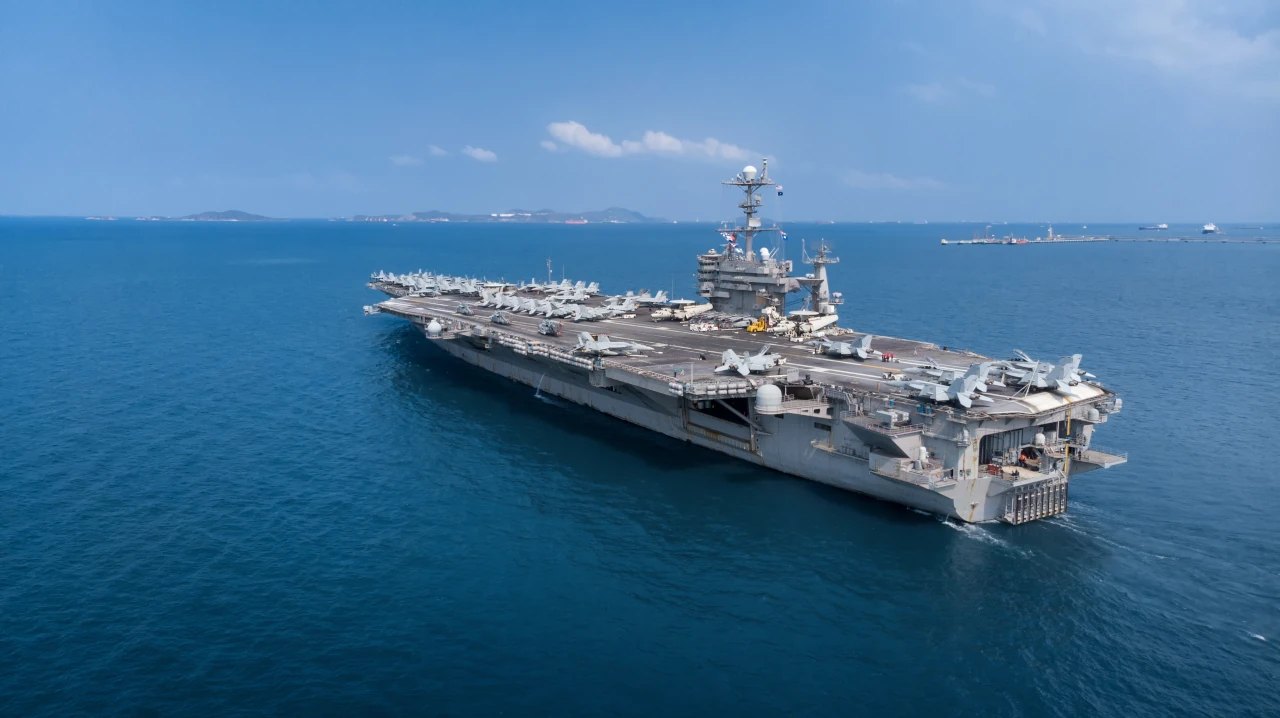
On the morning of April 13, 2026, the United States Navy began enforcing a blockade of Iranian ports along the Strait of Hormuz — a waterway through which roughly one-fifth of the world’s oil supply flows — after 21 hours of peace negotiations in Islamabad collapsed without agreement. The announcement, delivered not through a formal address to the nation or a coordinated diplomatic communiqué, but through a series of all-caps Truth Social posts, is a fitting encapsulation of the Trump administration’s approach to the most serious geopolitical crisis since the Second World War: raw, reactive, legally contested, and breathtaking in its disregard for the institutions — domestic and international — that have governed global order for eight decades.
The blockade, which U.S. Central Command clarified would affect vessels entering or departing Iranian ports and coastal areas rather than all traffic through the strait itself, represents the latest escalation in a conflict that began on February 28, when the United States and Israel jointly struck Iran without a congressional declaration of war, without a clearly articulated exit strategy, and — as subsequent events have made unmistakably clear — without a president temperamentally or cognitively prepared for the consequences.
1. The Collapse of Diplomacy
The peace talks in Islamabad, hosted by Pakistan, brought U.S. negotiators — led by Vice President JD Vance along with special envoy Steve Witkoff and Jared Kushner — face-to-face with Iranian representatives for the first time since the war began. That the delegation included Trump’s son-in-law as a principal diplomatic actor was itself a signal of how informally and idiosyncratically this administration has prosecuted a war of global consequence.
After more than 21 hours of negotiations, the talks failed on a central issue: Iran refused to commit to abandoning its nuclear enrichment program. Tehran also sought control over the Strait of Hormuz, war reparations, a regional ceasefire that included Lebanon, and the release of frozen assets abroad. These are not trivial demands, and reasonable negotiators might have anticipated them. Yet the administration’s response — not a counterproposal, not a measured pause, but an immediate blockade announcement — reveals the absence of any coherent diplomatic architecture supporting this war.
Vice President Vance, returning home without a deal, said Sunday that the U.S. had put “a lot on the table” and that “the ball is in the Iranian court.” The administration had sent its second-most powerful official on a 21-hour negotiating mission and came home with nothing — no deal, no framework, no scheduled follow-up. Within hours, the president was posting threats to “ELIMINATE” Iranian ships on Truth Social.
“Enjoy the current pump figures. With the so-called ‘blockade,’ soon you’ll be nostalgic for $4–$5 gas.”
— Mohammad Bagher Ghalibaf, Speaker of Iran’s Parliament, April 13, 2026
2. A Cascading Economic Catastrophe
The economic consequences of this blockade are not speculative. They are already unfolding — and they are severe. Fatih Birol, head of the International Energy Agency, called the disruption to global oil markets the worst energy shock the world has ever seen, more severe than the oil crises of the 1970s, the Iran-Iraq War of the 1980s, and Iraq’s invasion of Kuwait in 1990. Combined. Daniel Yergin, vice chairman of S&P Global, said in an interview with Barron’s that the disruption has no modern precedent.
Before the war began on February 28, hundreds of ships per day passed through the Strait of Hormuz. By the week the blockade was announced, that number had collapsed to fewer than ten ships per day — and on some days, just two. Tanker traffic, already near zero, came to a halt again within hours of Trump’s announcement, according to Lloyd’s List Intelligence.
U.S. crude oil futures jumped above $104 per barrel following the blockade announcement — a gain of over 55% since the war began. Brent crude, the international standard, similarly rose above $102. Analysts at the Quincy Institute warned prices could reach $150 per barrel if the blockade holds.
The national average for unleaded gasoline reached $4.12 per gallon by Monday, April 13, according to AAA — an increase of more than $1.20 per gallon since the war began. Iran’s parliament speaker openly warned Americans would be nostalgic for $4–$5 gas.
More than 34,000 ships have diverted from the strait over the past month. The disruption threatens not only oil and gas, but fertilizers, aluminum, apparel, and industrial goods. Supply chain consultants warn of sharp raw material price increases within weeks if the blockade holds into May.
The International Energy Agency forecast that the oil supply shock will depress global demand by 1.5 million barrels per day in the second quarter — the largest drop since the COVID-19 pandemic. Annual demand is expected to contract rather than grow.
Yields on the 10-year Treasury rose more than 333 basis points since the war began. The dollar index gained approximately 1.4% over the same period, while equities declined — a reflection of deep structural uncertainty baked into global financial markets.
France and the United Kingdom — America’s most important NATO partners — refused to join the blockade. Instead, French President Emmanuel Macron and British Prime Minister Keir Starmer convened their own international summit to restore freedom of navigation through the strait, explicitly without U.S. leadership.
3. The Legal and Strategic Incoherence
Beyond the economics lies a legal landscape that should alarm any serious constitutional scholar. Under international law — specifically the rules governing international straits — the United States has no legal authority to close, suspend, or impede transit passage through the Strait of Hormuz. Even the coastal states of Iran and Oman are prohibited under international law from suspending transit passage through it, according to experts cited by NBC News. Trump’s blockade, then, is simultaneously a strategic escalation and an act of legally dubious aggression carried out without congressional authorization.
Retired U.S. Admiral James Foggo, speaking to NPR’s Morning Edition on Monday as the blockade took effect, was unambiguous: “Technically speaking, a blockade of a country or a country’s ability to export goods and services is an act of war.” The president of the United States unilaterally initiated an act of war — against a nation already embroiled in a conflict he started without congressional consent — via Truth Social. This is not strategy. It is improvisation at civilizational scale.
Capital Economics chief economist Neil Shearing identified the specific flash points this blockade creates: Would the U.S. Navy seize allied ships that have paid tolls to Tehran? Would it target Chinese vessels in the Strait? Either outcome, Shearing warned, would represent a significant escalation with potential to metastasize beyond the current conflict’s already catastrophic parameters. JPMorgan Chase’s commodities analysts, meanwhile, warned plainly that reopening the Strait has become “the market’s most time-sensitive priority.”
Trump himself signaled on Truth Social that Iranian naval vessels approaching the blockade would be “immediately ELIMINATED,” invoking the same casual language he uses to discuss drug interdiction at sea. He was describing potential acts of war with the rhetorical register of a reality television host.
Get Involved Today
Contribute to our mission and turn your concerns into action.
4. A Pattern of Escalation: The Road to the Blockade
The blockade did not emerge from a vacuum. It is the predictable result of a months-long pattern of impulsive, unilateral military escalation that has consistently outpaced the administration’s diplomatic and legal scaffolding — because there has been no diplomatic or legal scaffolding to outpace. The following timeline documents the arc of a presidency careening through a war it started without a plan for ending.
The United States and Israel jointly strike Iran without a congressional declaration of war and without a clearly articulated strategic rationale. The Strait of Hormuz begins closing to oil traffic almost immediately as Iran retaliates by choking the world’s most critical energy corridor.
Trump issues a Jones Act waiver for domestic shipping to offset skyrocketing energy costs — an emergency measure that fails to prevent prices from rising sharply at the pump. More than 34,000 ships divert from the Strait over the following weeks.
Trump threatens to destroy Iran’s power plants and bridges — actions that legal experts immediately characterize as potential war crimes under international law. Congressional Democrats and some Republican voices begin to voice alarm about the president’s fitness for command.
In a profanity-laden Truth Social post, Trump threatens that Iran’s “whole civilization will die tonight” unless Tehran opens the Strait of Hormuz. The statement triggers immediate international condemnation and bipartisan calls for invocation of the 25th Amendment — including from former Trump allies.
Trump announces a two-week ceasefire, conditional on Iran reopening the Strait, minutes before his own self-imposed deadline. At least 85 House Democrats and several right-wing voices formally call for his removal under the 25th Amendment.
Rep. Jamie Raskin, Ranking Member of the House Judiciary Committee, formally demands a cognitive and neurological evaluation of the president from White House Physician Captain Sean Barbabella, citing a pattern of “increasingly volatile, incoherent, and alarming public statements.”
Vice President Vance, Witkoff, and Kushner travel to Islamabad for 21 hours of direct talks with Iranian negotiators. Talks collapse on nuclear enrichment. Iran demands control of the strait, war reparations, and a regional ceasefire.
The U.S. Naval blockade of Iranian ports takes effect. Oil surges past $104 per barrel. France and the UK refuse to join, instead convening their own international summit. Iran’s Revolutionary Guard calls the blockade an act of “piracy.” Retired Admiral Foggo calls it an act of war.
5. The World Moves Without Us
Perhaps the most damning dimension of this crisis is not the economic damage — severe as it is — nor even the legal recklessness. It is what is happening to American leadership of the international order. The post-World War II system of alliances, multilateral institutions, and negotiated frameworks that the United States built and led for eighty years is visibly fracturing, and the fracture lines run directly through this administration’s choices.
When Britain and France — America’s closest NATO partners — decline to join a U.S. military operation and instead convene their own competing summit to address the crisis, that is not a diplomatic setback. That is a structural rupture. When British Prime Minister Keir Starmer tells lawmakers the Strait must open with “no conditions” and “no tolls” — a statement pointedly aimed not just at Iran but at the chaos created by the American blockade’s legal ambiguity — we are witnessing allies publicly managing around U.S. behavior as if the United States were an unpredictable third party rather than the architect of the rules-based order.
Trump himself has repeatedly criticized NATO for not assisting in policing the strait. “We’re very disappointed with NATO,” he said on Fox News Sunday. What he did not say — and apparently cannot comprehend — is that NATO’s reluctance reflects not cowardice but the considered judgment of democratic governments that the president’s actions have been so legally and diplomatically improvised as to constitute an unreliable basis for allied commitment.
“At a time when our country is at war — especially when the war was initiated by the President without Congressional declaration or consent — the American people must be able to trust that the Commander-in-Chief has the mental capacity to discharge the essential duties of his office.”
— Rep. Jamie Raskin, House Judiciary Committee Ranking Member, April 10, 2026
The 25th Amendment: Mechanism, Momentum, and the Moral Case
The Mechanism
Section 4 of the 25th Amendment provides the constitutional mechanism for the involuntary transfer of presidential power when a sitting president is unable to discharge the powers and duties of the office. It requires that the Vice President and a majority of the Cabinet — or a majority of a congressional body established by law — transmit a written declaration to Congress stating that the president is unable to perform his duties. The Vice President would then immediately assume the role of Acting President. If the president contests this determination, Congress must convene and vote: a two-thirds majority of both chambers is required to sustain the removal.
Who Has Called for It
The calls have crossed ideological lines that would have been unthinkable a year ago. Rep. Ro Khanna (D-Calif.) called directly for invocation, saying “every member of Congress and senator must be calling for Trump’s removal today.” Rep. Yassamin Ansari (D-Ariz.) called the president “a deranged lunatic, and a national security threat.” Rep. Alexandria Ocasio-Cortez (D-N.Y.) described the war as “as clear a violation of the Constitution as any.” Former House Speaker Nancy Pelosi stated that “if the Cabinet is not willing to invoke the 25th Amendment and restore sanity, Republicans must reconvene Congress to end this war.” By one Axios tally, at least 85 House Democrats have formally called for his removal. Crucially, voices from outside the Democratic Party have joined them: former Trump ally Marjorie Taylor Greene called his Easter Sunday post “evil and madness” and added “25th Amendment!!!” Former Fox News host Tucker Carlson said Trump was threatening “a war crime, a moral crime.” Podcaster Candace Owens called for invocation. Former White House communications director Anthony Scaramucci called for removal. Republican Sen. Ron Johnson of Wisconsin said Trump “loses me if he attacks civilian targets.”
Rep. Jamie Raskin took the most formal institutional step: on April 10, he wrote directly to White House Physician Captain Sean Barbabella, demanding a comprehensive cognitive and neurological evaluation of the president, citing Trump’s “increasingly volatile, incoherent, and alarming public statements” about the Iran conflict, including the Easter Sunday speech at the White House Easter Egg Roll in which the president delivered a disjointed, graphic account of bombing missions to an audience of young children.
The Constitutional Argument
The constitutional argument rests on behavioral evidence that has accumulated in public, in real time, and without ambiguity. A president who threatens to annihilate “a whole civilization” on a social media platform at 8 a.m., then strikes a ceasefire before his own evening deadline, then announces a naval blockade after peace talks collapse, then threatens to “ELIMINATE” ships at sea — all within a two-week window, without congressional authorization, and in defiance of international law — has demonstrated a pattern of impulsive, incoherent, and potentially criminal decision-making that bears directly on his capacity to discharge the duties of his office. Section 4 does not require a medical diagnosis. It requires a determination by the principal officers of the executive branch that the president is unable to perform his duties. The evidence for that inability is now a matter of public record.
The Practical Barriers
The barriers are formidable and deserve honesty. Vice President JD Vance has given no indication he would participate, lauding Trump even as the Easter Sunday threats landed. Cabinet members are uniformly and publicly loyal. Republicans control both chambers of Congress, making the two-thirds threshold for sustained removal essentially unreachable in the current configuration. Several Democrats, including Rep. Gregory Meeks, have noted that without Republican votes, pursuing removal is not a viable near-term strategy. A possible Democratic majority emerging from the 2026 midterms represents the more realistic path to meaningful institutional constraint.
Why the Barriers Do Not Negate the Moral and Constitutional Case
The difficulty of invocation does not diminish its legitimacy as a constitutional demand. The 25th Amendment exists precisely for moments when the normal political incentives that protect a president from accountability — party loyalty, congressional deference, electoral calculus — are overwhelmed by evidence that the president cannot safely exercise the powers of the office. We have arrived at such a moment. The political impracticability of removal does not mean removal is wrong. It means that those who possess the constitutional authority to act and choose not to bear a share of the moral and historical responsibility for what follows. Every bomb dropped, every barrel of oil that fails to reach market, every family that cannot afford to fill their tank, is in part the consequence of a Cabinet that has chosen complicity over constitutional duty.
Editorial Conclusion
What is unfolding in the Strait of Hormuz is not merely a foreign policy crisis. It is the consequence of placing the instruments of the world’s most powerful military in the hands of a man who threatens civilizations before breakfast and announces acts of war in capital letters. The blockade may or may not succeed as a coercive measure. What it has already succeeded in doing is isolating the United States from its closest allies, handing Iran a propaganda victory, driving the worst energy shock in recorded history deeper, and demonstrating to the world that American global leadership has been replaced by American global volatility. The 25th Amendment provides the constitutional vocabulary for exactly this situation. The political will to use it remains the single most consequential test of institutional courage in a generation. That test has been failed — so far. The cost of continuing to fail it will be borne not by the Cabinet secretaries who look away, but by every nation, every worker, every family that depends on the stability of a world the United States once led and no longer does.
Sources & References
- CNBC — “Trump Says U.S. Will Blockade Strait of Hormuz After Iran Peace Talks Fail”
- TIME — “Trump Says U.S. Will Blockade Strait of Hormuz After Iran Peace Talks Fail”
- CNN — “Day 44 of Middle East Conflict: Trump Says U.S. Will Blockade the Strait of Hormuz”
- Fortune — “Here’s How a U.S. Naval Blockade of the Strait of Hormuz Could Work”
- Axios — “Trump Announces Naval Blockade on Iran After Peace Talks Collapse”
- CNBC — “U.S. Begins Blockade in Strait of Hormuz; Trump Warns Iran ‘Attack Ships’ to Stay Away”
- NBC News — “What to Know About Trump’s Iran Blockade and the Strait of Hormuz”
- NPR — “Trump Vows to Sink Iranian Ships Approaching a U.S. Blockade of Strait of Hormuz”
- CBS News — “U.S. Imposes Military Blockade of Iranian Ports on Strait of Hormuz”
- CNBC — “Global Markets After Donald Trump Announces Strait of Hormuz Blockade”
- CNBC — “Hormuz Blockade Could Deepen World’s Worst Energy Crisis — and Risk a Dangerous Misstep”
- NBC News Business — “Oil Prices Surge After Trump Says U.S. Will Blockade the Strait of Hormuz”
- Al Jazeera — “U.S. Blockade of Iran Would Worsen Global Energy Crisis, Analysts Say”
- CNN Business — “Why Trump Is Threatening to Blockade a Strait That Iran Is Already Blockading”
- CNBC — “Trump Is Blockading Iranian Ports in the Persian Gulf. What Does That Mean?”
- CNN Politics — “An Eclectic, Bipartisan Group Suddenly Calls for Removing Trump Using the 25th Amendment”
- CNBC — “Trump Faces Calls for Removal Over Threats to Wipe Out ‘Whole Civilization’ in Iran”
- TIME — “What to Know About the 25th Amendment as Lawmakers Call for Trump’s Removal”
- House Judiciary Committee Democrats — Raskin Demands Cognitive Fitness Evaluation of President Trump
- CNN Politics — “Raskin Calls for Trump to Take Cognitive Test in Wake of Iran Threats”
- Axios — “Trump 25th Amendment Chatter Erupts Among Democrats Over Iran Post”
- CNBC — “U.S. Oil Price Tumbles Below $92 as White House Considers Further Talks With Iran”
Related News