Posted on Truth Social by Donald J. Trump - 4-13-2026
[Click image full post]
In the span of a single hour on Truth Social, Donald Trump attacked a sitting pope and posted an AI image of himself as Jesus Christ — an act of messianic self-delusion that reveals, with terrifying clarity, that the man holding the nuclear codes no longer distinguishes between faith, power, and himself.
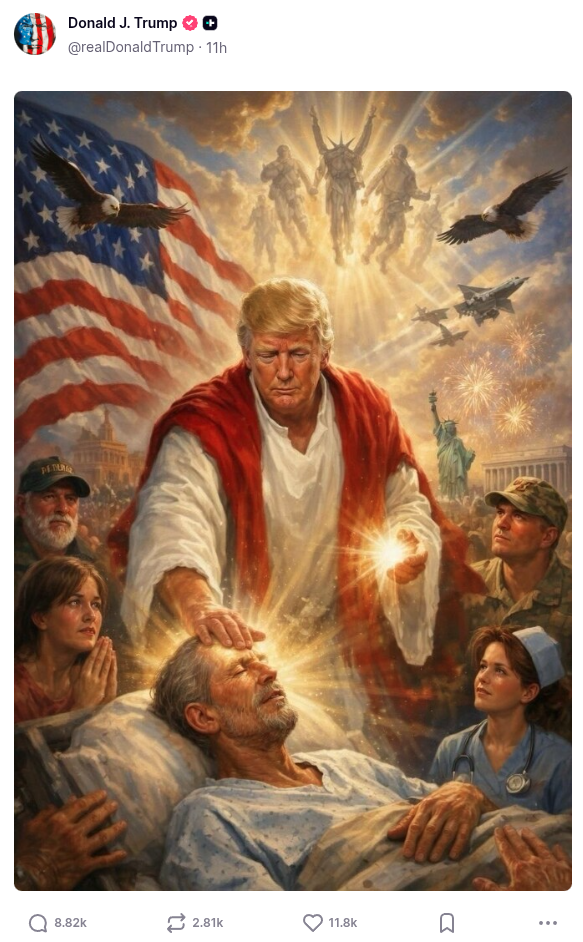
On the night of Sunday, April 12, 2026, the President of the United States posted two things to his Truth Social platform within the span of forty-six minutes. First, he wrote a lengthy, all-caps broadside against Pope Leo XIV, the first American-born pontiff in the history of the Catholic Church, calling him “WEAK on Crime, and terrible for Foreign Policy.” Then, as if to illustrate the logical endpoint of his own grandiosity, he shared an AI-generated image of himself in white and crimson robes, laying a healing hand on a bedridden man while light emanated from his fingertips — an image drawn unmistakably, deliberately, from the iconography of Jesus Christ. The post was deleted Monday morning. The crisis of American leadership it revealed cannot be deleted.
What we witnessed Sunday night was not the ordinary theater of a combative presidency. It was something categorically different: a sitting head of state, in the midst of an undeclared war, threatening civilizational destruction via social media in one breath and casting himself as a divine healer in the next. Taken together, Trump’s attacks on the pope and the messianic self-portrait constitute a pattern — accelerating and now unmistakable — of a man who has lost his grip on the perspective required to govern the most powerful nation on earth.
1. The Attack on Leo and the Invention of a Grievance
Pope Leo XIV, born Robert Prevost in Chicago, has done what religious leaders have done for two millennia: he has called for peace, urged restraint in war, and spoken in the name of the poor and the vulnerable. He has been critical of the U.S.-Israeli war in Iran, has called Trump’s threat to destroy “an entire civilization” in that country “truly unacceptable,” and has led prayer vigils for reconciliation. On Saturday, speaking at St. Peter’s Basilica, Leo declared: “Enough with the idolatry of self and money! Enough with the display of force! Enough with war! True strength is manifested in serving life.”
Trump’s response was extraordinary in its pettiness and incoherence. He claimed — without factual basis — that Leo would not be pope were it not for him. He said he preferred Leo’s brother, Louis Prevost, because Louis is “all MAGA.” He accused the pope of believing it was acceptable for Iran to possess nuclear weapons, a claim with no grounding in anything Leo has actually said. He complained that Leo had met with “a LOSER from the Left.” And he declared, with the menace of a landlord threatening a tenant: “Leo should get his act together as Pope, use Common Sense, stop catering to the Radical Left.”
“If I wasn’t in the White House, Leo wouldn’t be in the Vatican.”
— President Donald Trump, Truth Social, April 12, 2026
This claim — that Trump is responsible for the conclave’s choice of a successor to Peter — is not merely factually false. It is the statement of a man who believes he governs not just a country but the arc of world history itself. It is the statement of someone who has ceased to register where legitimate authority ends and where his own ego begins. Archbishop Paul S. Coakley, president of the U.S. Conference of Catholic Bishops, said he was “disheartened” by the President’s words. “Pope Leo is not his rival; nor is the Pope a politician,” Coakley wrote. “He is the Vicar of Christ who speaks from the truth of the Gospel and for the care of souls.”
Even Italian Prime Minister Giorgia Meloni — a conservative head of government who has maintained close ties with Trump — called his attack on Leo “unacceptable.” In Las Vegas, Archbishop George Leo Thomas said he was “grateful to God for sending us Pope Leo XIV, who is willing to speak truth to power just when we need him the most.” The backlash was not limited to Democrats, liberals, or the media Trump has long dismissed. It came from the heart of the Catholic institutional establishment — from conservatives, from bishops, from the very voters who delivered Trump 55 percent of the Catholic vote in 2024.
2. The Image That Says Everything
Forty-six minutes after his papal broadside, Trump posted the Jesus image. The timing matters. It was not a coincidence. The sequence — attack the actual representative of Christ on earth, then cast yourself as Christ — is the logic of a man operating beyond the boundaries of ordinary self-awareness. Christians across the political spectrum labeled the image “blasphemy.” Even prominent Trump administration allies expressed “discomfort.” John Yep, president of Catholics for Catholics — a group that actively campaigned to elect Trump in 2024 — said his initial reaction was “sadness,” and that the post “follows on the heels of just a general direction of unnecessary animosity towards the pope.”
When confronted by reporters Monday morning, Trump deleted the image and offered an explanation that was, in its own way, more alarming than the post itself. “I thought it was me as a doctor,” he said, “making people better.” He added: “And I do make people better. I make people a lot better.” Pressed on whether the image depicted him as Jesus, Trump blamed the “fake news” and insisted it showed him as a Red Cross worker. The image showed a man in white biblical robes, radiating divine light, healing the sick while onlookers gazed in reverence. There is no reading of that image — none — that places it in a medical or humanitarian context. Either the President of the United States cannot recognize an image he himself chose to share, or he chose to lie about it with no apparent concern that the lie would be immediately transparent.
Trump posted an expletive-filled threat on Truth Social demanding Iran reopen the Strait of Hormuz by Tuesday or face attacks on power plants and bridges. “Open the F—–‘ Strait, you crazy bastards, or you’ll be living in Hell,” he wrote — ending with “Praise be to Allah.”
Trump threatened on social media that “a whole civilization will die” if Iran did not comply with his demands. The statement prompted Pope Leo XIV to call the threat “truly unacceptable” — and triggered the first wave of 25th Amendment calls from lawmakers.
Trump attacked Pope Leo XIV on Truth Social, calling him “WEAK on Crime” and “terrible for Foreign Policy,” claiming credit for his papacy, and saying he preferred the pope’s brother because he was “all MAGA.”
Trump posted an AI image of himself as Jesus forty-six minutes after attacking the pope, then deleted it Monday morning and falsely claimed he thought it depicted him “as a doctor.” More than 80 Democratic lawmakers formally called for the 25th Amendment.
3. What Leadership Actually Requires
There is a specific and serious question embedded in this episode: what cognitive and psychological capacities does the presidency demand, and does this president continue to possess them? Leadership at the level of the American presidency requires the ability to maintain perspective under pressure — to distinguish one’s own interests from the national interest, to receive criticism without interpreting it as personal attack, to understand that the moral authority of a religious institution and the political authority of a government occupy different spheres. Trump’s response to Leo’s calls for peace — calls that have been universally understood as rooted in the Gospel by every serious religious authority in the world — was to accuse the pope of liking crime and wanting Iran to have nuclear weapons. This is not a policy disagreement. It is a failure of basic comprehension.
Leadership also requires the capacity for honest self-assessment. When the President of the United States posts an image of himself as a divine healer and then claims — to the cameras, in the White House driveway — that he thought he was looking at a picture of a Red Cross worker, something has broken. A Reuters/Ipsos poll published in February 2026 found that 61 percent of Americans believe Trump has become more erratic with age. A YouGov poll from March found that roughly half of Americans believe he is experiencing some degree of cognitive decline — a figure that has risen steeply from 34 percent in February 2025. These are not partisan numbers fabricated by the opposition. They are the verdict of the American public, watching in real time.
“In recent days, the country has watched President Trump’s public statements and outbursts turn increasingly incoherent, volatile, profane, and threatening.”
— Rep. Jamie Raskin, Letter to White House Physician, April 10, 2026
4. The Lawmakers Who Are Saying What Must Be Said
The political response to the past week’s events has been, on the Democratic side, unusually urgent. Rep. Jamie Raskin, Ranking Member of the House Judiciary Committee, wrote formally to White House Physician Captain Sean Barbabella on April 10th, demanding “a comprehensive cognitive and neuropsychological assessment” of the President, including full public disclosure of the results. Raskin briefed House Democrats on the constitutional mechanisms of the 25th Amendment and argued that Congress is empowered, under the amendment’s language, to constitute its own body to adjudicate presidential fitness.
Rep. Yassamin Ansari of Arizona was more direct. “The 25th Amendment exists for a reason,” she wrote. “The President of the United States is a deranged lunatic, and a national security threat to our country and the rest of the world.” Rep. Melanie Stansbury of New Mexico posted: “Time for the #25thAmendment. Congress and the Cabinet must act.” Sen. Chris Murphy of Connecticut, responding to Trump’s Easter Sunday Iran threats, wrote that if he were in Trump’s Cabinet he would be “spending Easter calling constitutional lawyers about the 25th Amendment. This is completely, utterly unhinged.” House Speaker Hakeem Jeffries, responding to Sunday’s pope attack, wrote: “Donald Trump shamefully attacked His Holiness Pope Leo XIV. People of faith will never worship a wannabe King.”
Get Involved Today
Contribute to our mission and turn your concerns into action.
5. The Timeline around a Sunday Night
Pope Leo XIV leads a prayer vigil, declaring: “Enough with the idolatry of self and money! Enough with the display of force! Enough with war!” He does not name Trump, but his words are understood worldwide as a direct moral rebuke.
Trump attacks Pope Leo XIV in a lengthy post, calling him “WEAK on Crime,” claiming credit for his papacy, and declaring: “I don’t want a Pope who criticizes the President of the United States.”
Trump posts the AI Jesus image: himself in white robes, hand on a sick man’s head, divine light emanating from his fingertips. The image is shared widely and labeled “blasphemy” by Christians across the political spectrum.
Trump deletes the image and tells reporters he thought it depicted him “as a doctor.” He adds: “I do make people better. I make people a lot better.” Pope Leo, boarding a flight to Algeria, says he has “no fear of the Trump administration.”
The backlash crescendos. Archbishop Coakley issues a formal statement. Italy’s Meloni calls the attack “unacceptable.” More than 80 Democratic lawmakers call for 25th Amendment proceedings. Rep. Raskin demands a cognitive examination.
The Mechanism the Framers Built for This Moment
The 25th Amendment, ratified in 1967, provides in Section 4 a mechanism for removing a president who is “unable to discharge the powers and duties of his office” — even if the president refuses to acknowledge that inability. Under the provision, the Vice President and a majority of the Cabinet must jointly transmit a written declaration to Congress that the president is unfit. The Vice President then immediately assumes the powers of the office as Acting President. If the President contests the declaration, Congress has 21 days to resolve the matter, requiring a two-thirds vote of both chambers to sustain the removal.
The language was intentionally broad. The amendment’s principal author, Sen. Birch Bayh, embraced an understanding that presidential inability would encompass both physical and mental inability. Rep. Richard Poff of Virginia stated during the drafting debates that Section 4 applied not only to presidents physically incapacitated but to a president who, “by reason of mental debility, is unable or unwilling to make any rational decision, including particularly the decision to stand aside.”
Who has called for it? Rep. Jamie Raskin has briefed House Democrats on the amendment and formally demanded a cognitive exam. Rep. Yassamin Ansari, Rep. Melanie Stansbury, Sen. Chris Murphy, Rep. Alexandria Ocasio-Cortez, Sen. Ed Markey, Rep. Ro Khanna, and more than 80 Democratic lawmakers have called publicly for its invocation. Raskin has argued that Congress may also constitute its own body under the amendment’s language to adjudicate fitness — a mechanism that does not depend solely on the cooperation of a cabinet appointed by Trump himself.
The practical barrier is real but does not make the case. Vice President JD Vance has shown no public willingness to act, and Trump’s Cabinet is composed almost entirely of loyalists. The Republican-controlled Congress has not broken with the President. The political obstacles to invoking Section 4 are, at this moment, formidable. But the constitutional case is not weakened by the political cowardice required to ignore it. The amendment exists. The language is clear. The conduct it was designed to address — a president “unable or unwilling to make any rational decision” — describes with disturbing accuracy what the American public observed Sunday night. The barrier is not the law. The barrier is whether the people entrusted with enforcing it choose to act.
6. The Pope, the Peacemaker, and the Mirror
Pope Leo XIV, for his part, did not blink. En route to Algeria — the beginning of an 11-day tour of four African nations — he spoke aboard the papal plane with the clarity and composure that has been entirely absent from the American presidency. “I have no fear of the Trump administration, or speaking out loudly of the message of the Gospel,” he told reporters. “We are not politicians. We do not look at foreign policy from the same perspective he might understand it, but I do believe in the message of the gospel, as a peacemaker.”
The contrast is not accidental. It is the precise and clarifying contrast the moment demands. One man — a former missionary, a canon lawyer, a theologian and pastor born in Chicago — boards a plane to Africa to speak for the voiceless and call the powerful to account. Another man, holding the arsenal of the most powerful military in human history, posts an AI image of himself as a healer and then lies about it when confronted. The Rev. Michael Pfleger of St. Sabina Church in Chicago put the matter with prophetic directness: “I think Trump unconsciously is waking up a sleeping giant.”
He may be right. But the giant in question is not merely the Catholic vote, or the coalition of the faithful, or even the political opposition. The sleeping giant is the American constitutional order itself — the document and its amendments, the mechanisms the founders and their successors built precisely because they understood that power, left unchecked, tends toward precisely this: men who mistake themselves for gods.
Editorial Conclusion
A president who attacks the global leader of the Catholic Church for preaching peace, then posts an AI image of himself as Jesus Christ, then lies to the press about having done so, has not merely made a political error. He has demonstrated, in sequence, a failure of judgment, proportion, and basic honesty that are the minimum prerequisites of the office he holds. The 25th Amendment was written for precisely this contingency — not to punish unpopular decisions, but to protect the republic when the man holding its power has lost the capacity to govern it responsibly. The constitutional mechanism exists. The documented pattern of conduct exists. The moral and institutional consensus — from Catholic bishops to allied heads of state to a majority of the American public — exists. What remains is the political will to act. If those with the authority to invoke Section 4 continue to look away, history will not absolve them of what comes next.
Sources & References
- CNBC — “Trump deletes Truth Social image depicting him as Jesus: ‘It was me as a doctor'”
- Axios — “Christians condemn Trump post depicting him as Jesus-like figure”
- Variety — “Donald Trump Posts AI-Generated Photo of Himself as Jesus After Slamming Pope Leo as ‘Weak'”
- NBC News — “Pope Leo says he has ‘no fear’ after Trump labels him ‘weak’ and ‘terrible'”
- Axios — “Trump slams Pope Leo as ‘weak,’ ‘terrible’ after Iran war criticism”
- CBS News — “Trump calls Pope Leo ‘WEAK on Crime, and terrible for Foreign Policy'”
- CBS News — “Trump faces backlash after posting AI image appearing to depict him like Jesus”
- National Catholic Reporter — “Backlash Grows: Religious and Political Leaders Criticize Trump’s Comments on Pope Leo XIV”
- National Catholic Register — “Trump Blasts Pope Leo as ‘Weak’ and ‘Terrible for Foreign Policy'”
- CNBC — “Pope Leo says ‘I have no fear of the Trump administration’ after president blasts pontiff”
- Al Jazeera — “Trump draws backlash over posting image depicting him as Jesus-like saviour”
- NPR — “Pope Leo says he does not fear Trump, as he pushes back in feud over Iran war”
- TIME — “Pope Leo Responds to Attack by Trump, Saying He Has ‘No Fear’ of Speaking Out”
- CNN — “Raskin calls for Trump to take cognitive test in wake of Iran threats”
- House Judiciary Democrats — Raskin Letter Demanding Presidential Cognitive Evaluation
- Axios — “Raskin demands Trump cognitive test in 25th Amendment push”
- TIME — “What to Know About the 25th Amendment as Lawmakers Call for Trump’s Removal”
- Axios — “House Democratic leadership signals sudden openness to 25th Amendment push”
- PBS NewsHour — “Could the 25th Amendment be invoked against Trump? Here’s how it works”
- IBTimes UK — “Trump Sparks Alarm Over Mental Health After Lashing Out at Pope Leo, ‘Unhinged’ Iran Threats”
- Chicago Sun-Times — “Pope Leo brushes off Trump attack as Chicago Catholic leader says president is ‘waking up a sleeping giant'”
Related News