Donald Trump has privately promised his entire White House staff a get-out-of-jail-free card before he leaves office. He has already erased nearly $2 billion in court-ordered restitution for crime victims. He fired the official whose job was to ensure pardons weren’t corrupt, and replaced her with a Stop the Steal activist and a former prisoner. The message to every official in his administration is now explicit: do whatever it takes, because accountability will never come.
In a recent meeting with senior aides, President Donald Trump joked — or perhaps didn’t — that he would “pardon everyone who has come within 200 feet of the Oval.” The radius, sources told the Wall Street Journal, had already been expanding: an earlier version of the quip had placed the threshold at 10 feet. The White House called it a joke. But when the same joke is told repeatedly in meetings where frightened aides are wondering whether they face prosecution or congressional investigation, it is not a joke. It is a policy. It is a promise. And that promise — coupled with Trump’s unprecedented dismantling of the institutions designed to prevent corrupt clemency, and his documented practice of erasing nearly $2 billion in victim restitution through politically motivated pardons — is not just an abuse of power. It is a standing invitation for every official in his administration to break the law, knowing the bill will never come due.
1. The Promise: “I’ll Pardon Everyone”
The Wall Street Journal broke the story on April 10, 2026: Trump has repeatedly promised top administration officials blanket pardons before he leaves office, often surfacing the topic in meetings where aides express concern about potential legal exposure. The conversations, according to multiple people familiar with them, have become frequent enough inside the White House that some aides have begun to question whether the president is “laying the groundwork for sweeping preemptive pardons.” In one discussion, Trump said he would host a news conference to announce the pardons publicly before departing office.
The White House’s response to the Journal’s reporting was telling. Press Secretary Karoline Leavitt did not deny the substance of the report. She offered five words — “learn to take a joke” — and then added, ominously: “the President’s pardon power is absolute.” It is a response that simultaneously dismisses the story as humor and asserts the legal authority to carry it out. Both things cannot be true. What is unambiguously true is the effect the promise has on behavior inside the executive branch. Liz Oyer, the former DOJ Pardon Attorney who was fired for refusing a politically motivated clemency order, warned plainly: “It seems like he previewed many times his intent to use the pardon power to bail out those who carry out his agenda faithfully” — and that the promises could “spur officials to behave more aggressively.”
This is the crucial point that the “it’s just a joke” defense cannot paper over. A president who signals to his officials that they will be pardoned for carrying out his agenda — regardless of legality — is not making a quip. He is removing the deterrent effect of law enforcement from an entire branch of the federal government. He is telling agents of the most powerful government on earth: act with impunity. I will cover you. The rule of law does not apply to my team. That is not leadership. It is the architecture of a protection racket.
2. The Track Record: $1.9 Billion in Victim Restitution Erased
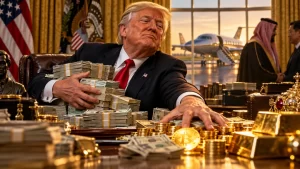
The blanket pardon promise would be alarming even if Trump had used clemency responsibly. He has not. The documented record of his pardon power is one of the most sweeping abuses of executive authority in American history. A March 2026 analysis by the California Governor’s Office found that Trump’s pardons — across both terms — have wiped more than $1.3 billion in court-ordered restitution and fines owed directly to crime victims and taxpayers. When asset forfeitures are included, the total reaches nearly $1.9 billion in financial penalties that convicted criminals no longer have to pay.
Citizens for Responsibility and Ethics in Washington (CREW) documented that Trump has pardoned at least 20 corrupt politicians — including individuals convicted of bribery, fraud, public corruption, conspiracy to defraud the United States, and campaign finance violations. He pardoned Representative Henry Cuellar for bribery charges in December 2025, before the case even went to trial. He pardoned former Puerto Rico Governor Wanda Vasquez and the foreign billionaire accused of bribing her — and in defending Vasquez’s pardon, the White House cited her endorsement of Trump but did not address the substance of the charges.
The most explicit evidence of pay-to-pardon comes from the Campaign Legal Center’s analysis, which documented case after case of financial flows preceding clemency grants. Julio Herrera Velutini, a foreign billionaire charged with bribery, received a pardon in January 2026 after his 25-year-old daughter — whose only previous political donation was $20 to Pete Buttigieg — gave $3.5 million to a Trump super PAC. Trevor Milton, the Nikola electric truck founder convicted of securities fraud, donated $1.8 million to Trump’s campaign and received a pardon that wiped $660 million in restitution obligations. Paul Walczak, a tax evader, was pardoned after his mother paid $1 million to dine with Trump at Mar-a-Lago and raised millions more for MAGA candidates.
The Three Categories of Corrupt Clemency
Reward pardons: Given to donors and supporters who break the law on Trump’s behalf. Examples include the 1,500+ January 6 insurrectionists pardoned on day one.
Purchased pardons: Given to individuals who donated millions to Trump before receiving clemency that wiped hundreds of millions in restitution obligations.
Corrupt pardons: Given to public officials who abused their offices — normalized political corruption by sending the message that if you’re loyal to Trump, accountability doesn’t apply. CREW counts 20 corrupt politicians pardoned, covering 166 counts of corruption-related crimes.
Brokered pardons: Obtained when wealthy individuals hire well-connected Trump lobbyists and fixers to secure clemency. One former federal prosecutor told the New York Times that “defense attorneys are telling us they can’t get their clients to take good or reasonable plea offers because they felt they’re better off spending their money on a political donation.”
3. Destroying the Watchdog: The Firing of Liz Oyer
To fully understand what the blanket pardon promise means, you have to understand what Trump has done to the institution designed to prevent pardon abuse. In March 2025, Trump fired Liz Oyer, the career Senior Executive Service official who served as U.S. Pardon Attorney — the person whose job is to provide independent review of clemency applications and ensure they are not corrupted by political considerations. In congressional testimony, Oyer explained what happened: she had refused to recommend restoring firearm rights to actor Mel Gibson — a Trump ally and domestic violence misdemeanor convict — after a DOJ official explained that “Mel Gibson has a personal relationship with President Trump and that should be sufficient basis” for the recommendation. Oyer refused. She was fired the next day.
The termination notice was three sentences long, offered no stated reason, and was signed not by the Attorney General but by the Deputy AG — a detail that Oyer’s attorneys noted the DOJ itself had conceded was “legally fatal to its own theory” of why the removal was authorized. When Oyer sought to testify before Congress about the circumstances of her firing, the Justice Department sent armed deputy marshals to her home to deliver a letter warning her against testifying. “The letter was a warning to me about the risks of testifying here today,” Oyer told Congress. “But I am here because I will not be bullied into concealing the ongoing corruption and abuse of power at the Department of Justice.”
Who replaced the professional pardon attorney? Oyer was replaced in the pardon review process by Ed Martin, a former Stop the Steal activist. Alice Marie Johnson — herself a former federal prisoner who received a sentence commutation from Trump in 2018 — was named “Pardon Czar” in February 2026. The institution now responsible for reviewing presidential pardons for propriety is led by a January 6 apologist and a woman whose own freedom was a gift from the man she now serves. The foxes are not just guarding the henhouse. They moved in.
Get Involved Today
Contribute to our mission and turn your concerns into action.
4. Dismantling the Infrastructure of Accountability
The pardon machine does not operate in isolation. The Trump administration has systematically dismantled every institution designed to detect and prosecute government corruption — ensuring that when blanket pardons are eventually issued, there will be little left of the prosecutorial machinery that would otherwise hold people accountable. CREW documented that Trump’s DOJ has largely dismantled its Public Integrity Section, which is the unit charged with investigating and prosecuting corruption cases nationwide. High-profile corruption investigations have been dropped — including cases against Senior DHS official Tom Homan, who was accused of accepting a $50,000 cash payment from undercover FBI agents, and New York City Mayor Eric Adams, whose case was dropped in exchange for Adams’s cooperation with Trump’s immigration agenda.
- March 2025Liz Oyer fired as U.S. Pardon Attorney after refusing to recommend restoring Mel Gibson’s gun rights at Trump’s personal request. She is replaced by a Stop the Steal activist. Armed marshals sent to her home when she seeks to testify to Congress.
- Day 1, January 20251,500+ January 6 insurrectionists pardoned by executive order, wiping over $1.3 billion in restitution and fines owed directly to victims and taxpayers — the single largest mass pardon in U.S. history. Rep. Raskin: “He wiped out $1.3 billion in restitution payments owed directly to their victims.”
- Throughout 2025–202620 corrupt politicians pardoned, covering 166 counts of corruption-related crimes. Includes individuals convicted of bribery, public corruption, fraud, and conspiracy to defraud the United States — some before they even served a day in prison.
- January 2026Foreign billionaire pardoned for bribing a governor after his daughter donated $3.5 million to a Trump super PAC. Wanda Vasquez, the governor accused of receiving the bribe, is also pardoned. White House cites her Trump endorsement, not the merits of the case.
- February 2026Alice Marie Johnson named “Pardon Czar” — a former federal prisoner whose own sentence was commuted by Trump. Ed Martin, a Stop the Steal organizer, takes over the pardon review process. The independent Pardon Attorney office is effectively neutralized.
- April 10, 2026Wall Street Journal reports Trump has repeatedly promised blanket pardons to all White House officials before he leaves office. “I’ll pardon everyone who has come within 200 feet of the Oval.” The White House calls it a joke. The radius is expanding.
5. What This Means in Practice: A Permission Slip for Lawlessness
The legal and ethical consequences of Trump’s blanket pardon promise are not abstract. They are immediate and concrete. When officials know they will be pardoned, the law ceases to function as a constraint on executive branch behavior. Legal experts told PBS News that Trump “is using the pardon power in a way that’s very destructive to the justice system more broadly” — pardoning individuals before their trials conclude, undermining his own Justice Department’s cases, and signaling to the entire bureaucracy that political loyalty, not legal compliance, determines consequences.
Consider what the promise means in practice for, say, a DHS official contemplating whether to carry out a deportation that may violate a court order. Or a Pentagon official considering whether to share classified information with a political ally. Or a Treasury official wondering whether to use government data for partisan purposes. In a functioning administration with functioning accountability, those officials would weigh legal risk against their actions. Under Trump’s blanket pardon promise, the legal risk has been explicitly removed. The message is: do it. I’ll handle the rest. That is not a government. That is a syndicate.
The Cato Institute — not a liberal publication — raised this alarm explicitly, noting that “formality in pardon deliberation is desirable because it immunizes the president from the appearance of pay-to-play; the absence of such formality makes it plausible that a multitude of recent pardons are transactional.” When the Cato Institute and progressive watchdogs reach the same conclusion about the corruption of executive clemency, the case is not partisan. It is overwhelming. And it has real consequences: one former federal prosecutor told the New York Times that defense attorneys are now advising clients to forgo reasonable plea deals and instead “spend their money on a political donation, drawing Trump’s attention, and getting the case dismissed or going to trial and getting a pardon.”
No Vetting, No Accountability
Trump has bypassed the Office of the Pardon Attorney — the independent review body — for politically motivated clemency. The ordinary vetting procedures have been sidestepped, making transactional pardons impossible to distinguish from merit-based ones. Cato Institute analysis →
Prosecutors Undermined
Trump’s pardons actively undermine his own DOJ’s cases. Defense lawyers advise clients to donate to Trump instead of accepting plea deals, knowing pardons may be available. Campaign Legal Center →
Corruption Normalized
By pardoning 20 elected officials convicted of corruption — some before serving a day in prison — Trump has signaled that public corruption carries no consequence for loyalists. The Public Integrity Section has been largely dismantled. CREW report →
The Hypocrisy Standard
Trump and Republicans loudly condemned Biden’s end-of-term pardons, calling them an abuse of power. Biden issued 80 individual pardons over four years, carrying $688,000 in combined financial penalties — more than 2,000 times less than Trump’s clemency total. Newsweek →
The 25th Amendment and the Pardon Power as Evidence of Unfitness
The constitutional case for the 25th Amendment has focused, in recent weeks, on Trump’s cognitive fitness — his Easter Sunday profanity, his civilization-ending Truth Social posts, his closing of his eyes in Cabinet meetings because they are “boring as hell.” But the blanket pardon promise adds a distinct and equally alarming dimension to the fitness question: not just whether Trump understands what he is doing, but whether what he is doing constitutes the discharge of presidential duties at all.
Section 4 of the 25th Amendment speaks of a president who is “unable to discharge the powers and duties of his office.” The pardon power — the very power Trump is now deploying as a blanket immunity shield for his staff — is explicitly among the powers and duties of the presidency. Article II grants clemency to serve “the public welfare,” as the Supreme Court has explained. Using that power to signal preemptive immunity to officials engaged in potential criminal conduct, to erase $1.9 billion in victim restitution through transactional clemency, and to fire the independent official whose job is to ensure pardons aren’t corrupted — is not a discharge of the pardon power. It is a corruption of it. And The New Republic argued directly that “when the Framers invented the pardon power, they never imagined someone like Trump as president” and that the power must be reined in urgently.
Crucially, Trump’s own administration established the precedent that presidential cognitive and ethical fitness is subject to congressional scrutiny. Republicans used that precedent aggressively against Joe Biden — subpoenaing Biden’s White House physician, demanding cognitive evaluations, launching public oversight hearings. Rep. Jamie Raskin has now applied the same standard to Trump, formally demanding a cognitive and neurological evaluation with results by April 24. But the pardon record goes beyond cognitive fitness. It raises the question of whether a president who has converted the most sweeping executive power in the Constitution into a personal loyalty-reward system is capable of exercising any power consistent with his oath to faithfully execute the laws of the United States.
The barriers to invoking Section 4 remain high: the Cabinet is full of loyalists, Vice President Vance has shown no appetite for action, and Republicans in Congress have largely abdicated. But the legal and moral argument grows stronger with every pardon granted for a donation, every watchdog fired for refusing a political favor, and every joke about “200 feet of the Oval” that is told with a wink and a warning. A president who explicitly promises immunity to his team for actions not yet committed is not deterred by law. He is making law irrelevant. That, too, is a form of inability to discharge the duties of the office.
Editorial Conclusion
When a president promises blanket pardons to everyone around him, fires the official responsible for independent pardon review, replaces her with political operatives, erases nearly $2 billion in court-ordered victim restitution, and declares that loyalty to him supersedes accountability to the law — he has not exercised the pardon power. He has abolished it as a constitutional safeguard and converted it into a tool of personal protection. This is not ambiguous. This is not partisan. The Cato Institute and CREW, Foreign Policy and the Campaign Legal Center, career prosecutors and fired DOJ officials all reach the same conclusion: the corruption is documented, the system is broken, and the person who broke it is still in power. The 25th Amendment was written for moments when the person holding the office has made the office itself unrecognizable. We are in that moment. History is watching.
“I’ll pardon everyone who has come within 200 feet of the Oval,”
— President Donald J. Trump, The Wall Street Journal, April 10, 2026
Sources & References
- Raw Story — “Trump Tells Staff Fearing Prosecution Not to Worry — a Pardon Is Coming”
- Newsweek — “Donald Trump Discussing Mass Pardons: Report” (WSJ reporting)
- HNGN / IBTimes — “Trump Has Wiped $1.5B in Victim Repayments With Pardons”
- California Governor’s Office — “Trump Pardons Wipe Nearly $2 Billion in Victim Repayment” (Official)
- California Governor’s Office — “Fraud Alert: Trump’s Pardoned Fraudster Friends” (Official)
- CREW — “Trump Has Granted Clemency to 20 Corrupt Politicians — So Far”
- Campaign Legal Center — “Inside the Pardon Playbook: An Analysis of Trump’s Clemency Abuses”
- Cato Institute — “Trump’s Pardons: An Embarrassment of Riches”
- PBS NewsHour — “How Trump Is Using Presidential Pardon Power in New Ways”
- The New Republic — “Trump’s Corrupt Pardons May Well Be the Most Corrupt Thing About Him”
- The Globalist — “Trump’s Disgraceful and Destructive Use of Presidential Pardons”
- Courthouse News — “Fired DOJ Pardon Attorney Accuses Agency of ‘Ongoing Corruption'”
- Newsweek — “Attorney Fired from DOJ Sounds Alarm on ‘Ongoing Corruption'”
- Democracy Forward — “Former Pardon Attorney Challenges Unlawful Removal”
- Democracy Docket — “Trump’s Damage to DOJ Will Be ‘Generational,’ Former Pardon Attorney Says”
- MSNBC Deadline Legal — “Can Trump Just Pardon Himself and Everyone Else at the End of His Term?”
- DOJ Office of the Pardon Attorney — Official Clemency Grants by President Trump (2025–Present)
Related News